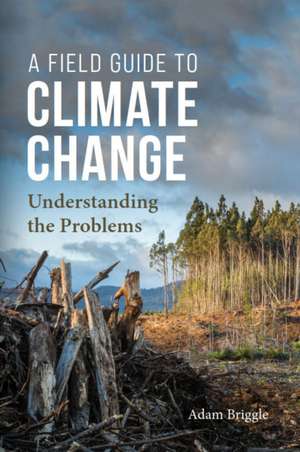
A Field Guide to Climate Change: Understanding the Problems
Autor Adam Briggleen Limba Engleză Paperback – 22 mai 2024
Aplicabilitatea practică a volumului A Field Guide to Climate Change rezidă în transformarea unei teme abstracte într-un set de instrumente analitice pentru studenți și profesioniști. Putem afirma că lucrarea semnată de Adam Briggle nu se limitează la a prezenta date, ci instruiește cititorul în „alfabetizarea climatică”, oferind mecanisme de înțelegere a modului în care problemele globale sunt încadrate, dezbătute și soluționate. Notăm cu interes structura tripartită a cărții: prima parte ancorează discuția în concepte fundamentale precum Antropocenul și dezvoltarea durabilă, a doua parte investighează epistemologia științelor climatice (cine deține cunoașterea și cum este ea validată), în timp ce ultima secțiune se concentrează pe dimensiunile etice și politice, de la justiția climatică la soluții tehnice precum geoingineria. Acoperă aceeași arie ca Climate Change de Stephen Peake, dar cu o abordare mai interdisciplinară, care pune accent pe filozofia morală și pe modul în care valorile umane modelează interpretarea datelor științifice. În contextul operei sale, Adam Briggle continuă direcția explorată în Ethics and Science și Thinking Through Climate Change, rafinând conceptul de „filozofie de teren” prin aplicarea ei directă asupra crizei climatice. Merită menționat că autorul reușește să sintetizeze tensiunile dintre „creșterea verde” și „descreștere” (degrowth), oferind un cadru critic necesar pentru evaluarea politicilor de atenuare și adaptare.
Preț: 209.07 lei
Carte disponibilă
Livrare economică 18 mai-01 iunie
Livrare express 01-07 mai pentru 77.43 lei
Specificații
ISBN-10: 1554815932
Pagini: 280
Dimensiuni: 152 x 229 x 13 mm
Greutate: 0.42 kg
Editura: BROADVIEW PR
Colecția Broadview Press
Locul publicării:Peterborough, Canada
V-ar putea interesa
-
 Climate Change: What Everyone Needs to KnowJoseph Romm-18%Preț: 74.31 lei91.02 lei
 -
 -17%Preț: 122.64 lei148.58 lei
 -
 The Politics of the EarthJohn S. Dryzek-12%Preț: 311.49 lei353.95 lei
 -
 Climate Change: From science to sustainabilityStephen Peake-21%Preț: 349.49 lei441.31 lei
 -
 -18%Preț: 75.04 lei91.44 lei
 -
 -15%Preț: 125.41 lei146.73 lei
 -
 Preț: 321.69 lei
 -
 Global Climate Change: Turning Knowledge Into ActionDavid KitchenPreț: 476.23 lei
 -
 Against the MachinePaul KingsnorthPreț: 180.02 lei
 -
 Environmental PhilosophySimon P JamesPreț: 142.88 lei
 -
 Understanding Climate ChangeSarah BurchPreț: 320.21 lei
 -
 Climate Change Isn't EverythingMike HulmePreț: 126.43 lei
 -
 The Ethics of the Climate CrisisRobin AttfieldPreț: 123.38 lei
 -
 How to Be HopefulElin KelseyPreț: 140.29 lei
 -
 Clearing the AirHannah RitchiePreț: 116.12 lei
 -
 What We Can KnowIan McEwanPreț: 110.57 leiRecomandat
 -
 The Week Junior Guide to the EnvironmentSai Pathmanathan-16%Preț: 40.56 lei48.32 lei
 -
 Human NatureKate MarvelPreț: 130.60 lei
 -
 Life on a Little-Known PlanetElizabeth KolbertPreț: 180.39 lei
De ce să citești această carte
Această lucrare este esențială pentru studenții de la facultățile de științe umaniste, politice sau de mediu care doresc să depășească simpla acumulare de date tehnice. Cititorul câștigă o perspectivă critică asupra modului în care etica și politica influențează deciziile climatice, primind un ghid practic pentru a naviga prin complexitatea dezbaterilor actuale. Este un instrument de lucru care transformă incertitudinea științifică într-un subiect de analiză riguroasă.
Despre autor
Adam Briggle este profesor în cadrul Departamentului de Filozofie și Religie la University of North Texas. Deține un doctorat în Studii de Mediu de la University of Colorado Boulder, formarea sa fiind situată la intersecția dintre etică, știință și politici publice. Prin lucrările sale, precum Field Philosophy sau A Rich Bioethics, Briggle s-a remarcat ca un promotor al filozofiei aplicate, care părăsește mediul academic izolat pentru a aborda problemele stringente ale societății contemporane. Expertiza sa în etica mediului și filozofia științei oferă cărții de față o profunzime analitică rară în literatura dedicată schimbărilor climatice.
Descriere
Part One (Big Picture and Fundamentals) provides basic definitions and broad orientation by situating climate change within larger contexts like the Anthropocene, international climate diplomacy, sustainable development, and “green growth.” Part Two (Climate Sciences) offers tools for understanding climate science, its historical development, and its place in society by asking: who knows, what do we know, and how do we know it? Part Three (Politics, Ethics, and Policy) shows how to analyze debates about climate change policies from mitigation to rewilding.
Recenzii
Part One (Big Picture and Fundamentals) provides basic definitions and broad orientation by situating climate change within larger contexts like the Anthropocene, international climate diplomacy, sustainable development, and “green growth.” Part Two (Climate Sciences) offers tools for understanding climate science, its historical development, and its place in society by asking: who knows, what do we know, and how do we know it? Part Three (Politics, Ethics, and Policy) shows how to analyze debates about climate change policies from mitigation to rewilding.
“When I tell my liberal arts students that climate change is not just a science problem, they look skeptical. Now I have an undergraduate textbook that brilliantly makes the case that climate change is above all a moral issue of unprecedented proportions. Adam Briggle turns the esoteric matters of philosophy and climate modeling into an accessible introductory text that engages students personally and academically. Interrogating familiar tropes and eschewing easy answers, Briggle provides students with the tools of ethical reasoning essential to navigating the wicked problem of climate change.” — Janice Harvey, Department of Environment & Society, St. Thomas University, Canada
“Briggle provides an engaging and insightful overview of the key themes and debates in climate change. He frames the issue in terms of our mental models, where they come from, and how they resonate with our values. Briggle’s Field Guide challenges us to reflect on the many paradoxes that define our climate problem and guides us to develop our own perspective on climate action through a series of questions and activities. This accessible text will be useful for undergraduates and anyone approaching climate change for the first time.” — Sam Rowan, Department of Political Science, Concordia University, Montreal
“There aren’t a lot of textbooks in the climate literature that introduce the complicated scientific and political background necessary to understand the climate problem while also remaining sensitive to the philosophical arguments that inform climate policy. Briggle’s Field Guide goes a long way to fill that gap. This fantastic book offers readers and instructors a clearly organized, well-argued introduction to the conceptual connections between science, values, and policy.” — Benjamin Hale, Departments of Environmental Studies and Philosophy, University of Colorado Boulder
Cuprins
Introduction: Teaching and Learning in the Tangle
Part 1: The Big Picture and Fundamentals
- Chapter 1. The Anthropocene and Development
- Chapter 2. What Is Climate Change?
- Chapter 3. Framing the Climate Problem: What Are the Goals?
- Chapter 4. Green Growth or Degrowth?
- Chapter 5. Who Knows? Institutions and Norms
- Chapter 6. What Do We Know? Knowledge and Uncertainty
- Chapter 7. How Do We Know? Methods and Tools
- Chapter 8. Climate Politics
- Chapter 9. Climate Ethics and Justice
- Chapter 10. Climate Policy Fundamentals and Frameworks
- Chapter 11. Mitigation, Adaptation, and Finance
- Chapter 12. Geoengineering and Rewilding
Index