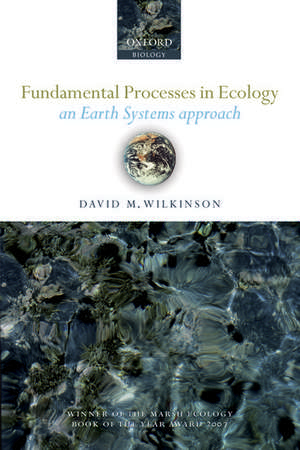
Fundamental Processes in Ecology: An Earth Systems Approach
Autor David M. Wilkinsonen Limba Engleză Paperback – 13 sep 2007
Preț: 293.37 lei
Preț vechi: 370.30 lei
-21%
Puncte Express: 440
Carte tipărită la comandă
Livrare economică 27 noiembrie-08 decembrie
Livrare prin curier în România Termenul estimat este afișat lângă disponibilitate.
Transport gratuit de la 400.00 lei Plată online sau ramburs, în funcție de opțiunile comenzii.
Retur gratuit în 14 zile Comandă securizată și suport în română.
Specificații
ISBN-13: 9780199229062
ISBN-10: 0199229066
Pagini: 196
Ilustrații: 12 line and 19 halftone illustrations
Dimensiuni: 160 x 240 x 10 mm
Greutate: 0.31 kg
Editura: OUP OXFORD
Colecția OUP Oxford
Locul publicării:Oxford, United Kingdom
ISBN-10: 0199229066
Pagini: 196
Ilustrații: 12 line and 19 halftone illustrations
Dimensiuni: 160 x 240 x 10 mm
Greutate: 0.31 kg
Editura: OUP OXFORD
Colecția OUP Oxford
Locul publicării:Oxford, United Kingdom
V-ar putea interesa
-
 Ecology and Natural HistoryDavid WilkinsonPreț: 275.97 lei
 -
 Soil Microbiology, Ecology and BiochemistryEldor Paul-31%Preț: 523.53 lei757.63 lei
 -
 Beyond Equilibria: Historical Approaches to Ecology and EvolutionHamish G. Spencer-13%Preț: 277.49 lei320.01 lei
 -
 -20%Preț: 57.15 lei71.12 lei
 -
 Gaia: A New Look at Life on EarthJames Lovelock-20%Preț: 68.00 lei84.99 lei
 -
 Ecology: A Very Short IntroductionJaboury Ghazoul-20%Preț: 57.15 lei71.12 lei
 -
 -13%Preț: 131.16 lei151.45 lei
 -
 Darwinizing GaiaW. Ford DoolittlePreț: 361.62 lei
 -
 Preț: 348.44 lei
 -
 The Web of LifeFritjof CapraPreț: 98.49 lei
 -
 -23%Preț: 741.97 lei963.60 lei
 -
 Ecology for BeginnersAndy PrenticePreț: 76.12 lei
 -
 On the Emergence of an Ecological ClassBruno LatourPreț: 69.75 lei
 -
 Becoming EarthFerris Jabr-33%Preț: 81.98 lei122.83 lei
 -
 Becoming EarthFerris Jabr-43%Preț: 52.75 lei93.21 lei
 -
 KingdomWill MillardPreț: 223.50 lei
 -
 Thinking Small and LargePeter ForbesPreț: 109.04 lei
 -
 Human NatureKate MarvelPreț: 136.91 lei
 -
 Life on a Little-Known PlanetElizabeth KolbertPreț: 193.02 lei
Recenzii
Review from previous edition This is a remarkabe book at many levels...Put simply, this should be seen as a key text in any undergraduate ecology/environment course. It's one of the most interesting texts published for some time - a must-buy for the library.
Wilkinson has succeeded in writing an extraordinarily readable and accessible book that examines some of the very basic questions underlying ecology in its widest sense. There are relatively few books that encourage the reader to shake free from the shackles of conventional thinking and move along new and illuminating paths. Wilkinson has achieved this, and his book deserves to be read, assimilated, and argued over by all those interested in ecology, from undergraduates to senior academics.
In this lucidly written book, Dave Wilkinson introduces the ecological building blocks needed for life to thrive on a planet and explains how a self-regulating 'Gaia' system can emerge from them.
This is a broad and wide ranging yet scrupulously scientific book on ecology. It is just what is needed for the understanding of the fast unfolding disaster of global climate change. I unhesitatingly recommend it to all concerned biologists and climate scientists.
Fundamental Processes in Ecology is an intriguing but iconoclastic introduction...[it] provides a novel and thought-provoking organizational framework for ecology...
The unconventional theoretical perspective of this clearly written, concise volume will shed fresh light on areas of one's own interest. Readers will find his or her own surprises and illuminations. For me, the exclamation point was Wilkinson's list of fundamental guilds: autotrophs, decomposers, and parasites.
Wilkinson does a fine job explaining fundamental ecological processes such as energy flow, multiple guilds, carbon sequestration, etc...
Wilkinson has succeeded in writing an extraordinarily readable and accessible book that examines some of the very basic questions underlying ecology in its widest sense. There are relatively few books that encourage the reader to shake free from the shackles of conventional thinking and move along new and illuminating paths. Wilkinson has achieved this, and his book deserves to be read, assimilated, and argued over by all those interested in ecology, from undergraduates to senior academics.
In this lucidly written book, Dave Wilkinson introduces the ecological building blocks needed for life to thrive on a planet and explains how a self-regulating 'Gaia' system can emerge from them.
This is a broad and wide ranging yet scrupulously scientific book on ecology. It is just what is needed for the understanding of the fast unfolding disaster of global climate change. I unhesitatingly recommend it to all concerned biologists and climate scientists.
Fundamental Processes in Ecology is an intriguing but iconoclastic introduction...[it] provides a novel and thought-provoking organizational framework for ecology...
The unconventional theoretical perspective of this clearly written, concise volume will shed fresh light on areas of one's own interest. Readers will find his or her own surprises and illuminations. For me, the exclamation point was Wilkinson's list of fundamental guilds: autotrophs, decomposers, and parasites.
Wilkinson does a fine job explaining fundamental ecological processes such as energy flow, multiple guilds, carbon sequestration, etc...
Notă biografică
David M. Wilkinson is Reader in Environmental Science in the School of Biological and Earth Sciences at Liverpool John Moores University. He has wide interests within the environmental and biological sciences, where much of his research is on theoretical topics within evolutionary ecology, biogeography and Earth systems science. In addition he is involved in more empirical research on soil protozoa, environmental archaeology and the history of science. His teaching covers a diverse range of topics from the history of geology to forensic archaeology, but centres on various aspects of ecology.