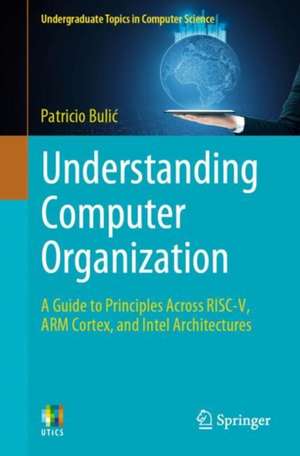
Understanding Computer Organization: Undergraduate Topics in Computer Science
Autor Patricio Buli¿en Limba Engleză Paperback – 6 iul 2024
Înțelegerea modului în care hardware-ul interacționează cu software-ul reprezintă fundamentul oricărei cariere solide în ingineria sistemelor de calcul. Understanding Computer Organization abordează direct această provocare, oferind o perspectivă tehnică asupra arhitecturilor care domină piața actuală. Observăm o tranziție clară de la conceptele teoretice la implementări practice, autorul Patricio Bulić structurând materialul în jurul a patru piloni esențiali: memoria principală, magistralele de date, gestionarea întreruperilor și accesul direct la memorie (DMA). Ceea ce diferențiază acest volum de lucrări precum Computer Organization, Design, and Architecture de Sajjan G. Shiva este ancorarea strictă în ecosistemele reale. În timp ce alte manuale utilizează adesea computere ipotetice pentru a preda designul logic, Understanding Computer Organization utilizează exemple concrete din mediile RISC-V, ARM și Intel. Găsim aici explicații detaliate despre tehnologii moderne, de la controlere SDRAM și module DIMM, până la subtilitățile memoriei virtuale și ale cache-ului. Această abordare este mult mai aplicabilă pentru un inginer care trebuie să optimizeze codul pentru un procesor specific sau să proiecteze drivere de dispozitiv. În contextul operei sale anterioare, Introduction to Parallel Computing, autorul continuă explorarea eficienței la nivel de procesor, însă de data aceasta se concentrează pe micro-arhitectură înainte de a trece la algoritmi paraleli. Textul publicat de Springer în seria Undergraduate Topics in Computer Science este riguros tehnic, eliminând abstracțiunile inutile în favoarea unei înțelegeri profunde a fluxului de date și a ierarhiilor de memorie.
Din seria Undergraduate Topics in Computer Science
-
 Preț: 395.23 lei
 - 20%
 Preț: 312.27 lei
 - 20%
 Preț: 365.26 lei
 - 20%
 Preț: 189.38 lei
 - 20%
 Preț: 421.74 lei
 - 20%
 Preț: 305.83 lei
 - 20%
 Preț: 371.00 lei
 - 20%
 Preț: 449.65 lei
 - 20%
 Preț: 379.01 lei
 - 20%
 Preț: 418.11 lei
 - 20%
 Preț: 415.26 lei
 - 20%
 Preț: 420.26 lei
 - 20%
 Preț: 417.70 lei
 - 20%
 Preț: 405.77 lei
 - 38%
 Preț: 213.33 lei
 - 20%
 Preț: 307.20 lei
 - 20%
 Preț: 300.52 lei
 - 20%
 Preț: 209.72 lei
 - 20%
 Preț: 294.96 lei
 - 20%
 Preț: 300.06 lei
 - 20%
 Preț: 318.89 lei
 - 20%
 Preț: 360.32 lei
 - 20%
 Preț: 370.16 lei
 - 20%
 Preț: 395.42 lei
 - 20%
 Preț: 277.03 lei
 - 20%
 Preț: 228.11 lei
 -
 Preț: 251.33 lei
 - 20%
 Preț: 490.78 lei
 - 20%
 Preț: 300.10 lei
 - 20%
 Preț: 267.09 lei
 - 20%
 Preț: 299.46 lei
 - 20%
 Preț: 263.25 lei
 - 20%
 Preț: 432.63 lei
 - 20%
 Preț: 303.67 lei
 - 20%
 Preț: 304.25 lei
 - 20%
 Preț: 463.30 lei
 - 20%
 Preț: 432.17 lei
 - 20%
 Preț: 288.59 lei
 - 20%
 Preț: 211.77 lei
 - 20%
 Preț: 233.54 lei
 - 20%
 Preț: 359.54 lei
 - 20%
 Preț: 354.18 lei
 -
 Preț: 385.53 lei
 - 20%
 Preț: 373.16 lei
 - 20%
 Preț: 322.62 lei
 - 20%
 Preț: 302.22 lei
 - 20%
 Preț: 304.65 lei
Preț: 385.10 lei
Preț vechi: 481.38 lei
-20%
Carte disponibilă
Livrare economică 04-18 noiembrie
Livrare express 20-24 octombrie pentru 36.100 lei
Specificații
ISBN-10: 3031580745
Pagini: 312
Ilustrații: XIII, 297 p. 184 illus., 121 illus. in color.
Dimensiuni: 155 x 235 x 16 mm
Greutate: 0.53 kg
Ediția:2024
Editura: Springer
Colecția Undergraduate Topics in Computer Science
Seria Undergraduate Topics in Computer Science
Locul publicării:Cham, Switzerland
V-ar putea interesa
-
 -41%Preț: 457.81 lei769.47 lei
 -
 -40%Preț: 488.50 lei820.18 lei
 -
 -40%Preț: 492.21 lei824.42 lei
 -
 -40%Preț: 493.63 lei823.98 lei
 -
 -20%Preț: 374.94 lei468.68 lei
 -
 Principles of Computer HardwareAlan Clements-29%Preț: 602.71 lei846.14 lei
 -
 Structured Computer OrganizationAndrew Tanenbaum-20%Preț: 628.10 lei785.14 lei
 -
 -41%Preț: 447.91 lei755.52 lei
 -
 -31%Preț: 438.72 lei638.36 lei
 -
 Essentials of Computer ArchitectureDouglas Comer-20%Preț: 370.93 lei463.66 lei
 -
 Modern Assembly Language Programming with the ARM ProcessorLarry D Pyeatt-31%Preț: 462.90 lei675.11 lei
 -
 Computer Architecture: A Quantitative ApproachJohn L. Hennessy-39%Preț: 536.81 lei884.58 lei
 -
 -20%Preț: 1015.88 lei1269.85 lei
 -
 Computer Systems: A Programmer's Perspective, Global EditionRandal E. Bryant-20%Preț: 643.64 lei804.55 lei
 -
 Computer Organization and Architecture, Global EditionWilliam Stallings-20%Preț: 576.60 lei720.75 lei
 -
 -36%Preț: 297.08 lei461.98 lei
 -
 Dive Into Systems: A Gentle Introduction to Computer SystemsSuzanne J Matthews-35%Preț: 407.65 lei625.36 lei
 -
 Introduction to Computer Organization: ARM EditionRobert G. Plantz-35%Preț: 303.72 lei468.10 lei
 -
 The Art of ARM Assembly Volume 1Randall Hyde-35%Preț: 433.54 lei665.69 lei
 -
 Computer ArchitectureCharles Fox-35%Preț: 302.86 lei467.47 lei
De ce să citești această carte
Recomandăm această carte studenților și inginerilor care doresc să depășească nivelul abstract al programării și să înțeleagă fizic cum funcționează un sistem de calcul modern. Cititorul câștigă o viziune comparativă rară între RISC-V, ARM și Intel, învățând să gestioneze eficient resursele de memorie, întreruperile și transferurile de date hardware, competențe critice pentru dezvoltarea de sisteme embedded sau de înaltă performanță.
Despre autor
Patricio Bulić este un specialist recunoscut în arhitectura calculatoarelor, cu un interes academic și practic extins în eficientizarea sistemelor de procesare. Experiența sa anterioară, reflectată în lucrarea Introduction to Parallel Computing, se concentrează pe designul și analiza algoritmilor paraleli în raport cu avansurile tehnologice ale microprocesoarelor. În prezentul volum, acesta își canalizează expertiza spre educația tehnică, oferind resurse clare pentru înțelegerea interdependenței dintre hardware și software în contextul noilor arhitecturi emergente precum RISC-V.
Cuprins
Notă biografică
Textul de pe ultima copertă
This unique textbook unlocks modern computer organizations' secrets, with real-world examples from RISC-V, ARM, and Intel-based computer systems. The guide provides a comprehensive yet accessible explanation of fundamental principles and components and serves as a gateway to mastering the interplay between hardware and software. It demystifies complex concepts and provides clear explanations and practical insights into their roles in computing systems.
Topics and features:
- Provides comprehensive coverage of computer organization principles across three major architectures (RISC-V, ARM Cortex, and Intel), ensuring a broad understanding of modern computing
- Includes numerous practical explanations using real-world examples from each architecture, offering hands-on insights into memory-mapped I/O, interrupts, DMA, and various memory technologies
- Presents detailed exploration of diverse components such as interrupts and their usage, interrupt controllers, DMA transfers, and DMA controllers
- Offers exploration of DDRx SDRAM memory, SDRAM controllers, DIMM modules, caches, and virtual memory
Patricio Bulić is a computer engineering professor at the Faculty of Computer Science, University of Ljubljana, Slovenia.