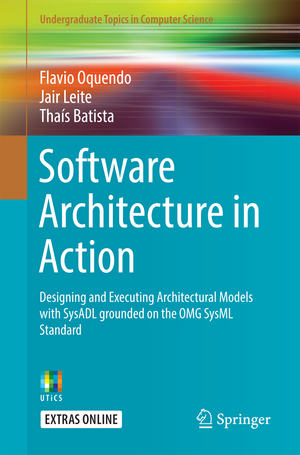
Software Architecture in Action: Undergraduate Topics in Computer Science
Autor Flavio Oquendo, Jair Leite, Thaís Batistaen Limba Engleză Paperback – 4 noi 2016
Descoperim în Software Architecture in Action o resursă tehnică riguroasă, unde fundamentul teoretic este dublat de o metodologie aplicată prin limbajul SysADL. Apreciem faptul că autorii nu se limitează la diagrame abstracte, ci oferă o punte către implementare prin prezentarea modului în care modelele arhitecturale pot fi reprezentate textual pentru a completa notația vizuală standardizată. Această abordare sistematică este ancorată în standardul ISO/IEC/IEEE 42010, asigurând o rigoare necesară în proiectarea sistemelor complexe. Structura volumului reflectă o progresie logică, de la definirea cerințelor și punctelor de vedere (structură, comportament, execuție), până la strategii concrete pentru atingerea atributelor de calitate precum scalabilitatea și toleranța la erori. Un element distinctiv este Partea a III-a, unde sunt analizate stiluri arhitecturale consacrate — cum ar fi Pipe-Filter sau Blackboard — prin prisma unor variante și exemple extrase din sisteme informatice reale. Abordarea diferă de Software Modeling and Design de Hassan Gomaa prin faptul că este mai puțin axată pe metodologia generală UML și mai mult pe utilizarea specifică a SysADL pentru a unifica puterea expresivă a unui limbaj de descriere arhitecturală (ADL) cu o notație industrială standard. În contextul operei sale, Flavio Oquendo continuă să exploreze rigoarea formală în ingineria software, însă acest volum este mult mai aplicabil și orientat către rezultate de învățare imediate față de lucrările sale pur teoretice, precum Software Architecture (2004). Cartea reușește să sintetizeze decenii de cercetare într-un format digerabil, unde fiecare capitol este construit pentru a oferi instrumente practice inginerilor și arhitecților care trebuie să fundamenteze deciziile de design pe modele verificabile.
Din seria Undergraduate Topics in Computer Science
- 20%
 Preț: 421.74 lei
 -
 Preț: 395.23 lei
 - 20%
 Preț: 449.65 lei
 - 20%
 Preț: 189.38 lei
 - 20%
 Preț: 420.26 lei
 - 20%
 Preț: 383.59 lei
 - 20%
 Preț: 312.27 lei
 - 20%
 Preț: 417.70 lei
 - 20%
 Preț: 307.20 lei
 - 20%
 Preț: 316.85 lei
 - 20%
 Preț: 300.06 lei
 - 20%
 Preț: 405.77 lei
 - 38%
 Preț: 213.33 lei
 - 20%
 Preț: 300.52 lei
 - 20%
 Preț: 209.72 lei
 - 20%
 Preț: 323.88 lei
 - 20%
 Preț: 360.32 lei
 - 20%
 Preț: 370.16 lei
 - 20%
 Preț: 395.42 lei
 - 20%
 Preț: 277.03 lei
 - 20%
 Preț: 228.11 lei
 -
 Preț: 251.33 lei
 - 20%
 Preț: 490.78 lei
 -
 Preț: 385.53 lei
 - 20%
 Preț: 373.16 lei
 - 20%
 Preț: 346.61 lei
 - 20%
 Preț: 300.10 lei
 - 20%
 Preț: 280.15 lei
 - 20%
 Preț: 299.46 lei
 - 20%
 Preț: 263.25 lei
 - 20%
 Preț: 432.63 lei
 - 20%
 Preț: 303.67 lei
 - 20%
 Preț: 304.25 lei
 - 20%
 Preț: 463.30 lei
 - 20%
 Preț: 432.17 lei
 - 20%
 Preț: 288.59 lei
 - 20%
 Preț: 211.77 lei
 - 20%
 Preț: 233.54 lei
 - 20%
 Preț: 302.22 lei
 - 20%
 Preț: 304.65 lei
 - 20%
 Preț: 401.64 lei
 - 20%
 Preț: 377.21 lei
 - 20%
 Preț: 354.18 lei
 - 20%
 Preț: 305.61 lei
 - 20%
 Preț: 239.21 lei
 - 20%
 Preț: 460.94 lei
 - 20%
 Preț: 295.79 lei
Preț: 305.83 lei
Preț vechi: 382.28 lei
-20%
Carte disponibilă
Livrare economică 16-30 noiembrie
Specificații
ISBN-10: 3319443372
Pagini: 256
Ilustrații: XVII, 236 p. 249 illus., 46 illus. in color.
Dimensiuni: 155 x 235 x 14 mm
Greutate: 0.44 kg
Ediția:1st edition 2016
Editura: Springer
Colecția Undergraduate Topics in Computer Science
Seria Undergraduate Topics in Computer Science
Locul publicării:Cham, Switzerland
V-ar putea interesa
-
 Applying UML and PatternsCraig Larman-15%Preț: 605.79 lei712.70 lei
 -
 Designing Software ArchitecturesHumberto Cervantes-20%Preț: 313.58 lei391.97 lei
 -
 Clean ArchitectureRobert C. Martin-20%Preț: 231.92 lei289.90 lei
 -
 Preț: 291.45 lei
 -
 Software Architecture in PracticeLen Bass-20%Preț: 394.59 lei493.24 lei
 -
 Khononov, V: Balancing Coupling in Software DesignVlad Khononov-20%Preț: 259.90 lei324.87 lei
 -
 -20%Preț: 428.14 lei535.18 lei
 -
 Software Design DecodedAndre van der Hoek-20%Preț: 85.23 lei106.54 lei
 -
 Patterns of Enterprise Application ArchitectureMartin Fowler-20%Preț: 396.95 lei496.18 lei
 -
 SysML DistilledLenny DelligattiPreț: 323.34 lei
 -
 Computer Architecture: A Quantitative ApproachJohn L. Hennessy-39%Preț: 539.69 lei882.55 lei
 -
 Software ArchitectMichael BellPreț: 240.36 lei
 -
 -20%Preț: 627.14 lei783.93 lei
 -
 Software Architecture FundamentalsMahbouba Gharbi-20%Preț: 245.98 lei307.47 lei
 -
 Introduction to Software ArchitectureKevin Lano-20%Preț: 413.87 lei517.35 lei
 -
 -20%Preț: 620.33 lei775.42 lei
 -
 -20%Preț: 328.94 lei411.17 lei
 -
 Building Model-based Enterprise ArchitectureMudar Bahri-20%Preț: 241.80 lei302.25 lei
 -
 -20%Preț: 373.26 lei466.58 lei
De ce să citești această carte
Recomandăm această lucrare profesioniștilor care doresc să treacă de la schițe informale la o arhitectură software riguroasă, bazată pe modele. Cititorul câștigă o metodă clară de a utiliza SysADL pentru a documenta structura și execuția sistemelor, asigurând conformitatea cu standardele internaționale. Este un ghid esențial pentru arhitecții care caută să stăpânească atributele de calitate prin stiluri arhitecturale verificate în practică.
Despre autor
Flavio Oquendo, Jair Leite și Thaís Batista sunt cercetători și academicieni recunoscuți în domeniul ingineriei sistemelor software. Flavio Oquendo are o experiență vastă în cercetarea arhitecturilor software, fiind o prezență constantă în comitetele științifice internaționale care definesc standardele de modelare. Expertiza colectivă a autorilor acoperă atât zona teoretică a limbajelor de descriere arhitecturală, cât și aplicabilitatea acestora în industrie, cu un accent deosebit pe sistemele software-intensive. Prin această colaborare, ei reușesc să transforme concepte complexe de modelare în tehnici accesibile pentru noua generație de ingineri software.
Descriere scurtă
The book is clearly structured in four parts:
- The first part focuses on the fundamentals of software architecture, exploring the concepts and constructs for modeling software architecture from differing viewpoints. Each chapter covers a specific viewpoint illustrated with examples of a real system. The second part focuses on how to design software architecture for achieving quality attributes. Each chapter covers a specific quality attribute and presents well-defined approaches to achieve it. Each architectural case study is illustrated with different examples drawn from a real-life system.
- The third part shows readers how to apply software architecture style to design architectures that meet the quality attributes. Each chapter covers a specific architectural style and gives insights on how to describe substyles. Each style is illustrated by variants and examples of a real-life system.
- The fourth part presents how to textually represent software architecture models to complement visual notation, including different examples.
Cuprins
Recenzii
Notă biografică
Jair Leite has been working with Software Design and Architecture since 1998. His research interests are architecture-based development, human computer interaction, design languages. He has been member of several Program Committees of Brazilian and International conferences involving Software Architecture.
Thais Batista is Full Professor of the Informatics Department at the Federal University of Rio Grande do Norte (UFRN), Brazil. She is vice-president of the Brazilian Computer Society (SBC). She has been working with Software Architecture since 2000. Her research interests are architecture-based development, middleware, internet of things, cloud computing, system-of-systems. She has been involved as Program Committee member of several Brazilian and International conferences involving Software Architecture.