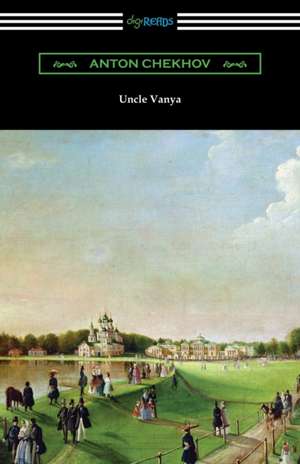
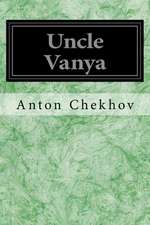
Uncle Vanya
Autor Anton Chekhoven Limba Engleză Paperback – 4 noi 2019
Preț: 42.70 lei
Carte tipărită la comandă
Livrare economică 14-28 iulie
Specificații
ISBN-10: 1420964097
Pagini: 48
Dimensiuni: 140 x 216 x 4 mm
Greutate: 0.08 kg
Editura: Digireads.com
V-ar putea interesa
-
 The Plays of Anton ChekhovAnton ChekhovPreț: 102.56 lei
 -
 PlaysAnton Chekhov-26%Preț: 58.20 lei78.73 lei
 -
 Death of a SalesmanArthur Miller-29%Preț: 49.11 lei69.56 lei
 -
 Preț: 52.71 lei
 -
 Anton Chekhov: Selected StoriesAnton Chekhov-30%Preț: 33.50 lei47.71 lei
 -
 Cyrano de BergeracEdmond RostandPreț: 32.78 lei
 -
 Rosencrantz and Guildenstern Are DeadTom StoppardPreț: 76.50 lei
 -
 Young ChekhovAnton ChekhovPreț: 123.74 lei
 -
 Four Plays and Three JokesAnton Chekhov-17%Preț: 96.06 lei115.66 lei
 -
 Adapting Chekhov in the 21st Century: Seven Contemporary PlaysFrances Babbage-22%Preț: 182.75 lei234.18 lei
 -
 Uncle VanyaAnton Pavlovich ChekhovPreț: 42.62 lei
 -
 The SeagullAnton ChekhovPreț: 25.92 lei
 -
 IvanovAnton ChekhovPreț: 31.07 lei
 -
 Three SistersAnton ChekhovPreț: 31.11 lei
 -
 The Cherry OrchardAnton ChekhovPreț: 30.24 lei
 -
 The Three Theban PlaysSophoclesPreț: 45.74 lei
 -
 Chekhov Selected StoriesAnton ChekhovPreț: 54.68 lei
 -
 The Importance of Being EarnestOscar WildePreț: 31.83 lei
 -
 Long Day's Journey into NightEugene O'NeillPreț: 54.49 lei
Notă biografică
Descriere
Uncle Vanya (1898) is a four-act play by Russian short story writer and playwright Anton Chekhov. It was first performed at the Moscow Art Theatre in 1899, directed by acclaimed actor Konstantin Stanislavski--who also played the role of Astrov. Reviews were lukewarm at first, but as the play continued to run, Uncle Vanya gained both popularity and critical prowess, and has since become one of the most influential dramas ever produced. When retired Professor Aleksandr Serebryakov and his young second wife Yelena arrive at their country estate, they disrupt the mundanity and relative boredom of provincial life for its inhabitants. While the elderly Serebryakov enjoys life in the city, Sonya, his daughter, and Vanya, his first wife's brother, remain at the estate to manage its daily upkeep. Vanya, whose only companion is Mikhail Astrov, a doctor dissatisfied with his life and role in the rural community, regrets his failure to become a man of letters, and blames Serebryakov for saddling him with responsibility for the estate. He also loves the beautiful Yelena and wishes he had realized it before she married his brother-in-law. Meanwhile, Sonya secretly loves Astrov, but fears he thinks of her as only a friend. As Serebryakov's decision to sell the estate in order to increase his income is revealed, Vanya--incensed by years of disappointment and disrespect, as well as his by own mother's idolization of the Professor--reaches his breaking point, bringing the play to its startling, powerful conclusion. Uncle Vanya is a masterful drama that illuminates the intersecting obligations of family while dissecting the bitterness and ambition which so often define the relationships of men. With a beautifully designed cover and professionally typeset manuscript, this edition of Anton Chekhov's Uncle Vanya is a classic of Russian literature reimagined for modern readers.
Recenzii
Michael Frayn has left his signature upon our contemporary enjoyment of Chekhov...this Uncle Vanya possesses all the scrupulous, subtly idiomatic life we have come to expect from his hand, allied with - and this is the true mark of Frayn - a fine sense of Chekhovian complexity.