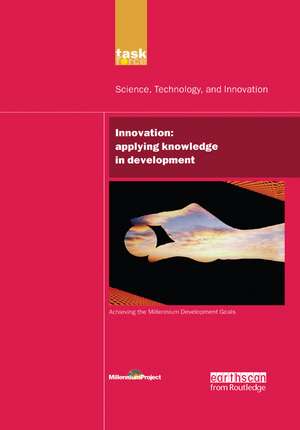
UN Millennium Development Library: Innovation: Applying Knowledge in Development
Autor UN Millennium Projecten Limba Engleză Paperback – iun 2005
| Toate formatele și edițiile | Preț | Express |
|---|---|---|
| Paperback (1) | 341.13 lei 3-5 săpt. | |
| Taylor & Francis – iun 2005 | 341.13 lei 3-5 săpt. | |
| Paperback (1) | 359.55 lei 3-5 săpt. | |
| Taylor & Francis – iun 2005 | 359.55 lei 3-5 săpt. | |
| Paperback (1) | 351.15 lei 3-5 săpt. | |
| Taylor & Francis – iun 2005 | 351.15 lei 3-5 săpt. | |
| Paperback (1) | 234.92 lei 3-5 săpt. | |
| Taylor & Francis – iun 2005 | 234.92 lei 3-5 săpt. | |
| Paperback (1) | 344.54 lei 3-5 săpt. | |
| Taylor & Francis – iun 2005 | 344.54 lei 3-5 săpt. | |
| Paperback (1) | 226.15 lei 3-5 săpt. | |
| Taylor & Francis – iun 2005 | 226.15 lei 3-5 săpt. | |
| Paperback (1) | 228.09 lei 3-5 săpt. | |
| Taylor & Francis – iun 2005 | 228.09 lei 3-5 săpt. | |
| Paperback (1) | 229.73 lei 3-5 săpt. | |
| Taylor & Francis – iun 2005 | 229.73 lei 3-5 săpt. | |
| Paperback (1) | 222.40 lei 3-5 săpt. | |
| Taylor & Francis – iun 2005 | 222.40 lei 3-5 săpt. | |
| Paperback (1) | 346.30 lei 3-5 săpt. | |
| Taylor & Francis – iun 2005 | 346.30 lei 3-5 săpt. | |
| Paperback (1) | 219.31 lei 3-5 săpt. | |
| Taylor & Francis – iun 2005 | 219.31 lei 3-5 săpt. | |
| Paperback (1) | 227.18 lei 3-5 săpt. | |
| Taylor & Francis – iun 2005 | 227.18 lei 3-5 săpt. | |
| Paperback (1) | 340.64 lei 3-5 săpt. | |
| Taylor & Francis – iun 2005 | 340.64 lei 3-5 săpt. | |
| Hardback (1) | 1041.18 lei 3-5 săpt. | |
| Taylor & Francis – 30 sep 2020 | 1041.18 lei 3-5 săpt. | |
| Hardback (1) | 702.04 lei 3-5 săpt. | |
| Taylor & Francis – 30 sep 2020 | 702.04 lei 3-5 săpt. | |
| Hardback (1) | 1047.90 lei 3-5 săpt. | |
| Taylor & Francis – 18 dec 2020 | 1047.90 lei 3-5 săpt. | |
| Hardback (1) | 1045.12 lei 3-5 săpt. | |
| Taylor & Francis – 30 sep 2020 | 1045.12 lei 3-5 săpt. | |
| Hardback (1) | 1041.18 lei 3-5 săpt. | |
| Taylor & Francis – 30 sep 2020 | 1041.18 lei 3-5 săpt. | |
| Hardback (1) | 1098.97 lei 3-5 săpt. | |
| Taylor & Francis – 11 aug 2017 | 1098.97 lei 3-5 săpt. | |
| Hardback (1) | 701.28 lei 3-5 săpt. | |
| Taylor & Francis – 30 sep 2020 | 701.28 lei 3-5 săpt. | |
| Hardback (1) | 1041.78 lei 3-5 săpt. | |
| Taylor & Francis – 30 sep 2020 | 1041.78 lei 3-5 săpt. | |
| Hardback (1) | 699.76 lei 3-5 săpt. | |
| Taylor & Francis – 30 sep 2020 | 699.76 lei 3-5 săpt. | |
| Hardback (1) | 699.70 lei 3-5 săpt. | |
| Taylor & Francis – 30 sep 2020 | 699.70 lei 3-5 săpt. | |
| Hardback (1) | 708.81 lei 3-5 săpt. | |
| Taylor & Francis – 30 sep 2020 | 708.81 lei 3-5 săpt. | |
| Hardback (1) | 1041.18 lei 3-5 săpt. | |
| Taylor & Francis – 2 oct 2019 | 1041.18 lei 3-5 săpt. | |
| Hardback (1) | 1043.17 lei 3-5 săpt. | |
| Taylor & Francis – 30 sep 2020 | 1043.17 lei 3-5 săpt. |
Preț: 341.13 lei
Preț vechi: 410.34 lei
-17%
60.37€ • 70.56$ • 52.41£
Carte disponibilă
Livrare economică 30 ianuarie-13 februarie
Specificații
ISBN-10: 1844072185
Pagini: 220
Dimensiuni: 178 x 254 x 14 mm
Greutate: 0.48 kg
Ediția:1
Editura: Taylor & Francis
Colecția Routledge
Locul publicării:Oxford, United Kingdom
V-ar putea interesa
-
 CSR in PracticeN. Kakabadse-15%Preț: 663.76 lei780.90 lei
 -
 CitizenshipA. KakabadsePreț: 372.15 lei
 -
 Rice Wine with the MinisterN. KakabadsePreț: 417.26 lei
 -
 Spiritual MotivationN. Kakabadse-15%Preț: 616.45 lei725.24 lei
 -
 -15%Preț: 611.43 lei719.34 lei
 -
 Evaluating Environment in International DevelopmentJuha I. Uitto-29%Preț: 847.71 lei1196.64 lei
 -
 Preț: 112.39 lei
 -
 -20%Preț: 271.45 lei339.29 lei
 -
 Designing World Class Corporate StrategiesKeith Ward-17%Preț: 363.25 lei435.97 lei
 -
 -26%Preț: 362.25 lei491.60 lei
 -
 Governance, Risk Management, and ComplianceRichard M SteinbergPreț: 288.29 lei
 -
 -37%Preț: 841.31 lei1340.42 lei
 -
 Creating Futures: Leading Change Through Information SystemsAndrew Dorac-Kakabadse-20%Preț: 272.68 lei339.98 lei
 -
 Preț: 369.74 lei
 -
 Global Boards: One Desire, Many RealitiesA. Kakabadse-15%Preț: 616.45 lei725.24 lei
 -
 Preț: 371.20 lei
 -
 Preț: 374.34 lei
 -
 Preț: 367.49 lei
 -
 Preț: 371.00 lei
 -
 Preț: 370.10 lei
 -
 Preț: 368.43 lei
 -
 The Elephant HuntersA. LakePreț: 366.40 lei
 -
 Smart SourcingA. Kakabadse-15%Preț: 610.96 lei718.77 lei
 -
 -9%Preț: 721.69 lei793.06 lei
 -
 Governance, Strategy and PolicyN. Kakabadse-15%Preț: 616.15 lei724.89 lei
 -
 Leadership Intelligence: The 5Qs for Thriving as a LeaderAndrew KakabadsePreț: 98.35 lei
 -
 Success in SightAndrew Kakabadse-28%Preț: 496.40 lei685.48 lei
 -
 Preț: 204.11 lei
Cuprins
Notă biografică
Descriere
The Millennium Development Goals, adopted at the UN Millennium Summit in 2000, are the world's targets for dramatically reducing extreme poverty in its many dimensions by 2015�income poverty, hunger, disease, exclusion, lack of infrastructure and shelter�while promoting gender equality, education, health and environmental sustainability. These bold goals can be met in all parts of the world if nations follow through on their commitments to work together to meet them. Achieving the Millennium Development Goals offers the prospect of a more secure, just, and prosperous world for all. The UN Millennium Project was commissioned by United Nations Secretary-General Kofi Annan to develop a practical plan of action to meet the Millennium Development Goals. As an independent advisory body directed by Professor Jeffrey D. Sachs, the UN Millennium Project submitted its recommendations to the UN Secretary General in January 2005. �The core of the UN Millennium Project's work has been carried out by 10 thematic Task Forces comprising more than 250 experts from around the world, including scientists, development practitioners, parliamentarians, policymakers, and representatives from civil society, UN agencies, the World Bank, the IMF, and the private sector.This report lays out the recommendations of the UN Millennium Project Task Force on Environmental Sustainability. It identifies key environmental challenges, such as degradation of land, watersheds and marine fisheries, deforestation, pollution, and climate change. The Task Force proposes specific interventions and policy changes required to improve environmental management at the country, regional and international level. These bold yet practical approaches will help countries make progress towards environmental sustainability by 2015.