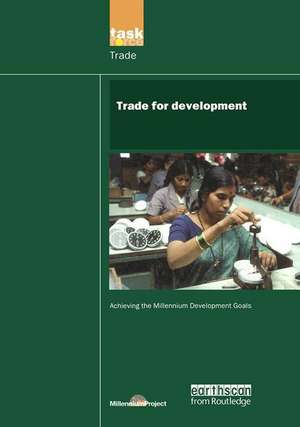
UN Millennium Development Library: Trade in Development
Autor UN Millennium Projecten Limba Engleză Hardback – 30 sep 2020
| Toate formatele și edițiile | Preț | Express |
|---|---|---|
| Paperback (1) | 449.06 lei 6-8 săpt. | |
| Taylor & Francis – iun 2005 | 449.06 lei 6-8 săpt. | |
| Hardback (6) | 858.92 lei 6-8 săpt. | |
| Taylor & Francis – 30 sep 2020 | 858.92 lei 6-8 săpt. | |
| Taylor & Francis – 30 sep 2020 | 861.79 lei 6-8 săpt. | |
| Taylor & Francis – 30 sep 2020 | 863.16 lei 6-8 săpt. | |
| Taylor & Francis – 30 sep 2020 | 1275.31 lei 6-8 săpt. | |
| Taylor & Francis – 30 sep 2020 | 1276.39 lei 6-8 săpt. | |
| Taylor & Francis – 30 sep 2020 | 1282.45 lei 6-8 săpt. |
Preț: 710.40 lei
Preț vechi: 995.18 lei
-29%
Puncte Express: 1066
Preț estimativ în valută:
125.76€ • 146.32$ • 109.06£
125.76€ • 146.32$ • 109.06£
Carte indisponibilă temporar
Doresc să fiu notificat când acest titlu va fi disponibil:
Se trimite...
Preluare comenzi: 021 569.72.76
Specificații
ISBN-13: 9781138471818
ISBN-10: 113847181X
Pagini: 354
Dimensiuni: 178 x 254 mm
Greutate: 1.01 kg
Ediția:1
Editura: Taylor & Francis
Colecția Routledge
Locul publicării:Oxford, United Kingdom
ISBN-10: 113847181X
Pagini: 354
Dimensiuni: 178 x 254 mm
Greutate: 1.01 kg
Ediția:1
Editura: Taylor & Francis
Colecția Routledge
Locul publicării:Oxford, United Kingdom
V-ar putea interesa
-
 An Essay on the Principle of Population and Other WritingsThomas MalthusPreț: 69.29 lei
 -
 -33%Preț: 773.34 lei1148.79 lei
 -
 Cities and Sovereignty – Identity Politics in Urban SpacesDiane E. DavisPreț: 215.14 lei
 -
 Buenos Aires: 400 YearsStanley R. RossPreț: 190.37 lei
 -
 No Shame in My GameKatherine S. NewmanPreț: 122.34 lei
 -
 History of Future CitiesDaniel BrookPreț: 156.77 lei
 -
 -15%Preț: 426.64 lei501.93 lei
 -
 Population and SocietyGregg Lee CarterPreț: 170.29 lei
 -
 Preț: 255.16 lei
 -
 -18%Preț: 1276.10 lei1556.22 lei
 -
 Uprooting Urban AmericaHorace R. HallPreț: 397.20 lei
 -
 No Matter How Loud I ShoutEdward HumesPreț: 102.80 lei
 -
 Population 10 BillionProfessor Danny Dorling-27%Preț: 66.18 lei90.20 lei
 -
 Preț: 423.23 lei
 -
 -15%Preț: 426.20 lei501.41 lei
 -
 -18%Preț: 1016.78 lei1239.98 lei
 -
 -18%Preț: 1280.90 lei1562.07 lei
 -
 -15%Preț: 410.74 lei483.23 lei
 -
 Preț: 417.69 lei
Cuprins
Foreword -- Task force members -- Preface -- Acknowledgments -- Abbreviations -- Millennium Development Goals -- Overview -- 1 Introduction -- Why is trade expansion critical for the Goals? -- Developing countries and trade -- The World Trade Organization -- The Doha Development Agenda -- Structure of this report -- Part 1 Market access agenda -- 2 Why another Round? -- Who pays for protection? -- 3 Agriculture -- The current protection in OECD countries -- Benefits from farm liberalization -- Addressing concerns about liberalization -- Negotiating issues— strategic view and tactical choices -- 4 Services -- Existing levels of protection in services trade and investment -- Addressing concerns about liberalization -- Priorities for liberalization -- 5 Non-agricultural merchandise trade -- Current levels of protection -- Benefits of liberalization -- Managing adjustment -- Priorities for liberalization -- 6 Keeping markets open -- Contingent protection -- Standards -- 7 Preferential market access -- Has preferential access conferred the expected benefits? -- Has preferential access caused harm? -- Preference erosion -- Conclusion -- Part 2 Rules-related issues -- 8 What should be the scope o f WTO rules? -- Is there a link to market access? -- Are there domestic benefits to negotiating rules on regulation? -- Is there specific value in a WTO agreement? -- 9 The Singapore issues -- The Singapore issues left out of the Doha Round -- Trade facilitation -- Conclusion -- 10 The TR IPS Agreement -- TRIPS and access to medicines -- Interpreting the TRIPS regime on geographical indications -- Conclusion -- 11 Special and differential treatment -- Is there a development case for different treatment on “traditional” trade policy instruments? -- Is there a development case for different treatment on regulatory-type rules? -- Moving forward on special and differential treatment -- Part 3 Other systemic issues -- 12 Coherence -- Policy coherence at the national level -- Policy coherence at the international level -- Other policy coherence for development -- 13 Free trade agreements -- Do free trade agreements confer benefits? -- Intra-developing country free trade agreements -- 14 The Dispute Settlement Understanding -- Who uses the system? -- Why has developing country participation been limited? -- 15 Main conclusions and recommendations -- Main conclusions -- Main recommendations -- Appendix 1 -- Appendix 2 -- Appendix 3 -- Appendix 4 -- Appendix 5 -- Appendix 6 -- Appendix 7 -- Appendix 8 -- Countries on the UN official list of LDCs that are WTO Members or observers -- G'90 countries (ACP, LDC , or African Union) that are WTO Members or observers -- OECD members -- The <(poorest developing countries ”— some relevant factors -- A brief explanation of the structure and operation of the GATS -- The unfinished rules agenda under the GATS -- Summary of preference margins by country for agricultural products, 2003 -- WTO disputes with developing country complainants -- Notes -- References.
Descriere
The trading system is unbalanced against developing countries. The progressive elimination of remaining trade barriers in goods and services, with rich counties leading by example, coupled with enough support for poor countries to bear adjustment costs and build export capacity must be part of the international pursuit to overcome poverty.