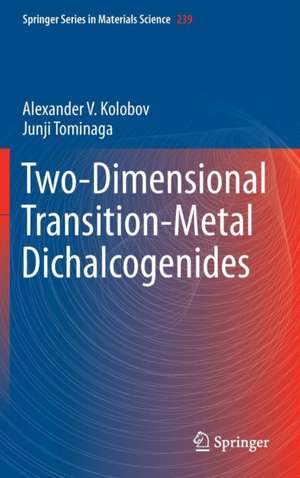
Two-Dimensional Transition-Metal Dichalcogenides: Springer Series in Materials Science, cartea 239
Autor Alexander V. Kolobov, Junji Tominagaen Limba Engleză Hardback – 4 aug 2016
Pentru a parcurge eficient acest volum din Springer Series in Materials Science, cititorul are nevoie de un nivel de experiență avansat, fiind necesare cunoștințe solide de fizica stării solide și chimia metalelor de tranziție. Two-Dimensional Transition-Metal Dichalcogenides reprezintă o sinteză tehnică riguroasă a progreselor teoretice și experimentale într-un domeniu care extinde potențialul nanomaterialelor dincolo de limitele grafenului. Reținem aici accentul pus pe semiconductorii cu bandă interzisă directă (direct gap), o caracteristică esențială pentru viitorul nano-optoelectronicii flexibile.
Suntem de părere că valoarea adăugată a acestei lucrări constă în modul în care autorii Alexander V. Kolobov și Junji Tominaga fac trecerea de la proprietățile fundamentale ale materialelor bulk la fizica exotică a straturilor atomice subțiri. Structura cărții este una progresivă, începând cu bazele chimice și metodele de fabricare (atât top-down, cât și bottom-up), continuând cu analiza detaliată a structurii benzilor de energie și a magnetismului, și culminând cu ingineria heterostructurilor. Pe linia practică a volumului 2D Materials for Nanoelectronics, dar cu un focus mult mai pronunțat pe dinamica excitonilor și trionilor, această lucrare oferă instrumentele necesare pentru controlul proprietăților prin stimuli externi.
În contextul operei lui Alexander V. Kolobov, acest titlu reprezintă o evoluție firească de la studiile sale anterioare prezentate în Chalcogenides. Dacă în lucrările precedente accentul cădea pe metastabilitatea aliajelor amorfe, aici descoperim o rafinare a cercetării către sistemele cristaline bidimensionale. Cartea nu se limitează la teorie, ci explorează aplicații concrete, cum este tranzistorul bazat pe monostrat de MoS2, oferind o perspectivă tehnică asupra modului în care simetria de inversiune spațială influențează cuplajul spin-orbită.
Din seria Springer Series in Materials Science
- 18%
 Preț: 1176.72 lei
 - 18%
 Preț: 1749.17 lei
 - 18%
 Preț: 746.03 lei
 - 18%
 Preț: 931.33 lei
 - 18%
 Preț: 916.64 lei
 - 18%
 Preț: 867.34 lei
 - 18%
 Preț: 916.64 lei
 - 18%
 Preț: 1209.06 lei
 - 18%
 Preț: 1172.94 lei
 - 18%
 Preț: 1070.93 lei
 - 18%
 Preț: 1335.19 lei
 -
 Preț: 416.96 lei
 - 24%
 Preț: 967.73 lei
 - 18%
 Preț: 914.55 lei
 - 24%
 Preț: 923.71 lei
 - 18%
 Preț: 966.21 lei
 - 15%
 Preț: 616.45 lei
 - 18%
 Preț: 912.69 lei
 - 15%
 Preț: 622.09 lei
 - 24%
 Preț: 901.32 lei
 - 24%
 Preț: 1146.73 lei
 - 18%
 Preț: 926.66 lei
 - 18%
 Preț: 1176.72 lei
 - 18%
 Preț: 1173.68 lei
 - 18%
 Preț: 904.53 lei
 - 18%
 Preț: 1922.18 lei
 - 15%
 Preț: 618.50 lei
 - 18%
 Preț: 1197.81 lei
 - 18%
 Preț: 919.67 lei
 - 15%
 Preț: 618.30 lei
 - 18%
 Preț: 1187.36 lei
 - 18%
 Preț: 909.82 lei
 - 18%
 Preț: 919.67 lei
 - 15%
 Preț: 619.71 lei
 - 18%
 Preț: 917.40 lei
Preț: 1762.85 lei
Preț vechi: 2149.81 lei
-18%
Carte tipărită la comandă
Livrare economică 02-16 iunie
Specificații
ISBN-10: 3319314491
Pagini: 464
Ilustrații: XVII, 538 p. 378 illus., 292 illus. in color.
Dimensiuni: 155 x 235 x 30 mm
Greutate: 0.95 kg
Ediția:1st ed. 2016
Editura: Springer International Publishing
Colecția Springer
Seria Springer Series in Materials Science
Locul publicării:Cham, Switzerland
V-ar putea interesa
-
 Optical Properties of SolidsMark Fox-11%Preț: 313.36 lei350.48 lei
 -
 Physics of Spin-Orbit-Coupled OxidesGang Cao-19%Preț: 571.17 lei705.15 lei
 -
 Semiconductors and SemimetalsZetian Mi-42%Preț: 1002.27 lei1731.83 lei
 -
 -9%Preț: 1191.03 lei1308.82 lei
 -
 -23%Preț: 1205.40 lei1565.46 lei
 -
 -9%Preț: 1066.04 lei1171.48 lei
 -
 Circular & Linear DichroismJasmin Wallace-26%Preț: 1245.65 lei1675.40 lei
 -
 -26%Preț: 1248.57 lei1677.44 lei
 -
 -21%Preț: 91.39 lei115.53 lei
 -
 Atomic and Electronic Properties of 2D Moiré InterfacesAstrid Weston-18%Preț: 901.48 lei1099.37 lei
 -
 Preț: 390.23 lei
 -
 -14%Preț: 920.51 lei1070.36 lei
 -
 -23%Preț: 804.77 lei1045.15 lei
 -
 -14%Preț: 828.17 lei962.99 lei
 -
 -14%Preț: 827.59 lei962.31 lei
 -
 -18%Preț: 909.56 lei1109.21 lei
 -
 Second-Order Photogalvanic Photocurrents in 2D MaterialsMustafa EginligilPreț: 367.47 lei
 -
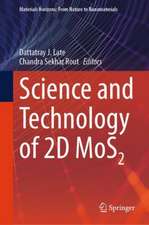 Science and Technology of 2D MoS2Dattatray J. Late-18%Preț: 1077.87 lei1314.47 lei
De ce să citești această carte
Această lucrare este esențială pentru inginerii de materiale și doctoranzii care doresc să stăpânească fizica dicalcogenidelor metalelor de tranziție. Cititorul câștigă o înțelegere profundă a fenomenelor de valleytronics și a metodelor de fabricare a dispozitivelor optoelectronice de ultimă generație. Este un instrument de lucru precis, care clarifică modul în care controlul benzii interzise poate revoluționa electronica flexibilă și dispozitivele cu consum redus de energie.
Despre autor
Alexander V. Kolobov este o figură proeminentă în studiul materialelor calcogenide, domeniu în care a început să activeze încă din 1977 la Institutul Fizico-Tehnic Ioffe din Leningrad. Cariera sa academică s-a consolidat prin cercetări de anvergură în Japonia, la Joint Research Center for Atom Technology și ulterior la National Institute of Advanced Industrial Science and Technology (AIST) din Tsukuba. Expertiza sa vastă în fenomenele foto-induse și transformările de fază ale aliajelor de calcogenide este transpusă în această lucrare prin rigoarea analizei structurilor bidimensionale și a aplicațiilor acestora în nanotehnologie.
Cuprins
Recenzii
Textul de pe ultima copertă
Starting with the basic chemistry of transition metals, the reader is introduced to the rich field of transition metal dichalcogenides. After a chapter on three dimensional crystalsand a description of top-down and bottom-up fabrication methods of few-layer and single layer structures, the fascinating world of two-dimensional TMDCs structures is presented with their unique atomic, electronic, and magnetic properties. The book covers in detail particular features associated with decreased dimensionality such as stability and phase-transitions in monolayers, the appearance of a direct gap, large binding energy of 2D excitons and trions and their dynamics, Raman scattering associated with decreased dimensionality, extraordinarily strong light-matter interaction, layer-dependent photoluminescence properties, new physics associated with the destruction of the spatial inversion symmetry of the bulk phase, spin-orbit and spin-valley couplings. The book concludes with chapters on engineered heterostructures and device applications such as a monolayer MoS2 transistor.
Considering the explosive interest in physics and applications of two-dimensional materials, this book is a valuable source of information for material scientists and engineers working in the field as well as for the graduate students majoring in materials science.