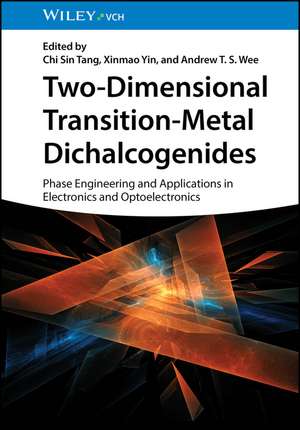
Two–Dimensional Transition–Metal Dichalcogenides – Phase Engineering and Applications in Electronics and Optoelectronics
Autor CS Tangen Limba Engleză Hardback – 12 dec 2023
Observăm că aplicabilitatea practică a dicalcogenidelor metalelor de tranziție (TMDs) a depășit faza pur teoretică, devenind esențială în dezvoltarea dispozitivelor optoelectronice și a soluțiilor de energie curată. Two–Dimensional Transition–Metal Dichalcogenides – Phase Engineering and Applications in Electronics and Optoelectronics oferă o analiză tehnică riguroasă a modului în care ingineria fazelor poate modula proprietățile electronice ale acestor materiale bidimensionale. Credem că elementul distinctiv al acestui volum este abordarea integrată a polimorfismului structural, oferind detalii despre sinteza in-situ și metodele de caracterizare care permit tranziția de la laborator la aplicații industriale precum memristorii sau cataliza.
Structura volumului este una progresivă, debutând cu o privire de ansamblu asupra sintezei structurilor TMD, continuând cu proprietățile magnetice și structurile de spin, și culminând cu analiza provocărilor actuale de pe piață. Această organizare facilitează înțelegerea fenomenelor complexe precum structurile Weyl semi-metalice sau proprietățile feromagnetice. Cartea reprezintă o alternativă la Two Dimensional Transition Metal Dichalcogenides de Narayanasamy Sabari Arul pentru cursurile de fizica materialelor, cu avantajul unei focalizări stricte pe ingineria tranzițiilor de fază și pe progresul recent al exfolierii mecanice. Față de lucrările cu spectru larg, precum 2D Materials coordonată de Phaedon Avouris, acest titlu publicat de Wiley Vch se distinge prin profunzimea analizei proprietăților de transport termoelectric și a mecanismelor de superconductivitate specifice fazelor polimorfice.
Preț: 827.59 lei
Preț vechi: 962.31 lei
-14%
Carte disponibilă
Livrare economică 18 mai-01 iunie
Livrare express 01-07 mai pentru 48.28 lei
Specificații
ISBN-10: 3527350640
Pagini: 352
Dimensiuni: 177 x 246 x 26 mm
Greutate: 0.82 kg
Ediția:1
Editura: Wiley Vch
Locul publicării:Weinheim, Germany
V-ar putea interesa
-
 The Fields of ElectronicsRalph Morrison-9%Preț: 691.06 lei759.41 lei
 -
 Transient ElectronicsPaul W Smith-9%Preț: 1304.73 lei1433.76 lei
 -
 -14%Preț: 908.18 lei1056.02 lei
 -
 REDUCE for PhysicistsN MacDonaldPreț: 461.35 lei
 -
 -25%Preț: 751.10 lei999.31 lei
 -
 Sterne und WeltraumWilhelm Raith-8%Preț: 462.32 lei502.52 lei
 -
 Einführung in die Theoretische ChemieWerner Kutzelnigg-20%Preț: 750.62 lei936.50 lei
 -
 -8%Preț: 507.41 lei551.54 lei
 -
 -19%Preț: 405.32 lei500.39 lei
 -
 Oberflächenanalyse von Si/SiGe-SchichtenHarald Sander-19%Preț: 439.13 lei542.14 lei
 -
 Modellierung von bistabilen QuantenpunktstrukturenAlexander Rack-19%Preț: 526.04 lei649.44 lei
De ce să citești această carte
Recomandăm această carte cercetătorilor și inginerilor care lucrează în nanotehnologie și electronică de calcul. Cititorul câștigă o înțelegere avansată a modului în care manipularea fazelor structurale în 2D-TMDs poate optimiza performanța dispozitivelor semiconductoare. Este un instrument esențial pentru cei care doresc să treacă de la studiul grafenului la materiale cu bandă interzisă modulabilă, oferind soluții concrete pentru provocările actuale din optoelectronică.
Despre autor
CS Tang este un cercetător recunoscut în domeniul științei materialelor, cu o expertiză consolidată în studiul nanomaterialelor bidimensionale. Contribuțiile sale se concentrează pe intersecția dintre fizica stării solide și ingineria electronică, fiind implicat în numeroase studii privind caracterizarea structurală și electronică a compușilor TMD. Prin lucrarea publicată la Wiley Vch, autorul sintetizează rezultate experimentale recente și modele teoretice, consolidându-și poziția de autoritate în domeniul ingineriei fazelor pentru materialele de tranziție metalică.