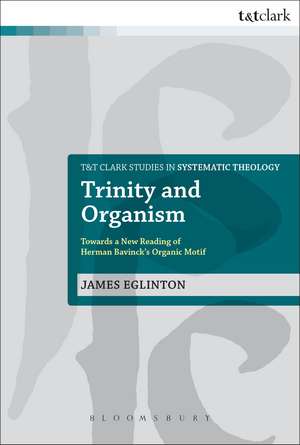
Trinity and Organism: Towards a New Reading of Herman Bavinck's Organic Motif: T&T Clark Studies in Systematic Theology
Autor Dr James Eglintonen Limba Engleză Hardback – 28 mar 2012
| Toate formatele și edițiile | Preț | Express |
|---|---|---|
| Paperback (1) | 264.58 lei 6-8 săpt. | |
| Bloomsbury Publishing – 6 noi 2013 | 264.58 lei 6-8 săpt. | |
| Hardback (1) | 916.99 lei 6-8 săpt. | |
| Bloomsbury Publishing – 28 mar 2012 | 916.99 lei 6-8 săpt. |
Din seria T&T Clark Studies in Systematic Theology
- 26%
 Preț: 232.29 lei
 - 14%
 Preț: 525.54 lei
 - 27%
 Preț: 202.84 lei
 - 34%
 Preț: 526.71 lei
 -
 Preț: 263.72 lei
 - 26%
 Preț: 239.55 lei
 - 27%
 Preț: 202.58 lei
 - 25%
 Preț: 223.05 lei
 - 17%
 Preț: 231.17 lei
 - 17%
 Preț: 265.15 lei
 - 17%
 Preț: 245.20 lei
 -
 Preț: 265.07 lei
 - 25%
 Preț: 223.53 lei
 - 26%
 Preț: 265.55 lei
 - 26%
 Preț: 229.76 lei
 - 26%
 Preț: 264.50 lei
 - 26%
 Preț: 264.30 lei
 - 27%
 Preț: 196.75 lei
 - 34%
 Preț: 586.39 lei
 - 17%
 Preț: 266.57 lei
 - 17%
 Preț: 265.55 lei
 - 26%
 Preț: 243.48 lei
 -
 Preț: 264.11 lei
 - 17%
 Preț: 264.11 lei
 - 26%
 Preț: 264.50 lei
 -
 Preț: 264.69 lei
 - 26%
 Preț: 918.24 lei
 - 17%
 Preț: 266.30 lei
 -
 Preț: 264.58 lei
 - 27%
 Preț: 196.65 lei
 - 17%
 Preț: 266.01 lei
 - 34%
 Preț: 797.90 lei
 - 14%
 Preț: 975.90 lei
Preț: 916.99 lei
Preț vechi: 1388.04 lei
-34% Nou
Puncte Express: 1375
Preț estimativ în valută:
162.27€ • 190.28$ • 142.50£
162.27€ • 190.28$ • 142.50£
Carte tipărită la comandă
Livrare economică 14-28 februarie
Preluare comenzi: 021 569.72.76
Specificații
ISBN-13: 9780567124784
ISBN-10: 0567124789
Pagini: 240
Dimensiuni: 156 x 234 x 25 mm
Greutate: 0.52 kg
Ediția:New.
Editura: Bloomsbury Publishing
Colecția T&T Clark
Seria T&T Clark Studies in Systematic Theology
Locul publicării:London, United Kingdom
ISBN-10: 0567124789
Pagini: 240
Dimensiuni: 156 x 234 x 25 mm
Greutate: 0.52 kg
Ediția:New.
Editura: Bloomsbury Publishing
Colecția T&T Clark
Seria T&T Clark Studies in Systematic Theology
Locul publicării:London, United Kingdom
V-ar putea interesa
-
 Calvinism: A Very Short IntroductionJon Balserak-21%Preț: 53.26 lei67.78 lei
 -
 -14%Preț: 598.09 lei695.45 lei
 -
 Race and Redemption in Puritan New EnglandRichard A. BaileyPreț: 279.63 lei
 -
 -14%Preț: 678.41 lei788.84 lei
 -
 Calvin and His Influence, 1509-2009Irena BackusPreț: 367.01 lei
 -
 Preț: 347.49 lei
 -
 Charles Hodge: Guardian of American OrthodoxyPaul C. Gutjahr-13%Preț: 410.98 lei470.54 lei
 -
 John Wesley: A Brand From The BurningRoy HattersleyPreț: 103.92 lei
 -
 John CalvinMichael MullettPreț: 367.31 lei
 -
 Abraham Kuyper: A Centennial ReaderAbraham KuyperPreț: 252.80 lei
 -
 Preț: 127.59 lei
 -
 The Diary of Robert Woodford, 1637–1641John Fielding-11%Preț: 478.47 lei537.61 lei
 -
 To the Ends of the EarthMichael A G HaykinPreț: 104.05 lei
 -
 Pious PursuitsRobert Beachy-23%Preț: 721.28 lei936.73 lei
Caracteristici
One
of
the
first
monographs
on
Bavinck
since
the
publication
of
his
Dogmatics
in
English
Notă biografică
Dr
James
Eglintonis
a
Postdoctoral
Research
Fellow
at
Kampen
Theological
University
in
the
Netherlands.
His
current
postdoctoral
research
concerns
the
relationship
of
Scottish
and
Dutch
Calvinism.
Cuprins
AbstractAcknowledgements
List
of
Abbreviations1.
Where
was
Herman
Bavinck?2.
How
many
Herman
Bavincks?
3.
Bavinck's
Organic
Motif
4.
The
Organic
Motif
and
the
Doctrine
of
God5.
The
Organic
Motif
and
General
Revelation
6.
The
Organic
Motif
and
Scripture7.
The
Organic
Motif
and
EcclesiologyConclusionBibliographySubject
IndexIndex
of
Persons
Recenzii
'Herman
Bavinck
must
rank
as
one
of
the
most
creative
modern
interpreters
of
the
Calvinist
tradition.
James
Eglinton
matches
this
creative
capacity
with
a
bold
and
persuasive
new
reading
of
Bavinck's
doctrine
of
God,
showing
how
a
critical
deployment
of
nineteenth
century
organic
thought
enabled
the
theologian
to
produce
a
Trinitarian
vision
of
the
unity
in
particularity
of
all
creation.'
-
Professor
George
Newlands,
University
of
Glasgow,
UK
'By changing the dominant trend in the sphere of Herman Bavinck research, James Eglinton has accomplished something major. The trend in question assumes a tension between Bavinck's orthodoxy and his openness to modernity, resulting in a tension between 'two Bavincks', and for example, in a dualistic view of Scripture. Taking his starting point in one of the key issues of Bavinck's theology, the idea of the organic, Eglinton argues convincingly that this idea is not so much related to nineteenth century culture, as it is to the triunity of God as expressed in His creation. Eglinton does not deny tensions in Bavinck's thought, but rejects the option that they are irreconcilable. The theological character of the term organic implies a unity in Bavinck's thought and life that characterises his worldview and looks promising and fruitful in a new phase of Bavinck research.' - Professor George Harinck, Vrije Universiteit Amsterdam, The Netherlands
'James Eglinton's study reflects the recent growth of scholarly interest in the the theology of Herman Bavinck. Setting his work in the context of 19th century Dutch theology and church life, Eglinton explores the recurrence of the 'organic' motif which informs Bavinck's robust defence of Reformed dogmatics in its modern setting. By demonstrating the underlying unity of Bavinck's theology, he challenges some of the standard criticisms that it has attracted. Eglinton has made a significant contribution to our understanding of the leading Dutch theologian of the modern era.' - Professor David Fergusson, University of Edinburgh, UK
'By changing the dominant trend in the sphere of Herman Bavinck research, James Eglinton has accomplished something major. The trend in question assumes a tension between Bavinck's orthodoxy and his openness to modernity, resulting in a tension between 'two Bavincks', and for example, in a dualistic view of Scripture. Taking his starting point in one of the key issues of Bavinck's theology, the idea of the organic, Eglinton argues convincingly that this idea is not so much related to nineteenth century culture, as it is to the triunity of God as expressed in His creation. Eglinton does not deny tensions in Bavinck's thought, but rejects the option that they are irreconcilable. The theological character of the term organic implies a unity in Bavinck's thought and life that characterises his worldview and looks promising and fruitful in a new phase of Bavinck research.' - Professor George Harinck, Vrije Universiteit Amsterdam, The Netherlands
'James Eglinton's study reflects the recent growth of scholarly interest in the the theology of Herman Bavinck. Setting his work in the context of 19th century Dutch theology and church life, Eglinton explores the recurrence of the 'organic' motif which informs Bavinck's robust defence of Reformed dogmatics in its modern setting. By demonstrating the underlying unity of Bavinck's theology, he challenges some of the standard criticisms that it has attracted. Eglinton has made a significant contribution to our understanding of the leading Dutch theologian of the modern era.' - Professor David Fergusson, University of Edinburgh, UK