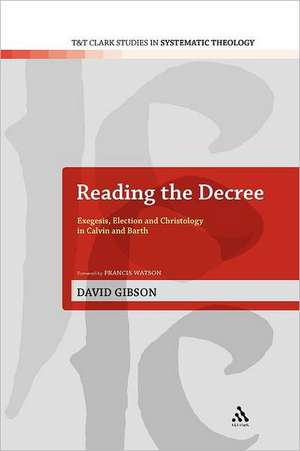
Reading the Decree: Exegesis, Election and Christology in Calvin and Barth: T&T Clark Studies in Systematic Theology
Autor David Gibsonen Limba Engleză Paperback – 3 noi 2011
What role does the interpretation of Scripture play in theological construction? In Reading the Decree David Gibson examines the exegesis of election in John Calvin and Karl Barth, and considers the relationship between election and Christology in their thought. He argues that for both Calvin and Barth their doctrine of election and its exegetical moorings are christologically shaped, but in significantly different ways.
Building on Richard A. Muller's conceptual distinction between Calvin's soteriological christocentrism and Barth's principial christocentrism, Gibson carefully explores their exegesis of the topics of Christ and election, and the election of Israel and the church. This distinction is then further developed by showing how it has a corresponding hermeneutical form: extensive christocentrism (Calvin) and intensive christocentrism (Barth). By focussing on the reception of biblical texts Reading the Decree draws attention to the neglected exegetical foundations of Calvin's doctrine of election, and makes a fresh contribution to current debates over election in Barth's thought.
The result is a study which will be of interest to biblical scholars, as well as historical and systematic theologians alike.
Building on Richard A. Muller's conceptual distinction between Calvin's soteriological christocentrism and Barth's principial christocentrism, Gibson carefully explores their exegesis of the topics of Christ and election, and the election of Israel and the church. This distinction is then further developed by showing how it has a corresponding hermeneutical form: extensive christocentrism (Calvin) and intensive christocentrism (Barth). By focussing on the reception of biblical texts Reading the Decree draws attention to the neglected exegetical foundations of Calvin's doctrine of election, and makes a fresh contribution to current debates over election in Barth's thought.
The result is a study which will be of interest to biblical scholars, as well as historical and systematic theologians alike.
Din seria T&T Clark Studies in Systematic Theology
- 25%
 Preț: 243.79 lei
 - 24%
 Preț: 234.61 lei
 - 25%
 Preț: 278.06 lei
 - 25%
 Preț: 255.56 lei
 - 16%
 Preț: 242.61 lei
 - 16%
 Preț: 277.20 lei
 - 25%
 Preț: 277.39 lei
 - 32%
 Preț: 203.12 lei
 - 25%
 Preț: 961.68 lei
 - 25%
 Preț: 278.68 lei
 - 15%
 Preț: 279.48 lei
 - 25%
 Preț: 277.58 lei
 - 24%
 Preț: 238.41 lei
 -
 Preț: 278.18 lei
 -
 Preț: 562.09 lei
 - 33%
 Preț: 582.69 lei
 -
 Preț: 281.77 lei
 -
 Preț: 277.68 lei
 - 16%
 Preț: 278.27 lei
 - 16%
 Preț: 278.68 lei
 - 24%
 Preț: 963.46 lei
 - 24%
 Preț: 251.42 lei
 - 16%
 Preț: 257.34 lei
 -
 Preț: 277.79 lei
 -
 Preț: 277.20 lei
 - 25%
 Preț: 241.20 lei
 - 25%
 Preț: 1025.27 lei
 - 24%
 Preț: 281.04 lei
 - 33%
 Preț: 961.42 lei
 - 14%
 Preț: 1042.16 lei
 - 33%
 Preț: 961.68 lei
 - 15%
 Preț: 279.74 lei
Preț: 277.58 lei
Preț vechi: 369.31 lei
-25%
Puncte Express: 416
Carte tipărită la comandă
Livrare economică 19 noiembrie-03 decembrie
Livrare prin curier în România Termenul estimat este afișat lângă disponibilitate.
Transport gratuit de la 400.00 lei Plată online sau ramburs, în funcție de opțiunile comenzii.
Retur gratuit în 14 zile Comandă securizată și suport în română.
Specificații
ISBN-13: 9780567129178
ISBN-10: 0567129179
Pagini: 240
Dimensiuni: 152 x 232 x 16 mm
Greutate: 0.34 kg
Editura: Bloomsbury Publishing
Colecția T&T Clark
Seria T&T Clark Studies in Systematic Theology
Locul publicării:London, United Kingdom
ISBN-10: 0567129179
Pagini: 240
Dimensiuni: 152 x 232 x 16 mm
Greutate: 0.34 kg
Editura: Bloomsbury Publishing
Colecția T&T Clark
Seria T&T Clark Studies in Systematic Theology
Locul publicării:London, United Kingdom
V-ar putea interesa
-
 -31%Preț: 774.45 lei1123.94 lei
 -
 Reading Romans in Context: Paul and Second Temple JudaismBen C. BlackwellPreț: 129.90 lei
 -
 The Open TextFrancis WatsonPreț: 269.40 lei
 -
 Paul, Judaism, and the GentilesFrances WatsonPreț: 304.40 lei
 -
 Agape, Eros, GenderFrancis WatsonPreț: 348.70 lei
 -
 Karl Barth and the Analogia EntisDr Keith L. Johnson-25%Preț: 278.18 lei369.61 lei
 -
 Barth Reception in BritainProf D. Densil Morgan-24%Preț: 284.75 lei376.62 lei
 -
 Calvin for Armchair TheologiansChristopher ElwoodPreț: 124.14 lei
 -
 Epistle to the PhilippiansKarl BarthPreț: 181.90 lei
 -
 Church History 101RamsayPreț: 96.43 lei
 -
 Theology for Liberal Presbyterians and Other Endangered SpeciesDouglas F. OttatiPreț: 104.98 lei
 -
 A Guide to the MinistryAndrew HerronPreț: 219.39 lei
 -
 The Kirk and the KingdomJohnston McKay-10%Preț: 129.12 lei142.86 lei
 -
 The Fourfold GospelFrancis WatsonPreț: 172.94 lei
 -
 Text and TruthFrancis WatsonPreț: 200.55 lei
 -
 Gospel WritingFrancis WatsonPreț: 328.46 lei
 -
 The Challenges of Cultural DiscipleshipRichard J. MouwPreț: 142.22 lei
 -
 A Reforming PeopleDavid D. HallPreț: 295.07 lei
 -
 Reformed Mission in an Age of World ChristianitySetri NyomiPreț: 79.81 lei
 -
 Shepherding the WindKevin ChiarotPreț: 77.24 lei
 -
 The Confessions of Our Faith with ESV ProofsBrian W KinneyPreț: 137.83 lei
 -
 Trinity of DiscordRichard Arnold-8%Preț: 512.75 lei557.34 lei
 -
 Wandering SoulsS. Scott RohrerPreț: 313.00 lei
 -
 The History of the WaldensesJames A. WyliePreț: 121.06 lei
 -
 Theology as a Life: Theological Discourses from J.H. ThornwellJames H. ThornwellPreț: 248.53 lei
 -
 Twelve What AboutsJohn SamsonPreț: 105.15 lei
 -
 Selected Sermons from the Pastoral EpistlesJohn CalvinPreț: 131.14 lei
 -
 Reclaiming Divine WrathStephen Butler MurrayPreț: 429.71 lei
Cuprins
Contents
Acknowledgments
Abbreviations
Chapter 1: Calvin, Barth, and Christocentrism
Introduction
1. Christ and election
1.1 A theological distinction
2. Exegesis and election
2.2 A hermeneutical distinction
3. On comparing Calvin and Barth
4. Plan of the present study
Chapter 2: Christology and Election
Introduction
1. Jesus Christ as the Subject of Election
1.1. Christ as author
1.2. The trinitarian basis of election in Calvin
1.3. Christ as electing God
1.4. The trinitarian basis of election in Barth
2. Jesus Christ as the Object of Election
2.1. Christ as the Mediator of election itself
2.2. Christ as the Mediator of salvation flowing from election
2.3. Christ as elected man
Conclusion: Trinity and Election
Chapter 3: Community and Election
Introduction
1. Calvin on Israel and the church
2. Barth on the community
3. Romans 9:1-23
4. Romans 9:24-11:36
Conclusion: Covenant and Election
Chapter 4: Hermeneutics and Election
Introduction
1. The hermeneutics of election in Calvin
1.1. The location of Christology
1.2. The location of election
1.3. Christology and election
1.4. Christology and revelation
2. The hermeneutics of election in Barth
2.1. Election and Epistemology
2.2. Scripture as witness to revelation
2.3. Jesus Christ: Scripture's object and content
2.4. Mediatio: Scripture's parts and Scripture's whole
Conclusion: Revelation and Election
Conclusions
Bibliography
Acknowledgments
Abbreviations
Chapter 1: Calvin, Barth, and Christocentrism
Introduction
1. Christ and election
1.1 A theological distinction
2. Exegesis and election
2.2 A hermeneutical distinction
3. On comparing Calvin and Barth
4. Plan of the present study
Chapter 2: Christology and Election
Introduction
1. Jesus Christ as the Subject of Election
1.1. Christ as author
1.2. The trinitarian basis of election in Calvin
1.3. Christ as electing God
1.4. The trinitarian basis of election in Barth
2. Jesus Christ as the Object of Election
2.1. Christ as the Mediator of election itself
2.2. Christ as the Mediator of salvation flowing from election
2.3. Christ as elected man
Conclusion: Trinity and Election
Chapter 3: Community and Election
Introduction
1. Calvin on Israel and the church
2. Barth on the community
3. Romans 9:1-23
4. Romans 9:24-11:36
Conclusion: Covenant and Election
Chapter 4: Hermeneutics and Election
Introduction
1. The hermeneutics of election in Calvin
1.1. The location of Christology
1.2. The location of election
1.3. Christology and election
1.4. Christology and revelation
2. The hermeneutics of election in Barth
2.1. Election and Epistemology
2.2. Scripture as witness to revelation
2.3. Jesus Christ: Scripture's object and content
2.4. Mediatio: Scripture's parts and Scripture's whole
Conclusion: Revelation and Election
Conclusions
Bibliography
Recenzii
'Dr Gibson's exploration of the complex of issues that arises in the theological intersection of Christology, election and Scripture in Calvin and Barth is deft and clear, and painstaking and fair. The way in which he approaches his task, by fashioning illuminating methodological tools to interrogate the two theologians, is very well done. The result is a fascinating and valuable study.' - Paul Helm, Regents College, Vancouver, Canada
'Debates about the future of Reformed theology often tend to focus on the nature of the legacy of two men in particular: John Calvin and Karl Barth. Much ink has been spilled in examining the theological, social, intellectual, cultural, and even psychological backgrounds of these two men as a means of establishing their respective significance; but, in this work, David Gibson addresses these matters via a close study of their exegesis as a means of establishing just how faithful each was to their own stated scripture principle. Gibson's work represents a constructive and insightful development of contemporary discussion of the nature of Reformed theology.' - Carl R. Trueman, Westminster Theological Seminary, Philadelphia, USA
'For those who deplore the "dumbing down" of so much Christian publishing nowadays, this volume will offer a refreshing change' Churchman, Sept. 2010
'There is much to commend about Gibson's study. He offers the reader a clear, careful and fair reading of Calvin and Barth... He is refreshingly appreciative of the ways in which the connections and motifs internal to Barth's own thought are deeply indebted to the Reform tradition, and particularly to Calvin... this study deserves a wide reading, and will be of particular interest to Calvin and Barth scholars.'
This rewarding study is a model of theology which is systematic in the best sense: it perceptively illumines the coherence of doctrine, and it does so through analysis of two towering figures in the Reformed tradition. Its most valuable contribution, however, is the care with which it examines the exegetical decisions which attend these doctrinal formulations.
'Debates about the future of Reformed theology often tend to focus on the nature of the legacy of two men in particular: John Calvin and Karl Barth. Much ink has been spilled in examining the theological, social, intellectual, cultural, and even psychological backgrounds of these two men as a means of establishing their respective significance; but, in this work, David Gibson addresses these matters via a close study of their exegesis as a means of establishing just how faithful each was to their own stated scripture principle. Gibson's work represents a constructive and insightful development of contemporary discussion of the nature of Reformed theology.' - Carl R. Trueman, Westminster Theological Seminary, Philadelphia, USA
'For those who deplore the "dumbing down" of so much Christian publishing nowadays, this volume will offer a refreshing change' Churchman, Sept. 2010
'There is much to commend about Gibson's study. He offers the reader a clear, careful and fair reading of Calvin and Barth... He is refreshingly appreciative of the ways in which the connections and motifs internal to Barth's own thought are deeply indebted to the Reform tradition, and particularly to Calvin... this study deserves a wide reading, and will be of particular interest to Calvin and Barth scholars.'
This rewarding study is a model of theology which is systematic in the best sense: it perceptively illumines the coherence of doctrine, and it does so through analysis of two towering figures in the Reformed tradition. Its most valuable contribution, however, is the care with which it examines the exegetical decisions which attend these doctrinal formulations.