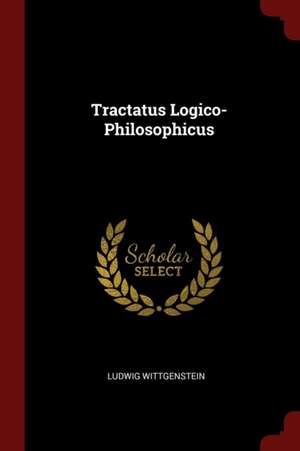
Tractatus Logico-Philosophicus
Autor Ludwig Wittgensteinen Limba Engleză Paperback – 17 aug 2017
This renewed edition of the Tractatus Logico-Philosophicus, exactly a century after Wittgenstein's release, presents the text in a hierarchical manner, "which is the way in which the book was composed and in which Wittgenstein arranged (selected and supplemented) the best of the philosophical remarks that he had been writing since 1913" (Peter Hacker). That tree-like reading is recommended by Wittgenstein himself in the sole footnote of his book, in which he suggests that the inner logical structure of the text is set by the decimal numbers of its propositions. "They alone - the Author will add - give the book perspicuity and clearness, and without this numbering it would be an incomprehensible jumble". Indeed, the compact and intricate sequence of the traditional presentation is only a rigorous logical bet, but only a logical machine or a robot can unravel the tangle: for an ordinary human understanding that does not exploit its numbering, the book remains "an incomprehensible jumble".
In the present disposition, instead, all horizontal and vertical references become directly manifest and any reader can enjoy the fine architecture and the elegant reasoning of Wittgenstein's work. Every page is an actual reading unit, perfectly coherent and complete. The Tractatus becomes comprehensible also to unskilled readers, of course at more or less deep levels, while a scholar or a more practised reader can detect suggestions and meanings that had remained, until now, completely hidden. A historical note shows in which manner the new structural perspective sheds new light also in the compositional manuscript we have, which "writing units" are very similar, actually, to the pages of the present edition. Besides, this allows to rebuild the list of "Supplements" (here in the Appendix) that Wittgenstein gathered after he roughly finished his manuscript, but that he used very little in the final book.
Printing the Tractatus following Wittgenstein's decimal prescriptions required meticulous philological care and some discretional conventions: for instance, at the top of each page the commented-upon proposition is printed again, to make the sight complete and self-sufficient. On the other hand, some forcing of the text by the translators in their sequential reading could be eliminated, restoring a more literal translation. Also the famous and intriguing picture of the eye and its visual field (5.6331) has been restored as Wittgenstein drafted it, making the entire page perfectly understandable and coherent. This documented and editorial work on one of the most referenced books of the last century was conceived to obtain, and in fact gained, a perspicuous and crystal clear text, philologically faithful and relaxingly readable at the same time.
| Toate formatele și edițiile | Preț | Express |
|---|---|---|
| Paperback (17) | 37.12 lei 3-5 săpt. | |
| CreateSpace Independent Publishing Platform – | 37.12 lei 3-5 săpt. | |
| Dover Publications – 31 dec 1997 | 53.26 lei 3-5 săpt. | |
| OUP OXFORD – 11 mai 2023 | 53.44 lei 22-27 zile | +21.13 lei 7-13 zile |
| CREATESPACE – | 62.23 lei 3-5 săpt. | |
| Penguin Books – 13 mai 2025 | 67.49 lei 3-5 săpt. | +5.26 lei 7-13 zile |
| Liveright Publishing Corporation – 27 mai 2025 | 92.49 lei 3-5 săpt. | +22.24 lei 7-13 zile |
| Martino Fine Books – 25 mar 2015 | 103.70 lei 18-23 zile | +9.62 lei 7-13 zile |
| Taylor & Francis – 18 mai 2001 | 149.42 lei 3-5 săpt. | +7.26 lei 7-13 zile |
| Taylor & Francis – 2 iul 2013 | 181.11 lei 3-5 săpt. | +6.24 lei 7-13 zile |
| Taylor & Francis – 10 sep 1981 | 293.83 lei 3-5 săpt. | +50.71 lei 7-13 zile |
| Neeland Media – 18 iun 2019 | 49.76 lei 6-8 săpt. | |
| CREATESPACE – | 50.45 lei 6-8 săpt. | |
| BENEDICTION CLASSICS – 19 noi 2019 | 53.16 lei 6-8 săpt. | |
| CHIZINE PUBN – 17 aug 2017 | 77.26 lei 18-23 zile | |
| COSIMO CLASSICS – 30 apr 2007 | 80.53 lei 6-8 săpt. | |
| Bottom of the Hill Publishing – 30 apr 2011 | 82.45 lei 39-44 zile | |
| Anthem Press – 10 mai 2021 | 292.66 lei 6-8 săpt. | |
| Hardback (6) | 80.43 lei 22-33 zile | |
| Penguin Books – 7 dec 2023 | 80.43 lei 22-33 zile | |
| BENEDICTION CLASSICS – 19 noi 2019 | 113.91 lei 6-8 săpt. | |
| Anthem Press – 10 mai 2021 | 670.72 lei 6-8 săpt. | |
| Anthem Press – 10 mai 2021 | 671.41 lei 6-8 săpt. | |
| Taylor & Francis – 18 mai 2001 | 849.84 lei 6-8 săpt. | |
| Taylor & Francis – 27 aug 2015 | 1273.21 lei 6-8 săpt. |
Preț: 77.26 lei
Nou
13.67€ • 15.94$ • 12.00£
Comandă specială
Livrare economică 22-27 decembrie
Specificații
ISBN-10: 1375401823
Pagini: 70
Dimensiuni: 157 x 233 x 10 mm
Greutate: 0.12 kg
Editura: CHIZINE PUBN
V-ar putea interesa
-
 Awakening of Intelligence, TheJiddu KrishnamurtiPreț: 118.44 lei
 -
 Being and TimeMartin HeideggerPreț: 133.49 lei
 -
 The Blank SlateSteven Pinker-29%Preț: 73.27 lei103.77 lei
 -
 -22%Preț: 58.13 lei74.28 lei
 -
 Irrational Man: A Study in Existential PhilosophyWilliam BarrettPreț: 92.90 lei
 -
 The Language of Change – Elements of Therapeutic CommunicationPaul WatzlawickPreț: 99.07 lei
 -
 Letter to a PriestSimone WeilPreț: 190.34 lei
 -
 On DialogueDavid BohmPreț: 181.21 lei
 -
 Sketch for a Theory of the EmotionsJean-Paul SartrePreț: 240.60 lei
 -
 The Undiscovered SelfCarl Gustav JungPreț: 180.64 lei
 -
 -9%Preț: 334.28 lei366.73 lei
 -
 NotebooksWittgensteinPreț: 256.72 lei
 -
 Preț: 286.89 lei
 -
 Urban ShamanSerge Kahili King-24%Preț: 62.19 lei82.05 lei
 -
 Cracking the Coding Interview: 189 Programming Questions and SolutionsGayle Laakmann McDowell-20%Preț: 225.45 lei281.82 lei
 -
 Php, Mysql, & JavaScript All-In-One for DummiesRichard Blum-20%Preț: 251.86 lei314.83 lei
 -
 Power Up Your BrainDavid PerlmutterPreț: 107.78 lei
 -
 Philosophical Investigations 4eL WittgensteinPreț: 237.95 lei
 -
 Postautonomous Ego DevelopmentSusanne Cook-GreuterPreț: 155.12 lei
 -
 JavaScript – The Definitive Guide, 7eDavid Flanagan-20%Preț: 376.26 lei470.32 lei
 -
 In an Unspoken VoicePeter A Levine-23%Preț: 117.18 lei152.90 lei
 -
 Cutting Through Spiritual MaterialismChogyam Trungpa-20%Preț: 93.52 lei117.04 lei
 -
 Thinking in SystemsDonella H. MeadowsPreț: 116.85 lei
 -
 -38%Preț: 56.42 lei90.35 lei
 -
 Scattered MindsGabor Mate-21%Preț: 70.71 lei89.00 lei
 -
 Full-Stack React Projects - Second EditionShama Hoque-20%Preț: 314.07 lei392.60 lei
 -
 Tractatus logico-philosophicus e Quaderni 1914-1916Ludwig WittgensteinPreț: 317.37 lei
Descriere
'what can be said at all can be said clearly; and of what one cannot talk, about that one must be silent'Wittgenstein's Tractatus Logico-Philosophicus, first published in German in 1921 and in English translation in 1922, is one of the most influential philosophical texts of the twentieth century. It played a fundamental role in the development of analytic philosophy, and its philosophical ideas and implications have been fiercely debated ever since. This new translation improves on the two main earlier translations, taking advantage of the scholarship over the last century that has deepened our understanding of both the Tractatus and Wittgenstein's philosophy more generally, scholarship that has also involved discussion of the difficulties in translating the original German text and the issues of interpretation that arise.Michael Beaney's translation is accompanied by two introductory essays, the first explaining the background to Wittgenstein's work, its main ideas and their subsequent development and influence, and some of the central debates, and the second providing an account of the history of the text and the two earlier translations. It is accompanied by detailed notes, explaining key points of translation and interpretation, a glossary, chronology, and other editorial material designed to help the reader understand the Tractatus and its place in the history of philosophy.
Recenzii
Notă biografică
Cuprins
Foreword to the Routledge Great Minds Edition 1. Translators' Preface 2. Introduction by Bertrand Russell 3. Tractatus Logico-Philosophicus Preface 4. Translation Index