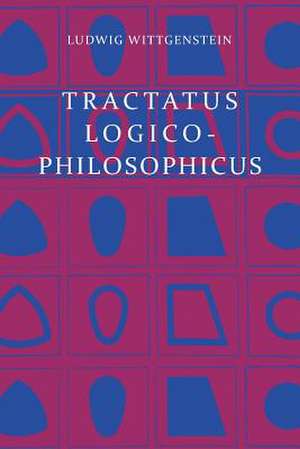
Tractatus Logico-Philosophicus
Autor Ludwig Wittgensteinen Limba Engleză Paperback – 25 mar 2015
| Toate formatele și edițiile | Preț | Express |
|---|---|---|
| Paperback (17) | 37.12 lei 3-5 săpt. | |
| CreateSpace Independent Publishing Platform – | 37.12 lei 3-5 săpt. | |
| Dover Publications – 31 dec 1997 | 53.26 lei 3-5 săpt. | |
| OUP OXFORD – 11 mai 2023 | 53.44 lei 22-27 zile | +21.13 lei 7-13 zile |
| CREATESPACE – | 62.23 lei 3-5 săpt. | |
| Penguin Books – 13 mai 2025 | 67.49 lei 3-5 săpt. | +5.26 lei 7-13 zile |
| Liveright Publishing Corporation – 27 mai 2025 | 92.49 lei 3-5 săpt. | +22.24 lei 7-13 zile |
| Martino Fine Books – 25 mar 2015 | 103.70 lei 18-23 zile | +9.62 lei 7-13 zile |
| Taylor & Francis – 18 mai 2001 | 149.42 lei 3-5 săpt. | +7.26 lei 7-13 zile |
| Taylor & Francis – 2 iul 2013 | 181.11 lei 3-5 săpt. | +6.24 lei 7-13 zile |
| Taylor & Francis – 10 sep 1981 | 293.83 lei 3-5 săpt. | +50.71 lei 7-13 zile |
| Neeland Media – 18 iun 2019 | 49.76 lei 6-8 săpt. | |
| CREATESPACE – | 50.45 lei 6-8 săpt. | |
| BENEDICTION CLASSICS – 19 noi 2019 | 53.16 lei 6-8 săpt. | |
| CHIZINE PUBN – 17 aug 2017 | 77.26 lei 18-23 zile | |
| COSIMO CLASSICS – 30 apr 2007 | 80.53 lei 6-8 săpt. | |
| Bottom of the Hill Publishing – 30 apr 2011 | 82.45 lei 39-44 zile | |
| Anthem Press – 10 mai 2021 | 292.66 lei 6-8 săpt. | |
| Hardback (6) | 80.43 lei 22-33 zile | |
| Penguin Books – 7 dec 2023 | 80.43 lei 22-33 zile | |
| BENEDICTION CLASSICS – 19 noi 2019 | 113.91 lei 6-8 săpt. | |
| Anthem Press – 10 mai 2021 | 670.72 lei 6-8 săpt. | |
| Anthem Press – 10 mai 2021 | 671.41 lei 6-8 săpt. | |
| Taylor & Francis – 18 mai 2001 | 849.84 lei 6-8 săpt. | |
| Taylor & Francis – 27 aug 2015 | 1273.21 lei 6-8 săpt. |
Preț: 103.70 lei
Nou
Puncte Express: 156
Preț estimativ în valută:
18.35€ • 21.40$ • 16.11£
18.35€ • 21.40$ • 16.11£
Carte disponibilă
Livrare economică 22-27 decembrie
Livrare express 11-17 decembrie pentru 19.61 lei
Preluare comenzi: 021 569.72.76
Specificații
ISBN-13: 9781614278030
ISBN-10: 1614278032
Pagini: 122
Dimensiuni: 156 x 234 x 7 mm
Greutate: 0.2 kg
Editura: Martino Fine Books
ISBN-10: 1614278032
Pagini: 122
Dimensiuni: 156 x 234 x 7 mm
Greutate: 0.2 kg
Editura: Martino Fine Books
V-ar putea interesa
-
 Awakening of Intelligence, TheJiddu KrishnamurtiPreț: 118.44 lei
 -
 Being and TimeMartin HeideggerPreț: 133.49 lei
 -
 The Blank SlateSteven Pinker-29%Preț: 73.27 lei103.77 lei
 -
 -22%Preț: 58.13 lei74.28 lei
 -
 Irrational Man: A Study in Existential PhilosophyWilliam BarrettPreț: 92.90 lei
 -
 The Language of Change – Elements of Therapeutic CommunicationPaul WatzlawickPreț: 99.07 lei
 -
 Letter to a PriestSimone WeilPreț: 190.34 lei
 -
 On DialogueDavid BohmPreț: 181.21 lei
 -
 Sketch for a Theory of the EmotionsJean-Paul SartrePreț: 240.60 lei
 -
 The Undiscovered SelfCarl Gustav JungPreț: 180.64 lei
 -
 -9%Preț: 334.28 lei366.73 lei
 -
 NotebooksWittgensteinPreț: 256.72 lei
 -
 Preț: 286.89 lei
 -
 Urban ShamanSerge Kahili King-24%Preț: 62.19 lei82.05 lei
 -
 Cracking the Coding Interview: 189 Programming Questions and SolutionsGayle Laakmann McDowell-20%Preț: 225.45 lei281.82 lei
 -
 Php, Mysql, & JavaScript All-In-One for DummiesRichard Blum-20%Preț: 251.86 lei314.83 lei
 -
 Power Up Your BrainDavid PerlmutterPreț: 107.78 lei
 -
 Philosophical Investigations 4eL WittgensteinPreț: 237.95 lei
 -
 Postautonomous Ego DevelopmentSusanne Cook-GreuterPreț: 155.12 lei
 -
 JavaScript – The Definitive Guide, 7eDavid Flanagan-20%Preț: 376.26 lei470.32 lei
 -
 In an Unspoken VoicePeter A Levine-23%Preț: 117.18 lei152.90 lei
 -
 Cutting Through Spiritual MaterialismChogyam Trungpa-20%Preț: 93.52 lei117.04 lei
 -
 Thinking in SystemsDonella H. MeadowsPreț: 116.85 lei
 -
 -38%Preț: 56.42 lei90.35 lei
 -
 Scattered MindsGabor Mate-21%Preț: 70.71 lei89.00 lei
 -
 Full-Stack React Projects - Second EditionShama Hoque-20%Preț: 314.07 lei392.60 lei
 -
 Tractatus logico-philosophicus e Quaderni 1914-1916Ludwig WittgensteinPreț: 317.37 lei
Notă biografică
Ludwig Josef Johann Wittgenstein (26 April 1889 - 29 April 1951) was an Austrian-British philosopher who worked primarily in logic, the philosophy of mathematics, the philosophy of mind, and the philosophy of language.[12]
From 1929 to 1947, Wittgenstein taught at the University of Cambridge.[13] During his lifetime he published just one slim book (the 75-page Tractatus Logico-Philosophicus, 1921), one article ("Some Remarks on Logical Form", 1929), one book review and a children's dictionary.[14][15] His voluminous manuscripts were edited and published posthumously. Philosophical Investigations appeared as a book in 1953. His teacher, Bertrand Russell, described Wittgenstein as "perhaps the most perfect example I have ever known of genius as traditionally conceived; passionate, profound, intense, and dominating".[16]
Born in Vienna into one of Europe's richest families, he inherited a fortune from his father in 1913. He initially made some donations to artists and writers, and then, in a period of severe personal depression after the First World War, he gave away his entire fortune to his brothers and sisters.[17][18] Three of his four brothers committed suicide, which Wittgenstein had also contemplated. He left academia several times-serving as an officer on the front line during World War I, where he was decorated a number of times for his courage; teaching in schools in remote Austrian villages where he encountered controversy for hitting children when they made mistakes in mathematics; and working as a hospital porter during World War II in London, where he told patients not to take the drugs they were prescribed while largely managing to keep secret the fact that he was one of the world's most famous philosophers.
His philosophy is often divided into an early period, exemplified by the Tractatus, and a later period, articulated in the Philosophical Investigations.[19] "Early Wittgenstein" was concerned with the logical relationship between propositions and the world and he believed that by providing an account of the logic underlying this relationship, he had solved all philosophical problems. "Late Wittgenstein", however, rejected many of the assumptions of the Tractatus, arguing that the meaning of words is best understood as their use within a given language-game.[20]
A survey among American university and college teachers ranked the Investigations as the most important book of 20th-century philosophy, standing out as "the one crossover masterpiece in twentieth-century philosophy, appealing across diverse specializations and philosophical orientations".The Investigations also ranked 54th on a list of most influential twentieth-century works in cognitive science prepared by the University of Minnesota's Center for Cognitive Sciences.[21] However, in the words of his friend Georg Henrik von Wright, he believed that "his ideas were generally misunderstood and distorted even by those who professed to be his disciples. He doubted he would be better understood in the future. He once said he felt as though he "was writing for people who would think in a different way, breathe a different air of life, from that of present-day men
Descriere
Descriere de la o altă ediție sau format:
'what can be said at all can be said clearly; and of what one cannot talk, about that one must be silent'Wittgenstein's Tractatus Logico-Philosophicus, first published in German in 1921 and in English translation in 1922, is one of the most influential philosophical texts of the twentieth century. It played a fundamental role in the development of analytic philosophy, and its philosophical ideas and implications have been fiercely debated ever since. This new translation improves on the two main earlier translations, taking advantage of the scholarship over the last century that has deepened our understanding of both the Tractatus and Wittgenstein's philosophy more generally, scholarship that has also involved discussion of the difficulties in translating the original German text and the issues of interpretation that arise.Michael Beaney's translation is accompanied by two introductory essays, the first explaining the background to Wittgenstein's work, its main ideas and their subsequent development and influence, and some of the central debates, and the second providing an account of the history of the text and the two earlier translations. It is accompanied by detailed notes, explaining key points of translation and interpretation, a glossary, chronology, and other editorial material designed to help the reader understand the Tractatus and its place in the history of philosophy.
'what can be said at all can be said clearly; and of what one cannot talk, about that one must be silent'Wittgenstein's Tractatus Logico-Philosophicus, first published in German in 1921 and in English translation in 1922, is one of the most influential philosophical texts of the twentieth century. It played a fundamental role in the development of analytic philosophy, and its philosophical ideas and implications have been fiercely debated ever since. This new translation improves on the two main earlier translations, taking advantage of the scholarship over the last century that has deepened our understanding of both the Tractatus and Wittgenstein's philosophy more generally, scholarship that has also involved discussion of the difficulties in translating the original German text and the issues of interpretation that arise.Michael Beaney's translation is accompanied by two introductory essays, the first explaining the background to Wittgenstein's work, its main ideas and their subsequent development and influence, and some of the central debates, and the second providing an account of the history of the text and the two earlier translations. It is accompanied by detailed notes, explaining key points of translation and interpretation, a glossary, chronology, and other editorial material designed to help the reader understand the Tractatus and its place in the history of philosophy.
Recenzii
Paradox is a powerful source of philosophical intrigue. And these two new editions attest to the status of the Tractatus as perhaps the philosophical classic of the twentieth century, inspiring not only philosophers of both "analytic" and "continental" stripes, but also writers, logicians and film-makers.
Cuprins
Foreword to the Routledge Great Minds Edition 1. Translators' Preface 2. Introduction by Bertrand Russell 3. Tractatus Logico-Philosophicus Preface 4. Translation Index