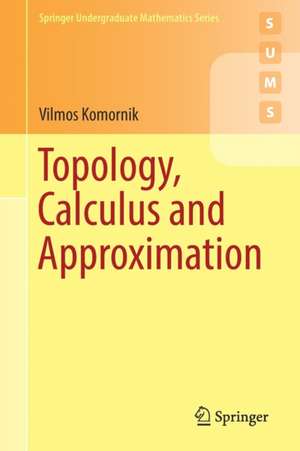
Topology, Calculus and Approximation: Springer Undergraduate Mathematics Series
Autor Vilmos Komorniken Limba Engleză Paperback – 10 apr 2017
În literatura academică actuală, studenții se confruntă adesea cu o fragmentare a resurselor: topologia, calculul diferențial și metodele numerice sunt tratate de regulă ca discipline izolate. Topology, Calculus and Approximation vine să completeze această lacună, oferind o sinteză coerentă care demonstrează cum structurile topologice fundamentează rigoarea calculului și cum ambele converg spre aplicațiile practice ale aproximării. Ne-a atras atenția în mod deosebit stilul de expunere, care onorează tradiția matematică maghiară a lui Paul Erdős, punând accent pe frumusețea demonstrațiilor și pe sursele originale ale conceptelor.
Volumul este organizat în trei părți distincte care reflectă o progresie logică: începe cu fundamentele spațiilor metrice și normate, trece prin calculul diferențial de ordin superior și ecuații diferențiale, și culminează cu metode de aproximare, de la polinoame ortogonale la integrare numerică. Merită menționat că autorul Vilmos Komornik alege să utilizeze definiția lui Carathéodory pentru derivată, o abordare pedagogică ce simplifică considerabil enunțurile teoremelor complexe. Comparabil cu Several Real Variables de Shmuel Kantorovitz în rigurozitate, volumul de față este actualizat pentru a include nu doar analiza pură, ci și o componentă solidă de matematică computațională, integrând rezultate clasice ale lui Descartes sau Stieltjes care sunt rareori găsite într-un manual modern.
Această lucrare se poziționează ca o continuare naturală a preocupărilor autorului din Lectures on Functional Analysis and the Lebesgue Integral, unde acesta explora generalizarea teoremelor geometrice. Aici, Vilmos Komornik rafinează acea viziune, oferind un instrument de lucru esențial pentru cei care doresc să înțeleagă nu doar „cum”, ci și „de ce” funcționează algoritmii de calcul în spații multidimensionale.
Din seria Springer Undergraduate Mathematics Series
-
 Preț: 339.27 lei
 -
 Preț: 373.88 lei
 -
 Preț: 413.31 lei
 -
 Preț: 366.50 lei
 -
 Preț: 265.98 lei
 -
 Preț: 414.81 lei
 - 13%
 Preț: 403.14 lei
 - 20%
 Preț: 374.59 lei
 -
 Preț: 383.13 lei
 -
 Preț: 422.57 lei
 -
 Preț: 390.50 lei
 -
 Preț: 404.72 lei
 -
 Preț: 400.74 lei
 -
 Preț: 438.54 lei
 -
 Preț: 368.16 lei
 -
 Preț: 282.72 lei
 -
 Preț: 306.67 lei
 -
 Preț: 261.80 lei
 -
 Preț: 269.23 lei
 -
 Preț: 267.01 lei
 -
 Preț: 267.95 lei
 -
 Preț: 362.56 lei
 -
 Preț: 270.56 lei
 -
 Preț: 276.73 lei
 -
 Preț: 278.40 lei
 -
 Preț: 273.62 lei
 -
 Preț: 353.46 lei
 -
 Preț: 271.48 lei
 - 15%
 Preț: 506.44 lei
 -
 Preț: 282.17 lei
 -
 Preț: 265.85 lei
 -
 Preț: 275.65 lei
 -
 Preț: 280.67 lei
 -
 Preț: 259.16 lei
 -
 Preț: 274.44 lei
 -
 Preț: 323.68 lei
 -
 Preț: 281.19 lei
 -
 Preț: 281.87 lei
 -
 Preț: 272.46 lei
 -
 Preț: 265.55 lei
 -
 Preț: 276.32 lei
 -
 Preț: 271.25 lei
 -
 Preț: 254.58 lei
 -
 Preț: 267.93 lei
 -
 Preț: 260.53 lei
 -
 Preț: 356.95 lei
 -
 Preț: 257.69 lei
 -
 Preț: 254.70 lei
 -
 Preț: 270.73 lei
 -
 Preț: 266.17 lei
Preț: 276.50 lei
Carte tipărită la comandă
Livrare economică 28 noiembrie-12 decembrie
Specificații
ISBN-10: 1447173155
Pagini: 335
Ilustrații: XIV, 382 p. 64 illus., 1 illus. in color.
Dimensiuni: 155 x 235 x 25 mm
Greutate: 0.55 kg
Ediția:1st ed. 2017
Editura: SPRINGER LONDON
Colecția Springer
Seria Springer Undergraduate Mathematics Series
Locul publicării:London, United Kingdom
V-ar putea interesa
-
 Fourier Series in Control TheoryVilmos KomornikPreț: 405.36 lei
 -
 -23%Preț: 613.10 lei796.23 lei
 -
 -23%Preț: 634.58 lei824.12 lei
 -
 -9%Preț: 777.29 lei854.17 lei
 -
 Lectures on Functional Analysis and the Lebesgue IntegralVilmos Komornik-15%Preț: 535.43 lei629.91 lei
 -
 Neoclassical Theory of Electromagnetic InteractionsAnatoli Babin-18%Preț: 1063.76 lei1297.27 lei
 -
 Ordinary Differential EquationsWilliam A. AdkinsPreț: 523.20 lei
 -
 Spectral and Dynamical Stability of Nonlinear WavesTodd Kapitula-15%Preț: 584.13 lei687.20 lei
 -
 Geometry: from Isometries to Special RelativityNam-Hoon LeePreț: 450.47 lei
 -
 A Journey Through The Realm of NumbersMenny AkaPreț: 326.96 lei
 -
 Nonlinear Partial Differential Equations with ApplicationsTomá¿ Roubí¿ek-15%Preț: 541.00 lei636.47 lei
 -
 Trends in PDE Constrained OptimizationGünter Leugering-18%Preț: 829.40 lei1011.47 lei
 -
 The Mathematical Theory of Time-Harmonic Maxwell's EquationsAndreas Kirsch-15%Preț: 526.32 lei619.20 lei
 -
 Historical Developments in Singular PerturbationsRobert E. O'MalleyPreț: 407.16 lei
 -
 Twenty-One Lectures on Complex AnalysisAlexander IsaevPreț: 266.77 lei
 -
 Functional AnalysisSergei Ovchinnikov-15%Preț: 402.83 lei473.91 lei
De ce să citești această carte
Recomandăm această carte studenților la matematică, fizică și inginerie care caută o viziune unitară asupra analizei matematice. Cititorul câștigă o înțelegere profundă a legăturii dintre structura spațiilor și metodele numerice utilizate în practică. Este un volum valoros pentru că recuperează teoreme clasice „uitate” și oferă exerciții noi, dificil de găsit în alte surse, facilitând tranziția de la teoria abstractă la soluționarea ecuațiilor diferențiale.
Despre autor
Vilmos Komornik este un matematician recunoscut, profesor la Universitatea din Strasbourg, cu o vastă experiență în predarea analizei matematice și a analizei funcționale. Stilul său pedagogic este profund influențat de școala maghiară de matematică, punând preț pe claritatea conceptuală și pe contextul istoric al descoperirilor. Pe lângă Topology, Calculus and Approximation, autorul a publicat lucrări de referință precum Lectures on Functional Analysis and the Lebesgue Integral, consolidându-și reputația de a prezenta teme matematice avansate într-o manieră accesibilă, dar riguroasă, adaptată nevoilor studenților de la nivel licență și master.
Cuprins
Part 1. Topology.- Chapter 1. Metric spaces.- Chapter 2. Topological spaces.- Chapter 3. Normed spaces.- Part 2. Differential calculus.- Chapter 4. The Derivative.- Chapter 5. Higher-order derivatives.- Chapter 6. Ordinary differential equations.- Chapter 7. Implicit functions and their applications.- Part 3. Approximation methods.- Chapter 8. Interpolation.- Chapter 9. Orthogonal polynomials.- Chapter 10. Numerical integration.- Chapter 11. Finding roots.- Chapter 12. Numerical solution of differential equations.
Notă biografică
Vilmos Komornik has studied in Budapest, Hungary, and has taught in Hungary and France for nearly 40 years. His main research fields are control theory of partial differential equations and combinatorial number theory. He has made a number of contributions to the theory of J.L. Lions on exact controllability and stabilization and has co-authored several papers on expansions in noninteger bases with P. Erdős. He is an external member of the Hungarian Academy of Sciences.
Textul de pe ultima copertă
Presenting basic results of topology, calculus of several variables, and approximation theory which are rarely treated in a single volume, this textbook includes several beautiful, but almost forgotten, classical theorems of Descartes, Erdős, Fejér, Stieltjes, and Turán.
Caracteristici
Illustrates the insufficiency of sequences with simple but rarely presented examples
Elaborates on the historical background of most notions and results treated in this volume
Includes supplementary material: sn.pub/extras