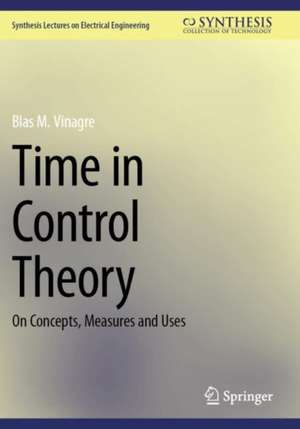
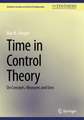
Time in Control Theory: Synthesis Lectures on Electrical Engineering
Autor Blas M. Vinagreen Limba Engleză Paperback – 24 apr 2025
Din seria Synthesis Lectures on Electrical Engineering
-
 Preț: 402.32 lei
-
 Preț: 400.65 lei
-
 Preț: 403.47 lei
- 15%
 Preț: 510.53 lei
-
 Preț: 221.49 lei
-
 Preț: 253.76 lei
-
 Preț: 199.58 lei
-
 Preț: 381.55 lei
-
 Preț: 390.28 lei
-
 Preț: 412.23 lei
-
 Preț: 412.05 lei
-
 Preț: 411.88 lei
-
 Preț: 402.26 lei
Preț: 381.13 lei
Puncte Express: 572
Carte tipărită la comandă
Livrare economică 15-21 decembrie
Livrare prin curier în România Termenul estimat este afișat lângă disponibilitate.
Transport gratuit de la 400.00 lei Plată online sau ramburs, în funcție de opțiunile comenzii.
Retur gratuit în 14 zile Comandă securizată și suport în română.
Specificații
ISBN-13: 9783031540448
ISBN-10: 3031540441
Pagini: 108
Dimensiuni: 168 x 240 x 7 mm
Greutate: 0.2 kg
Editura: Springer
Colecția Synthesis Lectures on Electrical Engineering
Seria Synthesis Lectures on Electrical Engineering
ISBN-10: 3031540441
Pagini: 108
Dimensiuni: 168 x 240 x 7 mm
Greutate: 0.2 kg
Editura: Springer
Colecția Synthesis Lectures on Electrical Engineering
Seria Synthesis Lectures on Electrical Engineering
V-ar putea interesa
-
 A Brief History of the Philosophy of TimeAdrian Bardon-15%Preț: 147.74 lei174.00 lei
-
 Time: A Very Short IntroductionJenann Ismael-19%Preț: 57.36 lei70.82 lei
-
 About Time: A Children's Guide to the History and Science of TimeRebecca Struthers-14%Preț: 96.08 lei112.10 lei
-
 Optimal Control TheoryDonald E. KirkPreț: 210.78 lei
-
 -23%Preț: 175.25 lei227.99 lei
-
 Linear System Theory: The State Space ApproachLofti A. ZadehPreț: 207.90 lei
-
 -20%Preț: 119.79 lei149.23 lei
-
 Preț: 294.99 lei
-
 -15%Preț: 695.06 lei817.71 lei
-
 -15%Preț: 694.35 lei816.88 lei
-
 The Science of ScalingBenjamin Hardy-19%Preț: 121.88 lei149.57 lei
-
 Time and WorldHartmut RosaPreț: 142.10 lei
-
 Control Theory: Perspectives, Applications & DevelopmentsFrancisco Miranda-35%Preț: 1528.95 lei2368.90 lei
-
 The Time MachineH. G. WellsPreț: 33.23 lei
-
 An Introduction to Optimal Control TheoryOnésimo Hernández-LermaPreț: 479.91 lei
-
 Robust and Adaptive ControlEugene LavretskyPreț: 542.07 lei
-
 Components Operationally: Reversibility and System EngineeringClaudio Antares Mezzina-20%Preț: 389.32 lei486.66 lei
-
 -18%Preț: 920.78 lei1122.90 lei
Cuprins
Introduction.- PID Control and the Sequence of the Time.- Control Theory, Time Concepts and Calculus.- Sampling and Integral Sums.- On Reversibility.- Feedback: Mixing Memory and Desire.- Fourfold Vision. A Code.
Notă biografică
Doctor Concepción A. Monje has been working on fractional derivatives and their applications for over seven years being author and co-author of over 40 technical papers mostly related to fractional-order controllers. Her research area focuses on the tuning and auto-tuning of fractional-order controllers for the control of industrial processes, including servomechanisms, pneumatic and liquid level systems. She has collaborated with the CRONE (Commande Robuste Ordre Non Entier) team from the Ecole Nationale Supérieure d’Électronique, Informatique et Radiocommunications of Bordeaux, publishing several works related to the tuning of fractional-order controllers and co-organizing the 2nd IFAC Workshop on Fractional Differentiation and its Applications (FDA’06). She has also worked on the application of fractional-order controllers to the control of flexible manipulators, in collaboration with the Electrical, Electronic, Control and Communications Engineering Department of the Technic High School of Industrial Engineers of the University of Castilla La-Mancha, Spain. Her collaborations in this field also extend to the Center for Self-Organizing and Intelligent System of the Utah State University, in USA, where she was invited to deliver a research lecture on design of fractional-order controllers to Ph.D. students and a joint public lecture on this topic to members of the IEEE Control Systems Society San Diego Section. She has co-chaired international conferences and she has been a member of international program committees. She has been involved in several international and national research and industrial projects, and she has reviewed articles for several international journals and conferences of relevance.
Doctor YangQuan Chen has authored over 200 academic papers plus numerous technical reports. He co-authored two textbooks: "System Simulation Techniques with MATLAB®/Simulink" (with Dingyu Xue . Tsinghua University Press, April 2002, ISBN7-302-05341-3/TP3137, in Chinese) and "Solving Advanced Applied Mathematical Problems Using Matlab" (with Dingyu Xue. Tsinghua University Press. August 2004. 419 pages in Chinese, ISBN 7-302-09311-3/O.392); and four research monographs: "Plastic Belt for Projectiles" (with Y. Shi. Shaanxi Science and Technology Press, Jan. 1995, ISBN 7-5369-2277-9/TJ.1, in Chinese), "Iterative Learning Control " (with C. Wen . Lecture Notes in Control and Information Sciences, Springer-Verlag, Nov. 1999, ISBN: 1-85233-190-9 ), "Iterative Learning Control" (with Hyo-Sung Ahn and Kevin L. Moore. Springer, July 2007, ISBN: 978-1-84628-846-3), and "Optimal Observation for Cyber-physical Systems"(with Zhen Song, Chellury Sastry and Nazif Tas. Springer, July 2009, ISBN: 978-1-84882-655-7). His current research interests include autonomous navigation and intelligent control of a team of unmanned ground vehicles, machine vision for control and automation, distributed control systems (MAS-net : mobile actuator-sensor networks), fractional-order control, interval computation, and iterative/repetitive/adaptive learning control. Currently, he serves as an Associate Editor for IEEE Control Systems Society, Conference Editorial Board (CSSCEB ). He was also an Associate Editor of ISA Review Board for AACC 's American Control Conference ( ACC2005 ). He has been the Co-Organizer and Instructor of the Tutorial Workshop on "Fractional-order Calculus in Control and Robotics" at IEEE 2002 Conference on Decision and Control (CDC'02), and a founding member of the ASME subcommittee on "Fractional Dynamics".
Doctor Blas M. Vinagre has been working on the area of Fractional Calculus Applications for over 12 years, and he has published over 60 technical papers on this subject. He co-organized the ever first whole day Tutorial Workshop (IEEE Conference on Decision and Control, Las Vegas, December 2002) and the Symposium on Applied Fractional Calculus (Badajoz, October 2007). He has been teacher for t
Textul de pe ultima copertă
Control Theory is an interdisciplinary field of engineering and mathematics that studies the behavior of dynamic systems with external stimuli and how to modify such behavior through feedback, and the very concept of dynamic system implies the study of how the trajectories of a point in a geometric space evolve in time. Thus, time is at the very foundation of control theory, and its development and achievements are conditioned both by the conception we have of it and by our way of measuring and using it. Following a quasi-chronological order, this work aims to give an overview of how these conceptions and these ways of measuring and using time are reflected in the paths followed by control theory from its origins to the present day.