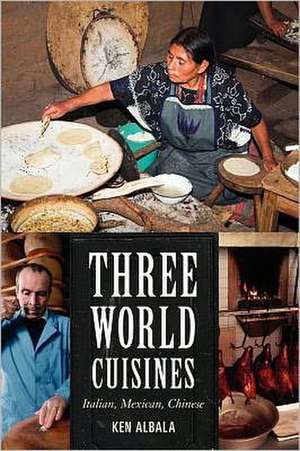
Three World Cuisines: Italian, Mexican, Chinese: Bloomsbury Studies in Food and Gastronomy
Autor Ken Albalaen Limba Engleză Hardback – 3 mai 2012
Din seria Bloomsbury Studies in Food and Gastronomy
- 17%
 Preț: 111.69 lei
 - 31%
 Preț: 504.51 lei
 - 35%
 Preț: 627.36 lei
 - 17%
 Preț: 323.49 lei
 - 33%
 Preț: 546.06 lei
 - 20%
 Preț: 339.04 lei
 - 33%
 Preț: 578.43 lei
 - 14%
 Preț: 576.05 lei
 - 18%
 Preț: 311.65 lei
 - 25%
 Preț: 288.34 lei
 - 23%
 Preț: 273.13 lei
 - 35%
 Preț: 621.10 lei
 - 25%
 Preț: 287.46 lei
 - 33%
 Preț: 543.15 lei
 -
 Preț: 345.19 lei
 - 21%
 Preț: 365.93 lei
 - 14%
 Preț: 318.40 lei
 - 23%
 Preț: 258.70 lei
 - 21%
 Preț: 259.88 lei
 - 28%
 Preț: 220.85 lei
 - 25%
 Preț: 224.12 lei
 - 28%
 Preț: 220.06 lei
 - 34%
 Preț: 635.66 lei
Preț: 1010.42 lei
Preț vechi: 1463.02 lei
-31%
Puncte Express: 1516
Carte tipărită la comandă
Livrare economică 23 noiembrie-07 decembrie
Livrare prin curier în România Termenul estimat este afișat lângă disponibilitate.
Transport gratuit pentru acest produs Plată online sau ramburs, în funcție de opțiunile comenzii.
Retur gratuit în 14 zile Comandă securizată și suport în română.
Specificații
ISBN-13: 9780759121256
ISBN-10: 0759121257
Pagini: 392
Dimensiuni: 183 x 265 x 27 mm
Greutate: 0.87 kg
Ediția:New.
Editura: Bloomsbury Publishing
Colecția AltaMira Press
Seria Bloomsbury Studies in Food and Gastronomy
Locul publicării:New York, United States
ISBN-10: 0759121257
Pagini: 392
Dimensiuni: 183 x 265 x 27 mm
Greutate: 0.87 kg
Ediția:New.
Editura: Bloomsbury Publishing
Colecția AltaMira Press
Seria Bloomsbury Studies in Food and Gastronomy
Locul publicării:New York, United States
V-ar putea interesa
-
 Building Valve AmplifiersMorgan Jones-19%Preț: 242.86 lei301.59 lei
 -
 -19%Preț: 499.74 lei616.97 lei
 -
 Food and Faith in Christian CultureKen Albala-27%Preț: 742.73 lei1017.44 lei
 -
 Preț: 174.56 lei
 -
 How to Go DigitalMit Sloan Management ReviewPreț: 231.22 lei
 -
 Food in Early Modern EuropeKen Albala-45%Preț: 292.67 lei532.99 lei
 -
 Eating Right in the RenaissanceKen AlbalaPreț: 387.96 lei
 -
 The Food History Reader: Primary SourcesKen Albala-25%Preț: 1048.36 lei1405.17 lei
 -
 Food PackagingCirillo-9%Preț: 1322.76 lei1453.59 lei
 -
 Beans: A HistoryKen Albala-23%Preț: 143.86 lei186.14 lei
 -
 Smart TechnologiesInformation Reso Management Association-18%Preț: 1948.29 lei2375.97 lei
 -
 Preț: 228.32 lei
 -
 Dictionnaire d'agricultureJean-Augustin BarralPreț: 450.99 lei
 -
 Le catéchisme de l'opérateur photographeAuguste BellocPreț: 169.14 lei
 -
 HIGH LUMINOSITY LARGE HADRON COLLIDER, THERossi Lucio-18%Preț: 837.85 lei1021.77 lei
 -
 HIGH LUMINOSITY LARGE HADRON COLLIDER, THERossi LucioPreț: 354.90 lei
Cuprins
List of Figures
List of Recipes
A Note on the Recipes
Introduction: A Theory of Gastronomy
Chapter 1. Historical Background
Chapter 2. Technology, Utensils, and Techniques
Chapter 3. Grains and Starches
Chapter 4. Vegetables
Chapter 5. Fruits and Nuts
Chapter 6. Meat, Poultry, and Dairy Products
Chapter 7. Fish and Shellfish
Chapter 8. Fats and Flavorings
Chapter 9. Beverages
Glossary
Bibliography
Index
List of Recipes
A Note on the Recipes
Introduction: A Theory of Gastronomy
Chapter 1. Historical Background
Chapter 2. Technology, Utensils, and Techniques
Chapter 3. Grains and Starches
Chapter 4. Vegetables
Chapter 5. Fruits and Nuts
Chapter 6. Meat, Poultry, and Dairy Products
Chapter 7. Fish and Shellfish
Chapter 8. Fats and Flavorings
Chapter 9. Beverages
Glossary
Bibliography
Index
Recenzii
Historian and gastronomer Albala notes in his introduction, 'that every culture discussed here...harbored various and often opposing food ideologies, each of which made their rival claims upon every individual.' After the opening chapter's impressively quick-paced historical overview of cuisine in Italy, Mexico, and China, Albala approaches modernity via individual foodstuffs. He demonstrates how all three cultures cook and serve porridge, then moves through vegetables, fruit, meat, seafood, desserts, and beverages. . . . This text should be recognized as an impressive, if imperfect, addition to the culinary or history classroom.
The book offers an opportunity to look at common factors in three culinary traditions that have developed not just within their own national or regional boundaries, but in contact with traditions and new material conditions around the world. ... This is a thought-provoking book that raises a number of questions about universality and common features in some areas of world cuisine.
Ken Albala is a leader in the movement to unite academic food studies with the practices of cooking. He offers new understandings of Chinese, Italian, and Mexican cuisines by comparing their historical development and material culture. This is serious history informed by mouth-watering recipes.
This is a great book for students of culinary cultures and for people who love to cook and [learn about] the ideas underlying cooking. I'm a great fan of Albala and his work. He's an academic and brings that intelligence to the work, but he writes for the cook in us all, and I love how he intertwines, scholarship, passion, cooking know-how, and a love of life and food.
The book offers an opportunity to look at common factors in three culinary traditions that have developed not just within their own national or regional boundaries, but in contact with traditions and new material conditions around the world. ... This is a thought-provoking book that raises a number of questions about universality and common features in some areas of world cuisine.
Ken Albala is a leader in the movement to unite academic food studies with the practices of cooking. He offers new understandings of Chinese, Italian, and Mexican cuisines by comparing their historical development and material culture. This is serious history informed by mouth-watering recipes.
This is a great book for students of culinary cultures and for people who love to cook and [learn about] the ideas underlying cooking. I'm a great fan of Albala and his work. He's an academic and brings that intelligence to the work, but he writes for the cook in us all, and I love how he intertwines, scholarship, passion, cooking know-how, and a love of life and food.