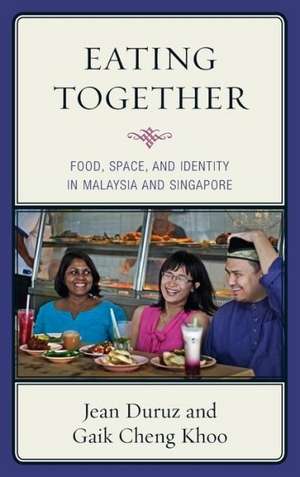
Eating Together: Food, Space, and Identity in Malaysia and Singapore: Bloomsbury Studies in Food and Gastronomy
Autor Jean Duruz, Gaik Cheng Khooen Limba Engleză Hardback – 18 dec 2014
Din seria Bloomsbury Studies in Food and Gastronomy
- 16%
 Preț: 114.43 lei
 - 31%
 Preț: 504.51 lei
 - 35%
 Preț: 627.36 lei
 - 31%
 Preț: 1010.42 lei
 - 17%
 Preț: 323.49 lei
 - 20%
 Preț: 339.04 lei
 - 33%
 Preț: 578.43 lei
 - 14%
 Preț: 576.05 lei
 - 18%
 Preț: 311.65 lei
 - 25%
 Preț: 288.34 lei
 - 23%
 Preț: 273.13 lei
 - 35%
 Preț: 621.10 lei
 - 25%
 Preț: 287.46 lei
 - 33%
 Preț: 543.15 lei
 -
 Preț: 345.19 lei
 - 21%
 Preț: 365.93 lei
 - 14%
 Preț: 318.40 lei
 - 23%
 Preț: 258.70 lei
 - 21%
 Preț: 259.88 lei
 - 28%
 Preț: 220.85 lei
 - 25%
 Preț: 224.12 lei
 - 28%
 Preț: 220.06 lei
 - 33%
 Preț: 651.19 lei
Preț: 546.06 lei
Preț vechi: 817.90 lei
-33%
Puncte Express: 819
Carte tipărită la comandă
Livrare economică 30 noiembrie-14 decembrie
Livrare prin curier în România Termenul estimat este afișat lângă disponibilitate.
Transport gratuit pentru acest produs Plată online sau ramburs, în funcție de opțiunile comenzii.
Retur gratuit în 14 zile Comandă securizată și suport în română.
Specificații
ISBN-13: 9781442227408
ISBN-10: 1442227400
Pagini: 278
Ilustrații: 13 b/w photos;
Dimensiuni: 163 x 238 x 26 mm
Greutate: 0.56 kg
Editura: Bloomsbury Publishing
Colecția Rowman & Littlefield
Seria Bloomsbury Studies in Food and Gastronomy
Locul publicării:New York, United States
ISBN-10: 1442227400
Pagini: 278
Ilustrații: 13 b/w photos;
Dimensiuni: 163 x 238 x 26 mm
Greutate: 0.56 kg
Editura: Bloomsbury Publishing
Colecția Rowman & Littlefield
Seria Bloomsbury Studies in Food and Gastronomy
Locul publicării:New York, United States
Cuprins
Introduction: Making Rojak . or Eating "Together-in-Difference"?
1: Kopitiam: In Search of Cosmopolitan Spaces and Meanings in Malaysia
2: Spreading the Toast of Memory: From Hainanese Kopitiams to Boutique Coffee Shops in Singapore
3: "Mamak, Anyone?": Tamil Muslim Eateries in Malaysia
4: Growing up Transnational: Travelling through Singapore's Hawker Centers
5: Dumplings at Changi: Singapore's Urban Villages as Spaces of Exchange and Re-invention
6: The Little Nyonya and Peranakan Chinese Identity: Between Commodification and Cosmopolitanism
7: Currying the Nation: A Song and Dance about Multiculturalism
Bibliography
Index
About the Authors
1: Kopitiam: In Search of Cosmopolitan Spaces and Meanings in Malaysia
2: Spreading the Toast of Memory: From Hainanese Kopitiams to Boutique Coffee Shops in Singapore
3: "Mamak, Anyone?": Tamil Muslim Eateries in Malaysia
4: Growing up Transnational: Travelling through Singapore's Hawker Centers
5: Dumplings at Changi: Singapore's Urban Villages as Spaces of Exchange and Re-invention
6: The Little Nyonya and Peranakan Chinese Identity: Between Commodification and Cosmopolitanism
7: Currying the Nation: A Song and Dance about Multiculturalism
Bibliography
Index
About the Authors
Recenzii
The book will be of interest to researchers in food, Southeast Asian and cultural studies. . . .A key strength of the volume is that, while clearly a work of combined case studies, it ultimately resists fragmentation because of the authors' palpable, shared intellectual (and social) passion for their subject matter. The distinctly collaborative nature of Eating Together enhances the rojak motif that the authors pursue throughout the book.
Richly imagined and analyzed, the authors explore what public eating spaces can tell us about contemporary nostalgia, cosmopolitanism and localism. Eating Together takes us into the heart of the tastes, smells, sounds and sights of public commonality in Singapore and Malaysia.
Duruz and Khoo demonstrate brilliantly that employing the semiotics of food renders legible the unexpected everyday negotiations involved in accommodating the nuances of national policies governing citizenship in Malaysia and Singapore. Given their histories of migration, conquest and ethnic composition, anxieties in both nations give rise to attempts to curb potential irruptions of communal conflict by legislating every aspect of inter-ethnic relations but places where citizens congregate to eat also allow for ways to thwart such containment. The book astutely maps the ways in which the rich sedimentation of local culinary habits modifies commodified globalisation.
This book is a testament to the possibility of bringing together rich sensuous writing with a sensible politics of eating-together-in-difference that avoids the dual traps of easy sentimentalism about palatal multiculturalism and cynicism about cross-cultural exchanges. That is a remarkable achievement which opens many sensory, ethical, and critical possibilities.
Richly imagined and analyzed, the authors explore what public eating spaces can tell us about contemporary nostalgia, cosmopolitanism and localism. Eating Together takes us into the heart of the tastes, smells, sounds and sights of public commonality in Singapore and Malaysia.
Duruz and Khoo demonstrate brilliantly that employing the semiotics of food renders legible the unexpected everyday negotiations involved in accommodating the nuances of national policies governing citizenship in Malaysia and Singapore. Given their histories of migration, conquest and ethnic composition, anxieties in both nations give rise to attempts to curb potential irruptions of communal conflict by legislating every aspect of inter-ethnic relations but places where citizens congregate to eat also allow for ways to thwart such containment. The book astutely maps the ways in which the rich sedimentation of local culinary habits modifies commodified globalisation.
This book is a testament to the possibility of bringing together rich sensuous writing with a sensible politics of eating-together-in-difference that avoids the dual traps of easy sentimentalism about palatal multiculturalism and cynicism about cross-cultural exchanges. That is a remarkable achievement which opens many sensory, ethical, and critical possibilities.