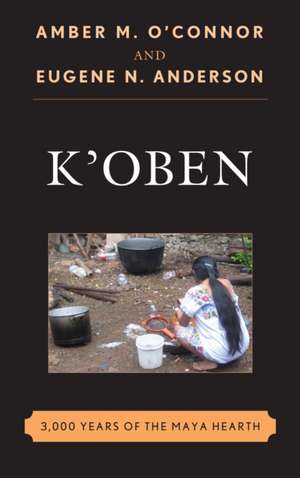
K'Oben: 3,000 Years of the Maya Hearth: Bloomsbury Studies in Food and Gastronomy
Autor Amber M. O'Connor, Eugene N. Andersonen Limba Engleză Hardback – 14 dec 2016
Din seria Bloomsbury Studies in Food and Gastronomy
- 17%
 Preț: 111.69 lei
 - 31%
 Preț: 504.51 lei
 - 35%
 Preț: 627.36 lei
 - 31%
 Preț: 1010.42 lei
 - 17%
 Preț: 323.49 lei
 - 33%
 Preț: 546.06 lei
 - 20%
 Preț: 339.04 lei
 - 33%
 Preț: 578.43 lei
 - 14%
 Preț: 576.05 lei
 - 18%
 Preț: 311.65 lei
 - 25%
 Preț: 288.34 lei
 - 23%
 Preț: 273.13 lei
 - 35%
 Preț: 621.10 lei
 - 25%
 Preț: 287.46 lei
 -
 Preț: 345.19 lei
 - 21%
 Preț: 365.93 lei
 - 14%
 Preț: 318.40 lei
 - 23%
 Preț: 258.70 lei
 - 21%
 Preț: 259.88 lei
 - 28%
 Preț: 220.85 lei
 - 25%
 Preț: 224.12 lei
 - 28%
 Preț: 220.06 lei
 - 34%
 Preț: 635.66 lei
Preț: 543.15 lei
Preț vechi: 815.32 lei
-33%
Puncte Express: 815
Carte tipărită la comandă
Livrare economică 23 noiembrie-07 decembrie
Livrare prin curier în România Termenul estimat este afișat lângă disponibilitate.
Transport gratuit pentru acest produs Plată online sau ramburs, în funcție de opțiunile comenzii.
Retur gratuit în 14 zile Comandă securizată și suport în română.
Specificații
ISBN-13: 9781442255258
ISBN-10: 1442255250
Pagini: 216
Ilustrații: 8 b/w photos
Dimensiuni: 159 x 237 x 20 mm
Greutate: 0.41 kg
Editura: Bloomsbury Publishing
Colecția Rowman & Littlefield
Seria Bloomsbury Studies in Food and Gastronomy
Locul publicării:New York, United States
ISBN-10: 1442255250
Pagini: 216
Ilustrații: 8 b/w photos
Dimensiuni: 159 x 237 x 20 mm
Greutate: 0.41 kg
Editura: Bloomsbury Publishing
Colecția Rowman & Littlefield
Seria Bloomsbury Studies in Food and Gastronomy
Locul publicării:New York, United States
V-ar putea interesa
-
 Arguments and Icons: Divergent Modes of ReligiosityHarvey Whitehouse-29%Preț: 474.53 lei666.28 lei
 -
 Art and Agency: An Anthropological TheoryAlfred Gell-26%Preț: 933.14 lei1255.00 lei
 -
 Humans and Other AnimalsJohn Dupré-12%Preț: 372.52 lei421.74 lei
 -
 Identity and Ecology in Arctic Siberia: The Number One Reindeer BrigadeDavid G. Anderson-27%Preț: 348.91 lei476.57 lei
 -
 Ethnosyntax: Explorations in Grammar and CultureN. J. Enfield-28%Preț: 413.60 lei576.27 lei
 -
 Feast: Why Humans Share FoodMartin Jones-18%Preț: 106.23 lei130.33 lei
 -
 Preț: 186.78 lei
 -
 Reflexive Ethnography: A Guide to Researching Selves and OthersCharlotte Aull DaviesPreț: 417.25 lei
 -
 The Routledge Critical and Cultural Theory ReaderNeil BadmingtonPreț: 445.03 lei
 -
 Preț: 415.97 lei
 -
 Cultural HybridityPeter BurkePreț: 147.21 lei
 -
 Ethnic Identity in Tang ChinaMarc S Abramson-11%Preț: 476.37 lei535.24 lei
 -
 Vietnam Today: A Guide to a Nation at a CrossroadsMark A. AshwillPreț: 154.72 lei
Descriere
K'Oben traces the Maya kitchen and its associated hardware, ingredients, and cooking styles from the earliest times for which we have archaeological evidence through today's culinary tourism in the area. It focuses not only on what was eaten and how it was cooked, but the people involved: who grew or sourced the foods, who cooked them, who ate them. Additionally, the authors examine how Maya foodways and the people involved fit into the social system, particularly in how food is incorporated into culture, economy, and society.
The authors provide a detailed literature review of hard-to-find sources including: out of print centuries old cookbooks, archaeological field notes, ethnographies and ethnohistories out of circulation and not available in English, thesis documents only available in Spanish and in university archives as well as current field research on the Maya.
The more recent Maya foodways can be studied from cookbooks, ethnographies and ethnohistorical documentation. Between the two of us, we have assembled a small but representative collection of cookbooks, some self-published and rare, that were available in Merida and elsewhere in Mexico during the late 20th century. Some are quite old, and all reflect local traditional foodways.
Geographically, the book concentrates on Yucatan, Tabasco and Chiapas in Mexico, but will include Pre-Classic and Classic evidence from Guatemala and El Salvador, whose foodways are influenced by Maya traditions.
The authors provide a detailed literature review of hard-to-find sources including: out of print centuries old cookbooks, archaeological field notes, ethnographies and ethnohistories out of circulation and not available in English, thesis documents only available in Spanish and in university archives as well as current field research on the Maya.
The more recent Maya foodways can be studied from cookbooks, ethnographies and ethnohistorical documentation. Between the two of us, we have assembled a small but representative collection of cookbooks, some self-published and rare, that were available in Merida and elsewhere in Mexico during the late 20th century. Some are quite old, and all reflect local traditional foodways.
Geographically, the book concentrates on Yucatan, Tabasco and Chiapas in Mexico, but will include Pre-Classic and Classic evidence from Guatemala and El Salvador, whose foodways are influenced by Maya traditions.
Recenzii
K'oben is the Yucatec term for the famous three-stoned hearth that centers the kitchen throughout the Maya region-and turns out to appear relatively recently in Maya history. What the two authors do best is move readers away from the stereotype of the Maya 'triad' (corn/tortilla, beans, squash, plus chiles) to understanding the historically emergent, postcolonial nature of Maya cooking, eating, and influence on world cuisines. O'Connor and Anderson (emer., anthropology, Univ. of California Riverside) organize most of their book chronologically; the last two chapters bring their account to the present. One details the cuisine of each Mexican 'Mayaland' state. The closing (and best written) chapter explores how expanded tourism and UNESCO efforts to curate and protect distinctive cuisines instead homogenize them and objectify Maya women. A useful appendix presents ingredients and recipes. The book is a lively read..The authors have filled it with sustained symbolic analysis as well as choice tidbits, such as the fact that the emblematic Mexican mole poblano is actually an Arab-Andalusian staple with chocolate and chile added, or Cuba's role in Yucatec Maya flavors.
Summing Up: Highly recommended. All levels/libraries.
K'oben is an intriguing conversation between two anthropologists about the absolute delight of cooking and food among Maya communities in Yucatan and Southern Mexico. In the Popol Vuh, the Maya classic book, the universe is created through a conversation; K'oben is likewise a dialogue, one that creates a wonderful universe of the foodscapes of Maya homes and Maya lands. The conversations of Amber O'Connor and Eugene Anderson range from the deep and profound history of Mayan language, history, and archaeology to fast foods, junk foods, and food tourism in Mexico today. These two people love the foods of Mexico, and their appreciation goes far beyond academic curiosity. Reading this book is to taste, see, and even smell the fires that give Maya cuisine its characteristic flavor. As they note, black beans are so good because, "The smoke from the k'oben gives them a heavenly flavor." Opening K'oben to any page is like joining a long and wonderful food journey replete with anecdote, science, history, and good recipes. Sometimes in Mexico you get on a bus and listen in on a fascinating conversation going on among the other passengers. O'Connor and Anderson's style is reflective yet deliciously enjoyable and so this book will whet not only your palate but also your curiosity about people who are Maya.
In K'Oben, O'Connor and Anderson take us in a journey through time by weaving together evidence from archaeology, history, linguistics, and their own ethnographic research on food and society in the Maya area. Readers will learn about food in society, religious ritual, art, gender roles, social class, and an infinite variety of areas of social and cultural life that are affected by food. Starting in the earliest villages in Mesoamerica and finishing in modern day Mexico, K'Oben will surely leave readers with a solid foundation on food studies in the Maya area, and a healthy appetite for more learning and tasting.
This book, written in an accessible language, provides an encompassing review of the transformations of cooking among the Maya people of Mexico. Based on archaeological, historical, and anthropological sources it describes the technologies, techniques and ingredients used through time in that region. It is highly informative for those interested in the cooking of the Maya.
Deeply informed yet readily accessible to the non-specialist, this work on Mayan cuisine moves easily and convincingly from ancient foods to contemporary issues of culinary heritage, from farming to recipes. A landmark treatment of an important and distinctive culinary tradition.
Summing Up: Highly recommended. All levels/libraries.
K'oben is an intriguing conversation between two anthropologists about the absolute delight of cooking and food among Maya communities in Yucatan and Southern Mexico. In the Popol Vuh, the Maya classic book, the universe is created through a conversation; K'oben is likewise a dialogue, one that creates a wonderful universe of the foodscapes of Maya homes and Maya lands. The conversations of Amber O'Connor and Eugene Anderson range from the deep and profound history of Mayan language, history, and archaeology to fast foods, junk foods, and food tourism in Mexico today. These two people love the foods of Mexico, and their appreciation goes far beyond academic curiosity. Reading this book is to taste, see, and even smell the fires that give Maya cuisine its characteristic flavor. As they note, black beans are so good because, "The smoke from the k'oben gives them a heavenly flavor." Opening K'oben to any page is like joining a long and wonderful food journey replete with anecdote, science, history, and good recipes. Sometimes in Mexico you get on a bus and listen in on a fascinating conversation going on among the other passengers. O'Connor and Anderson's style is reflective yet deliciously enjoyable and so this book will whet not only your palate but also your curiosity about people who are Maya.
In K'Oben, O'Connor and Anderson take us in a journey through time by weaving together evidence from archaeology, history, linguistics, and their own ethnographic research on food and society in the Maya area. Readers will learn about food in society, religious ritual, art, gender roles, social class, and an infinite variety of areas of social and cultural life that are affected by food. Starting in the earliest villages in Mesoamerica and finishing in modern day Mexico, K'Oben will surely leave readers with a solid foundation on food studies in the Maya area, and a healthy appetite for more learning and tasting.
This book, written in an accessible language, provides an encompassing review of the transformations of cooking among the Maya people of Mexico. Based on archaeological, historical, and anthropological sources it describes the technologies, techniques and ingredients used through time in that region. It is highly informative for those interested in the cooking of the Maya.
Deeply informed yet readily accessible to the non-specialist, this work on Mayan cuisine moves easily and convincingly from ancient foods to contemporary issues of culinary heritage, from farming to recipes. A landmark treatment of an important and distinctive culinary tradition.