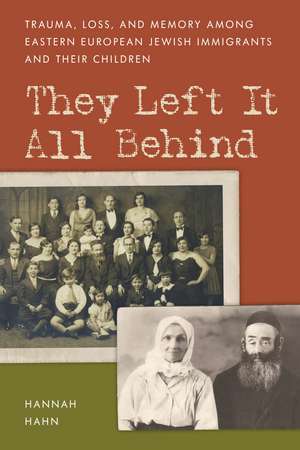
They Left It All Behind: Trauma, Loss, and Memory Among Eastern European Jewish Immigrants and their Children: New Imago
Autor Hannah Hahnen Limba Engleză Hardback – 5 noi 2019
Din seria New Imago
- 18%
 Preț: 342.17 lei
 - 24%
 Preț: 260.55 lei
 - 22%
 Preț: 785.04 lei
 - 31%
 Preț: 636.19 lei
 - 33%
 Preț: 673.73 lei
 - 30%
 Preț: 649.77 lei
 - 31%
 Preț: 566.18 lei
 - 28%
 Preț: 525.61 lei
 - 31%
 Preț: 595.44 lei
 - 31%
 Preț: 600.48 lei
 - 33%
 Preț: 609.76 lei
 - 31%
 Preț: 568.63 lei
 - 29%
 Preț: 360.15 lei
 - 23%
 Preț: 280.05 lei
 - 25%
 Preț: 218.96 lei
Preț: 692.35 lei
Preț vechi: 1005.90 lei
-31%
Puncte Express: 1039
Carte tipărită la comandă
Livrare economică 21 noiembrie-05 decembrie
Livrare prin curier în România Termenul estimat este afișat lângă disponibilitate.
Transport gratuit pentru acest produs Plată online sau ramburs, în funcție de opțiunile comenzii.
Retur gratuit în 14 zile Comandă securizată și suport în română.
Specificații
ISBN-13: 9781442254237
ISBN-10: 1442254238
Pagini: 286
Ilustrații: 10 b/w photos
Dimensiuni: 161 x 227 x 28 mm
Greutate: 0.61 kg
Editura: Bloomsbury Publishing
Colecția Rowman & Littlefield
Seria New Imago
Locul publicării:New York, United States
ISBN-10: 1442254238
Pagini: 286
Ilustrații: 10 b/w photos
Dimensiuni: 161 x 227 x 28 mm
Greutate: 0.61 kg
Editura: Bloomsbury Publishing
Colecția Rowman & Littlefield
Seria New Imago
Locul publicării:New York, United States
Descriere
Trauma was a potent influence in the lives of pre-1924 Eastern European Jewish immigrants. They uprooted themselves because of grinding poverty, anti-Semitic discrimination, pogroms, and the violence of World War I. This book's psychoanalytically-informed life stories, based on 22 in-depth interviews with the immigrants' adult children, tell the tales of these immigrants and their children.
Many of the children believed their parents had left their lives in Eastern Europe behind them. This disavowal-aided by the immigrants' silence and denial-allowed their children to minimize the trauma and loss their parents suffered both before and after immigrating. I analyze the impact of parental trauma and loss on the second generation.
Trauma and loss affected the transmission of memory, and, consequently, often immigrants' recollections were not passed on to future generations. The topics of trauma and loss in the lives of Eastern European immigrants are relevant in understanding current immigrants to America.
Often immigrants' children tried to repay the debt that they felt was incurred by their parents' sacrifices. Resilience, accomplishment, and their transition from their immigrant parents' world to their own full participation in the American milieu characterized the adult lives of the immigrants' children.
Many of the children believed their parents had left their lives in Eastern Europe behind them. This disavowal-aided by the immigrants' silence and denial-allowed their children to minimize the trauma and loss their parents suffered both before and after immigrating. I analyze the impact of parental trauma and loss on the second generation.
Trauma and loss affected the transmission of memory, and, consequently, often immigrants' recollections were not passed on to future generations. The topics of trauma and loss in the lives of Eastern European immigrants are relevant in understanding current immigrants to America.
Often immigrants' children tried to repay the debt that they felt was incurred by their parents' sacrifices. Resilience, accomplishment, and their transition from their immigrant parents' world to their own full participation in the American milieu characterized the adult lives of the immigrants' children.
Cuprins
Foreword: In the Shadow of the Sthetl
Preface: They Left It All Behind
Acknowledgments
Introduction
Dramatic Personae
1 They Left It All Behind and the Disavowal of Loss
2 Communicating about the Past and Trauma
3 Missing the Old Country and Life in America
4 Childhood: Growing Up in America
5 The First Generation: Adulthood
Conclusions: From Silence to Connection: Memory, History, Trauma, and Loss
Appendix A: Questionnaire: Eastern European Jewish Immigrants and Their Children in America
Appendix B: Research Approach
Glossary: Yiddish Words and Other Terms
References
About the Author
Preface: They Left It All Behind
Acknowledgments
Introduction
Dramatic Personae
1 They Left It All Behind and the Disavowal of Loss
2 Communicating about the Past and Trauma
3 Missing the Old Country and Life in America
4 Childhood: Growing Up in America
5 The First Generation: Adulthood
Conclusions: From Silence to Connection: Memory, History, Trauma, and Loss
Appendix A: Questionnaire: Eastern European Jewish Immigrants and Their Children in America
Appendix B: Research Approach
Glossary: Yiddish Words and Other Terms
References
About the Author
Recenzii
Examining the narratives of her interview subjects through a psychoanalytic lens, Hannah Hahn has written a highly compelling and evocative account of how trauma and loss experienced in immigration-and their recognition and disavowal-impact the transmission of memory through successive generations.
Not only does this book break the silence and inform us about the psychological lives of pre-1924 Eastern European Jewish immigrants, but it also provides a window into thinking about other pogroms: Armenians, Greeks, Turks, and Palestinian Arabs, for example, and about the intergenerational transmission of trauma and loss. They Left it All Behind is a compelling and timely book. In fact, this psychoanalytically-informed book is a must read.
In this uncommonly vivid study of the experiences of Jews who fled Europe and came to America before 1930, Hahn, a psychoanalyst, weaves together historical events, incidents from the lives of her interviewees (who are the adult children of the immigrants) and moving accounts of the experiences of her own grandparents. Hahn takes us on a personal and theoretical journey, and challenges us to think about what it means to "leave behind" a homeland, family, language, culture, and all that is familiar. What is the inevitable legacy, in the lives of subsequent generations, that can't simply be "left behind?" This timely account will be invaluable to clinicians and others tasked with helping today's uprooted immigrants.
Hannah Hahn's book is an important document on the history of Russian Jewish immigrants who were victims of the late C19 and early C20 pogroms in Europe. Via contemporary research and the application of psychoanalytic insight she shows what the experiences are that run through three generations of migrants. This intergenerational analysis is important because she shows how deeply affected each generation is and how long it can take to overcome the multi-faceted trauma of migration. The book will help descendants of those families from this specific migration, but it is written in such a way as to reach out to current migrants and to underline the importance of understanding damaged and strained attachment relationships caused by the impact of both loss and gaining a new life. The book implores us to be more empathic toward the complex needs of migrants, in the spirit of "we were all migrants once" and which might help to ease the current climate of fear and suspicion surrounding migration.
With compassion and insight Hahn tells the gripping stories of two generations: the Eastern European Jews who immigrated before 1924 and their children. Using material from her detailed interviews of this second generation, her discussion touches on issues including attachment and loss, memory, the impact of what is not spoken and the intergenerational transmission of trauma. This riveting, moving and informative account leads us to a deeper understanding of a timely topic, immigration and its effects.
In this well-researched and beautifully written book, Dr. Hannah Hahn depicts how trauma associated with immigration is transmitted to future generations of children and their offspring.
It has been said that people don't flee their homelands, leaving family, friends, community, language and cultural traditions, unless there are dire circumstances. In these immigrant families from Eastern Europe in the early twentieth century, their experience of poverty, discrimination, pogroms and hateful violence was palpable. And yet different people react differently - some hold on to their pasts, while others attempt to leave it behind in an effort to "forget," only to learn that it is not possible.
The timeliness of this book cannot be underestimated. As the author highlights the impact of minimized and/or disavowed trauma and loss, it reminds us to encourage recent immigrants to share their experiences with their descendants.
They Left it All Behind skillfully blends psychological and historical analysis to show how immigrant memories, and silences, echo from the past into the present. This valuable study illuminates Jewish life in Europe and America and raises important questions for anyone who wants to understand immigrants and immigration today.
Hahn depicts a highly successful generation nonetheless haunted by their parents' largely dissociated, disavowed, or unspoken traumas. Her detailed descriptions and sympathetic observations have helped me imagine and consider the experiences of my great-grandparents and their children, my grandparents, filling in the many gaps left by stories never shared and explaining the reasons for this silence. Any reader curious to gain familiarity and understanding of the lives of these forebearers, and to consider how this seldom-told history impacted their descendants, will appreciate this immersive study. So too will Clinicians working with immigrants and their children or anyone wishing to better understand how unprocessed historical trauma lives on in subsequent generations.
Not only does this book break the silence and inform us about the psychological lives of pre-1924 Eastern European Jewish immigrants, but it also provides a window into thinking about other pogroms: Armenians, Greeks, Turks, and Palestinian Arabs, for example, and about the intergenerational transmission of trauma and loss. They Left it All Behind is a compelling and timely book. In fact, this psychoanalytically-informed book is a must read.
In this uncommonly vivid study of the experiences of Jews who fled Europe and came to America before 1930, Hahn, a psychoanalyst, weaves together historical events, incidents from the lives of her interviewees (who are the adult children of the immigrants) and moving accounts of the experiences of her own grandparents. Hahn takes us on a personal and theoretical journey, and challenges us to think about what it means to "leave behind" a homeland, family, language, culture, and all that is familiar. What is the inevitable legacy, in the lives of subsequent generations, that can't simply be "left behind?" This timely account will be invaluable to clinicians and others tasked with helping today's uprooted immigrants.
Hannah Hahn's book is an important document on the history of Russian Jewish immigrants who were victims of the late C19 and early C20 pogroms in Europe. Via contemporary research and the application of psychoanalytic insight she shows what the experiences are that run through three generations of migrants. This intergenerational analysis is important because she shows how deeply affected each generation is and how long it can take to overcome the multi-faceted trauma of migration. The book will help descendants of those families from this specific migration, but it is written in such a way as to reach out to current migrants and to underline the importance of understanding damaged and strained attachment relationships caused by the impact of both loss and gaining a new life. The book implores us to be more empathic toward the complex needs of migrants, in the spirit of "we were all migrants once" and which might help to ease the current climate of fear and suspicion surrounding migration.
With compassion and insight Hahn tells the gripping stories of two generations: the Eastern European Jews who immigrated before 1924 and their children. Using material from her detailed interviews of this second generation, her discussion touches on issues including attachment and loss, memory, the impact of what is not spoken and the intergenerational transmission of trauma. This riveting, moving and informative account leads us to a deeper understanding of a timely topic, immigration and its effects.
In this well-researched and beautifully written book, Dr. Hannah Hahn depicts how trauma associated with immigration is transmitted to future generations of children and their offspring.
It has been said that people don't flee their homelands, leaving family, friends, community, language and cultural traditions, unless there are dire circumstances. In these immigrant families from Eastern Europe in the early twentieth century, their experience of poverty, discrimination, pogroms and hateful violence was palpable. And yet different people react differently - some hold on to their pasts, while others attempt to leave it behind in an effort to "forget," only to learn that it is not possible.
The timeliness of this book cannot be underestimated. As the author highlights the impact of minimized and/or disavowed trauma and loss, it reminds us to encourage recent immigrants to share their experiences with their descendants.
They Left it All Behind skillfully blends psychological and historical analysis to show how immigrant memories, and silences, echo from the past into the present. This valuable study illuminates Jewish life in Europe and America and raises important questions for anyone who wants to understand immigrants and immigration today.
Hahn depicts a highly successful generation nonetheless haunted by their parents' largely dissociated, disavowed, or unspoken traumas. Her detailed descriptions and sympathetic observations have helped me imagine and consider the experiences of my great-grandparents and their children, my grandparents, filling in the many gaps left by stories never shared and explaining the reasons for this silence. Any reader curious to gain familiarity and understanding of the lives of these forebearers, and to consider how this seldom-told history impacted their descendants, will appreciate this immersive study. So too will Clinicians working with immigrants and their children or anyone wishing to better understand how unprocessed historical trauma lives on in subsequent generations.