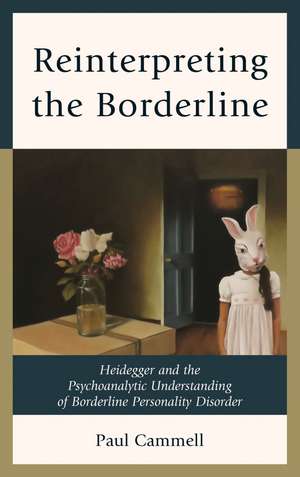
Reinterpreting the Borderline: Heidegger and the Psychoanalytic Understanding of Borderline Personality Disorder: New Imago
Autor Paul Cammellen Limba Engleză Hardback – 30 aug 2016






Preț: 525.61 lei
Preț vechi: 734.43 lei
-28%
Puncte Express: 788
Carte tipărită la comandă
Livrare economică 27 noiembrie-11 decembrie
Livrare prin curier în România Termenul estimat este afișat lângă disponibilitate.
Transport gratuit pentru acest produs Plată online sau ramburs, în funcție de opțiunile comenzii.
Retur gratuit în 14 zile Comandă securizată și suport în română.
Specificații
ISBN-13: 9781442252844
ISBN-10: 1442252847
Pagini: 280
Dimensiuni: 158 x 239 x 23 mm
Greutate: 0.54 kg
Editura: Bloomsbury Publishing
Colecția Rowman & Littlefield
Seria New Imago
Locul publicării:New York, United States
ISBN-10: 1442252847
Pagini: 280
Dimensiuni: 158 x 239 x 23 mm
Greutate: 0.54 kg
Editura: Bloomsbury Publishing
Colecția Rowman & Littlefield
Seria New Imago
Locul publicării:New York, United States
V-ar putea interesa
-
 Preț: 377.64 lei
 -
 InfluenceRobert CialdiniPreț: 374.96 lei
 -
 Research Methods and StatisticsIan Walker-12%Preț: 137.94 lei155.99 lei
 -
 -30%Preț: 494.49 lei703.43 lei
 -
 Qualitative Research Methods in PsychologyNollaig FrostPreț: 304.81 lei
 -
 EnoughJohn Naish-27%Preț: 67.34 lei92.02 lei
 -
 -15%Preț: 456.37 lei536.90 lei
 -
 -5%Preț: 734.59 lei773.25 lei
 -
 Essentials of Myers-Briggs Type Indicator AssessmentNaomi L QuenkPreț: 351.84 lei
 -
 -5%Preț: 725.30 lei763.47 lei
 -
 -5%Preț: 442.15 lei465.41 lei
Descriere
Reinterpreting the Borderline is a timely and comprehensive analysis of Heidegger's philosophy and its relevance to the clinical fields of psychiatry, psychotherapy, and psychoanalysis. Cammell presents the key elements of Heidegger's philosophy and further explores affiliations with other key philosophers influenced by Heidegger. By applying these philosophical ideas to developmental models and clinical treatments of borderline personality disorder, Cammell develops a system of ideas he terms "hermeneutic ontology," exploring the fundamentally relational, embodied, affective, temporal, and technical aspects of existence that become problematized in the experience of "the borderline"--both for the suffering individual and the concerned clinician. Cammell posits that "borderline experience" extends beyond the suffering individual to the context of the psychotherapy itself, something in which the therapist and suffering individual must collaborate to overcome. Reinterpreting the Borderline provides a rich and complex study toward simultaneously overcoming the divide between theory and practice, philosophy and psychotherapy, and finally the borderline between suffering individuals and their concerned clinicians.