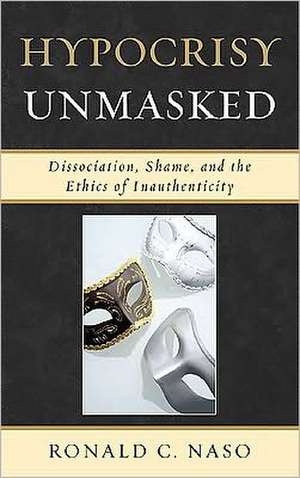
Hypocrisy Unmasked: New Imago
Autor Ronald C. Nasoen Limba Engleză Hardback – 18 mar 2010









Preț: 609.76 lei
Preț vechi: 913.23 lei
-33%
Puncte Express: 915
Carte tipărită la comandă
Livrare economică 27 noiembrie-11 decembrie
Livrare prin curier în România Termenul estimat este afișat lângă disponibilitate.
Transport gratuit pentru acest produs Plată online sau ramburs, în funcție de opțiunile comenzii.
Retur gratuit în 14 zile Comandă securizată și suport în română.
Specificații
ISBN-13: 9780765706775
ISBN-10: 0765706776
Pagini: 236
Dimensiuni: 157 x 235 x 19 mm
Greutate: 0.54 kg
Editura: JASON ARONSON INC
Colecția New Imago
Seria New Imago
Locul publicării:New York, United States
ISBN-10: 0765706776
Pagini: 236
Dimensiuni: 157 x 235 x 19 mm
Greutate: 0.54 kg
Editura: JASON ARONSON INC
Colecția New Imago
Seria New Imago
Locul publicării:New York, United States
Cuprins
Part 1 Preface
Part 2 Introduction
Part 3 Part I: Topographies of Transgression
Chapter 4 Chapter 1: The Paradox of Hypocrisy
Chapter 5 Chapter 2: The Call of Conscience
Chapter 6 Chapter 3: Perversion and Moral Reckoning
Part 7 Part II: The Ethics of Inauthenticity
Chapter 8 Chapter 4: Compromises of Integrity
Chapter 9 Chapter 5: Beneath the Mask
Chapter 10 Chapter 6: Youthful Indiscretions
Part 11 Part III: From Hypocrisy to Moral Ambiguity
Chapter 12 Chapter 7: Dissociation as Self-Deception
Chapter 13 Chapter 8: Multiplicity and Moral Ambiguity
Chapter 14 Conclusion
Part 15 Bibliography
Part 2 Introduction
Part 3 Part I: Topographies of Transgression
Chapter 4 Chapter 1: The Paradox of Hypocrisy
Chapter 5 Chapter 2: The Call of Conscience
Chapter 6 Chapter 3: Perversion and Moral Reckoning
Part 7 Part II: The Ethics of Inauthenticity
Chapter 8 Chapter 4: Compromises of Integrity
Chapter 9 Chapter 5: Beneath the Mask
Chapter 10 Chapter 6: Youthful Indiscretions
Part 11 Part III: From Hypocrisy to Moral Ambiguity
Chapter 12 Chapter 7: Dissociation as Self-Deception
Chapter 13 Chapter 8: Multiplicity and Moral Ambiguity
Chapter 14 Conclusion
Part 15 Bibliography
Recenzii
Through striking clinical examples and painstaking analysis, Naso documents hypocrisy's emergence as a form of compromise against the backdrop of ambiguity and moral dissonance that virtually defines postmodern sensibility. Masterfully exposing the vital pull of the field without negating individual agency, he nests hypocrisy in a search for attunement that goes far in explaining its ubiquity in human affairs and its enactment in the consulting room by client and therapist alike. Hypocrisy Unmasked illuminates the intersection of two-person psychology and contemporary ethics in ways that will enhance our capacity to negotiate moral uncertainty, both in our patients and ourselves.
Dr. Ron Naso presents us with an intriguing and highly original exploration of the phenomenon of hypocrisy. A psychoanalytically oriented psychologist, Naso asks us to consider hypocrisy without 'collapsing' it into psychopathology. He draws on psychoanalytic and philosophical texts to explore the sources of hypocrisy in dissociative mechanisms which function to avoid shame at the expense of morality.
Rather than succumb to the accepted yet simplistically negative definition of hypocrisy, Dr. Naso has unmasked the intricacies of purpose and context, then reformulated this designation in the best postmodern tradition. The result of his efforts is a stunning book demonstrating originality, creativity, nuance, and keen scholarship. This book makes a significant and welcome contribution to the discussion of shame and dissociation for both clinicians and academics.
Dr. Ron Naso presents us with an intriguing and highly original exploration of the phenomenon of hypocrisy. A psychoanalytically oriented psychologist, Naso asks us to consider hypocrisy without 'collapsing' it into psychopathology. He draws on psychoanalytic and philosophical texts to explore the sources of hypocrisy in dissociative mechanisms which function to avoid shame at the expense of morality.
Rather than succumb to the accepted yet simplistically negative definition of hypocrisy, Dr. Naso has unmasked the intricacies of purpose and context, then reformulated this designation in the best postmodern tradition. The result of his efforts is a stunning book demonstrating originality, creativity, nuance, and keen scholarship. This book makes a significant and welcome contribution to the discussion of shame and dissociation for both clinicians and academics.