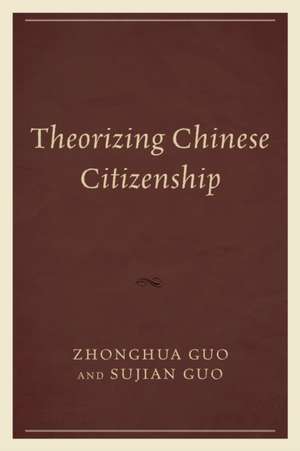
Theorizing Chinese Citizenship: Challenges Facing Chinese Political Development
Editat de Zhonghua Guo, Sujian Guo Contribuţii de Bing Guan, Taihui Guo, Malgorzata Jakimów, Thomas Janoski, Kerry Kennedy, Hui Li, Samantha A. Vortherms, Canglong Wang, Ying Xia, Bin Xiao, Yihan Xiong, Yi Lin, Zhenzhou Zhaoen Limba Engleză Hardback – 8 oct 2015
Din seria Challenges Facing Chinese Political Development
- 35%
 Preț: 575.11 lei
 - 34%
 Preț: 617.43 lei
 - 24%
 Preț: 321.47 lei
 - 30%
 Preț: 328.84 lei
 - 30%
 Preț: 327.23 lei
 - 30%
 Preț: 328.93 lei
 - 24%
 Preț: 322.08 lei
 - 36%
 Preț: 708.77 lei
 - 35%
 Preț: 603.83 lei
 - 35%
 Preț: 603.88 lei
 - 35%
 Preț: 576.37 lei
 - 36%
 Preț: 709.80 lei
 - 35%
 Preț: 604.34 lei
 - 35%
 Preț: 604.14 lei
 - 35%
 Preț: 603.37 lei
 - 34%
 Preț: 678.04 lei
 - 34%
 Preț: 675.87 lei
 - 38%
 Preț: 695.83 lei
 - 30%
 Preț: 328.50 lei
 - 35%
 Preț: 573.07 lei
 - 36%
 Preț: 566.87 lei
 - 36%
 Preț: 566.59 lei
 - 35%
 Preț: 604.16 lei
 - 35%
 Preț: 603.58 lei
 - 30%
 Preț: 327.03 lei
 - 34%
 Preț: 609.82 lei
 - 35%
 Preț: 667.10 lei
 - 34%
 Preț: 555.39 lei
 - 34%
 Preț: 671.26 lei
 - 33%
 Preț: 590.71 lei
Preț: 628.06 lei
Preț vechi: 1020.99 lei
-38%
Puncte Express: 942
Carte tipărită la comandă
Livrare economică 08-22 iunie
Specificații
ISBN-13: 9781498516693
ISBN-10: 1498516696
Pagini: 258
Ilustrații: 3 b/w illustrations; 17 tables
Dimensiuni: 159 x 236 x 24 mm
Greutate: 0.48 kg
Editura: Bloomsbury Publishing
Colecția Lexington Books
Seria Challenges Facing Chinese Political Development
Locul publicării:New York, United States
ISBN-10: 1498516696
Pagini: 258
Ilustrații: 3 b/w illustrations; 17 tables
Dimensiuni: 159 x 236 x 24 mm
Greutate: 0.48 kg
Editura: Bloomsbury Publishing
Colecția Lexington Books
Seria Challenges Facing Chinese Political Development
Locul publicării:New York, United States
V-ar putea interesa
-
 -15%Preț: 199.77 lei234.82 lei
 -
 -13%Preț: 301.62 lei345.02 lei
 -
 Citizenship and the EnvironmentAndrew Dobson-11%Preț: 509.28 lei572.23 lei
 -
 CoveringKenji YoshinoPreț: 97.36 lei
 -
 The Riddle of Gender: Science, Activism, and Transgender RightsDeborah RudacillePreț: 114.97 lei
 -
 OCR A Level History A2: Civil Rights in the USA 1865-1992David PatersonPreț: 257.56 lei
 -
 Freedom's DaughtersLynne OlsonPreț: 121.26 lei
 -
 Americanizing the WestFrank Van NuysPreț: 457.38 lei
 -
 To the Flag: The Unlikely History of the Pledge of AllegianceRichard J. EllisPreț: 287.63 lei
 -
 NationalismPhilip Spencer-15%Preț: 502.69 lei591.40 lei
 -
 Preț: 389.19 lei
 -
 Preț: 196.85 lei
 -
 The Politics of BelongingNira Yuval-DavisPreț: 470.65 lei
 -
 -28%Preț: 206.19 lei285.16 lei
Cuprins
Part 1: Imagining Chinese Citizenship
Chapter 1: The Emergence of Citizen Concept in Modern China: 1899-1919, Zhonghua Guo
Chapter 2: Citizenship in China: A Comparison of Rights with the East and West, Thomas Janoski
Chapter 3: Confucianism and Citizenship: A Review of Opposing Conceptualizaions, Canglong Wang
Part 2: Citizenship of Chinese Migrant Workers
Chapter 4: Localized Citizenships: Household Registration as an Internal Citizenship Institution, Samantha Vortherms
Chapter 5: Understanding Citizenship Beyond the Hukou System: The Role of Migrant worker NGOs in Transformation of Citizenship in China, Malgorzata Jakimow
Chapter 6: Rights in Action: The Impact of Chinese Migrant Workers' Resistances on Citizenship Rights, Taihui Guo
Part 3: Citizenship of the Chinese Middle Class
Chapter 7: Self-empowerment and Public Participation: How does a Middle-class Oriented Group Influence Local Government Decision-making in Urban China, Yihan Xiong
Chapter 8: The Politics of Citizenship Formation: Homeowners' Collective Action in Urban Beijing, Ying Xia and Bing Guan
Part 4: Chinese Citizenship Education
Chapter 9: Theorizing Citizenship as Discursive Practice: Chinese Students Talk about Citizenship, Kerry Kennedy, Hui Li, and Zhenzhou Zhao
Chapter 10: Modernity, Mobility, and Dilemma: The Making of Tibetan Cultural Citizenship through an English Training Program, Yi Lin
Chapter 1: The Emergence of Citizen Concept in Modern China: 1899-1919, Zhonghua Guo
Chapter 2: Citizenship in China: A Comparison of Rights with the East and West, Thomas Janoski
Chapter 3: Confucianism and Citizenship: A Review of Opposing Conceptualizaions, Canglong Wang
Part 2: Citizenship of Chinese Migrant Workers
Chapter 4: Localized Citizenships: Household Registration as an Internal Citizenship Institution, Samantha Vortherms
Chapter 5: Understanding Citizenship Beyond the Hukou System: The Role of Migrant worker NGOs in Transformation of Citizenship in China, Malgorzata Jakimow
Chapter 6: Rights in Action: The Impact of Chinese Migrant Workers' Resistances on Citizenship Rights, Taihui Guo
Part 3: Citizenship of the Chinese Middle Class
Chapter 7: Self-empowerment and Public Participation: How does a Middle-class Oriented Group Influence Local Government Decision-making in Urban China, Yihan Xiong
Chapter 8: The Politics of Citizenship Formation: Homeowners' Collective Action in Urban Beijing, Ying Xia and Bing Guan
Part 4: Chinese Citizenship Education
Chapter 9: Theorizing Citizenship as Discursive Practice: Chinese Students Talk about Citizenship, Kerry Kennedy, Hui Li, and Zhenzhou Zhao
Chapter 10: Modernity, Mobility, and Dilemma: The Making of Tibetan Cultural Citizenship through an English Training Program, Yi Lin
Recenzii
It would be easy for those not intimately acquainted with China to assume that the idea of citizenship is irrelevant. This lively and theoretically innovative collection of essays proves otherwise. It is an important read not only for students of Chinese politics and society, but also for those interested in the state-society relations of non-democratic countries more broadly.. In sum, this book contributes to a variety of ongoing debates in the field of Chinese studies, citizenship studies and political sociology.[I]t is a rich collection of materials and perspectives on the ways in which individuals and groups interact with the authorities in contemporary China.
Theorizing Chinese Citizenship is an eye-opener for those who still believe that citizenship is an exclusively western concept. This collection provides insights into the origins of Chinese ideas about citizenship and their relation with Confucianism, the current stratification of rights, citizenship practices among workers and middle classes, and citizenship consciousness among students and ethnic minorities. A must-read book for all who are interested in the potential and constraints for a democratic transformation of Chinese society.
This book is a fascinating contribution to citizenship studies. Its originality is to provide alternative accounts of the origins and development of modern Chinese citizenship and its contemporary meanings and functions. It eschews, on the one hand, Euro-American-centric perspectives that see citizenship in China as a derivative institution, and, on the other hand, essentialist accounts that see Chinese citizenship as a pure expression of ostensibly Asian values. Instead, the book provides lively analyses of modern Chinese citizenship as a struggle over obligations and for civil, political, and social rights.
In what sense can 'citizenship' be said to exist in contemporary Chinese society? What challenges face the further development of citizenship in China? The contributions in this book offer significant new theoretical and empirical studies of these important problems. The strong theoretical chapters which open the book provide new insights into the modern history, comparative sociology, and ideational structures of citizenship in China, while the bulk of the more empirically-oriented chapters which follow weave theoretical themes in interesting studies of citizenship-related identities and rights, problems and actions in the key areas of the lives of migrant workers, the emergence of a new urban middle class, and developments in education. This book succeeds in making a persuasive case for the value of a 'citizenship studies' framework for understanding social and political change in contemporary China.
Theorizing Chinese Citizenship is an eye-opener for those who still believe that citizenship is an exclusively western concept. This collection provides insights into the origins of Chinese ideas about citizenship and their relation with Confucianism, the current stratification of rights, citizenship practices among workers and middle classes, and citizenship consciousness among students and ethnic minorities. A must-read book for all who are interested in the potential and constraints for a democratic transformation of Chinese society.
This book is a fascinating contribution to citizenship studies. Its originality is to provide alternative accounts of the origins and development of modern Chinese citizenship and its contemporary meanings and functions. It eschews, on the one hand, Euro-American-centric perspectives that see citizenship in China as a derivative institution, and, on the other hand, essentialist accounts that see Chinese citizenship as a pure expression of ostensibly Asian values. Instead, the book provides lively analyses of modern Chinese citizenship as a struggle over obligations and for civil, political, and social rights.
In what sense can 'citizenship' be said to exist in contemporary Chinese society? What challenges face the further development of citizenship in China? The contributions in this book offer significant new theoretical and empirical studies of these important problems. The strong theoretical chapters which open the book provide new insights into the modern history, comparative sociology, and ideational structures of citizenship in China, while the bulk of the more empirically-oriented chapters which follow weave theoretical themes in interesting studies of citizenship-related identities and rights, problems and actions in the key areas of the lives of migrant workers, the emergence of a new urban middle class, and developments in education. This book succeeds in making a persuasive case for the value of a 'citizenship studies' framework for understanding social and political change in contemporary China.