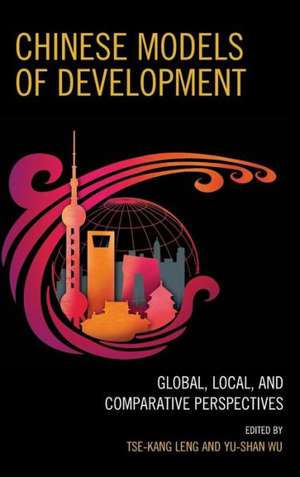
Chinese Models of Development: Global, Local, and Comparative Perspectives: Challenges Facing Chinese Political Development
Editat de Tse-Kang Leng, Yu-Shan Wu Contribuţii de Rumi Aoyama, Yun-han Chu, Szu-chien Hsu, Xiaoming Huang, David C. Kang, Allen C. Lynch, Herman Schwartz, Hans H. Tung, Brantly Womacken Limba Engleză Hardback – 20 noi 2014
Din seria Challenges Facing Chinese Political Development
- 34%
 Preț: 600.41 lei
 - 32%
 Preț: 660.36 lei
 - 23%
 Preț: 337.44 lei
 - 29%
 Preț: 344.70 lei
 - 29%
 Preț: 343.17 lei
 - 30%
 Preț: 328.93 lei
 - 23%
 Preț: 337.85 lei
 - 35%
 Preț: 742.45 lei
 - 33%
 Preț: 648.81 lei
 - 34%
 Preț: 633.75 lei
 - 34%
 Preț: 601.74 lei
 - 35%
 Preț: 744.19 lei
 - 34%
 Preț: 632.87 lei
 - 34%
 Preț: 633.67 lei
 - 34%
 Preț: 632.44 lei
 - 33%
 Preț: 711.29 lei
 - 33%
 Preț: 708.65 lei
 - 29%
 Preț: 345.00 lei
 - 34%
 Preț: 601.30 lei
 - 38%
 Preț: 653.41 lei
 - 35%
 Preț: 594.98 lei
 - 35%
 Preț: 594.56 lei
 - 34%
 Preț: 634.19 lei
 - 34%
 Preț: 633.31 lei
 - 29%
 Preț: 343.17 lei
 - 33%
 Preț: 639.64 lei
 - 34%
 Preț: 699.73 lei
 - 33%
 Preț: 582.81 lei
 - 33%
 Preț: 704.45 lei
 - 31%
 Preț: 638.07 lei
Preț: 730.32 lei
Preț vechi: 1149.25 lei
-36%
Puncte Express: 1095
Carte tipărită la comandă
Livrare economică 08-22 decembrie
Livrare prin curier în România Termenul estimat este afișat lângă disponibilitate.
Transport gratuit pentru acest produs Plată online sau ramburs, în funcție de opțiunile comenzii.
Retur gratuit în 14 zile Comandă securizată și suport în română.
Specificații
ISBN-13: 9780739192269
ISBN-10: 0739192264
Pagini: 320
Ilustrații: 57 Graphs, 12 Tables
Dimensiuni: 162 x 234 x 29 mm
Greutate: 0.62 kg
Editura: Bloomsbury Publishing
Colecția Lexington Books
Seria Challenges Facing Chinese Political Development
Locul publicării:New York, United States
ISBN-10: 0739192264
Pagini: 320
Ilustrații: 57 Graphs, 12 Tables
Dimensiuni: 162 x 234 x 29 mm
Greutate: 0.62 kg
Editura: Bloomsbury Publishing
Colecția Lexington Books
Seria Challenges Facing Chinese Political Development
Locul publicării:New York, United States
V-ar putea interesa
-
 Tibet: Writings on History and PoliticsParshotam MehraPreț: 395.12 lei
 -
 Bodh GayaFrederick AsherPreț: 114.69 lei
 -
 -6%Preț: 353.65 lei378.03 lei
 -
 Liberty or DeathPatrick FrenchPreț: 110.10 lei
 -
 Preț: 325.90 lei
 -
 -25%Preț: 100.88 lei135.01 lei
 -
 -23%Preț: 655.58 lei851.39 lei
 -
 Food and Fantasy in Early Modern JapanEric Rath-23%Preț: 505.33 lei656.28 lei
 -
 Zen at WarBrian Daizen Victoria-20%Preț: 319.18 lei396.68 lei
 -
 -14%Preț: 110.41 lei127.76 lei
 -
 The Spirit of Modern IndiaRobert A McDermottPreț: 215.33 lei
Descriere
Discussion of the "Chinese Model" abounds with the rise of China. This volume analyzes the Chinese case in a theoretical framework, provides an evolutionary perspective, and compares it with other models of development. Instead of focusing on one specific case, the book's contributors shed light on the application of theories of international relations, comparative politics, and development studies to the topic under deliberation. This book reflects that the "uniqueness" of the Chinese model should also be put in an historical and evolutionary context. It also provides insights into comparisons with other models of development, such as the East Asian model and experiences of the former Soviet Union. The authors in the book argue that while globalization constrains state power, it may also open new windows of accommodation and adjustments. Linkages between the domestic dynamics of development and external forces of change become pertinent in understanding the Chinese models of development.
Cuprins
Chapter 1: Sources of Regime Legitimacy and the Debate over the Chinese Model
Yun-han Chu
Chapter 2: All Roads Lead to Rome: Modern Economic Growth and the Chinese Model
Xiaoming Huang
Chapter 3: Comparing Development Models in Mainland China and Taiwan: A Macro Analytical Framework
Yu-Shan Wu
Chapter 4: Political Economies of Reform and Reaction: The Russian & Chinese Cases Compared, 1965-2010
Allen C. Lynch
Chapter 5: The Sino-Vietnamese Model: Path and Future
Brantly Womack
Chapter 6: Local Governance and Cultural Industry in China: The Case of Nanjing
Tse-Kang Leng
Chapter 7: Whither the Local Autonomy under the "China Model"? The Political Economy of China's 2008 Stimulus Package
Szu-chien Hsu and Hans H.Tung
Chapter 8: China's Development Model in Comparative Perspective: Hegemony, Power, and History in International Relations
David C. Kang
Chapter 9: Public Opinion, Nationalism and China's Cooperative International Behavior
Rumi Aoyama
Chapter 10: China and the United States Respond to the Crisis: Cooperation or Conflict?
Herman Schwartz
Yun-han Chu
Chapter 2: All Roads Lead to Rome: Modern Economic Growth and the Chinese Model
Xiaoming Huang
Chapter 3: Comparing Development Models in Mainland China and Taiwan: A Macro Analytical Framework
Yu-Shan Wu
Chapter 4: Political Economies of Reform and Reaction: The Russian & Chinese Cases Compared, 1965-2010
Allen C. Lynch
Chapter 5: The Sino-Vietnamese Model: Path and Future
Brantly Womack
Chapter 6: Local Governance and Cultural Industry in China: The Case of Nanjing
Tse-Kang Leng
Chapter 7: Whither the Local Autonomy under the "China Model"? The Political Economy of China's 2008 Stimulus Package
Szu-chien Hsu and Hans H.Tung
Chapter 8: China's Development Model in Comparative Perspective: Hegemony, Power, and History in International Relations
David C. Kang
Chapter 9: Public Opinion, Nationalism and China's Cooperative International Behavior
Rumi Aoyama
Chapter 10: China and the United States Respond to the Crisis: Cooperation or Conflict?
Herman Schwartz
Recenzii
[T]he essays in this volume provide some fruitful material to contemplate as we think about comparing China to other places or experiences, and what makes China's experience during the post-Mao period unique.
In the light of China's triumphant emergence from the Global Financial Crisis there has been increasing interest in the "Chinese Consensus" or model of development. This collection provides a multifaceted analysis of China's models of development, both national and local, political and economic, from both comparative and international perspectives--a most timely and interesting overview of China's constantly evolving developmental path.
The outstanding scholarly analyses in this volume place the Chinese model of economic and political development in a valuable comparative perspective. The contributors compare the experience of post-Mao China with the paths of development taken earlier under the leadership of Sun Yat-sen, Chiang Kai-shek, and Mao Zedong, as well as with those subsequently adopted in Taiwan, Russia, and Vietnam. Suggesting that 'Mainland China has now walked into Taiwan's past,' the editors ask whether it will follow Taiwan in evolving into a market democracy or whether it will retain its statist and authoritarian features. Either way, they argue that the success and failures of the Chinese experience will have a significant influence on the development strategies of other emerging economies
Placing the Chinese model in a historical, evolutionary, and comparative context, this collection of chapters by noted scholars of Chinese and East Asian politics makes a major contribution to our understanding of political development of contemporary China. All chapters are clearly written and original, providing many fresh and unique insights into the ongoing China model debate.
In the light of China's triumphant emergence from the Global Financial Crisis there has been increasing interest in the "Chinese Consensus" or model of development. This collection provides a multifaceted analysis of China's models of development, both national and local, political and economic, from both comparative and international perspectives--a most timely and interesting overview of China's constantly evolving developmental path.
The outstanding scholarly analyses in this volume place the Chinese model of economic and political development in a valuable comparative perspective. The contributors compare the experience of post-Mao China with the paths of development taken earlier under the leadership of Sun Yat-sen, Chiang Kai-shek, and Mao Zedong, as well as with those subsequently adopted in Taiwan, Russia, and Vietnam. Suggesting that 'Mainland China has now walked into Taiwan's past,' the editors ask whether it will follow Taiwan in evolving into a market democracy or whether it will retain its statist and authoritarian features. Either way, they argue that the success and failures of the Chinese experience will have a significant influence on the development strategies of other emerging economies
Placing the Chinese model in a historical, evolutionary, and comparative context, this collection of chapters by noted scholars of Chinese and East Asian politics makes a major contribution to our understanding of political development of contemporary China. All chapters are clearly written and original, providing many fresh and unique insights into the ongoing China model debate.