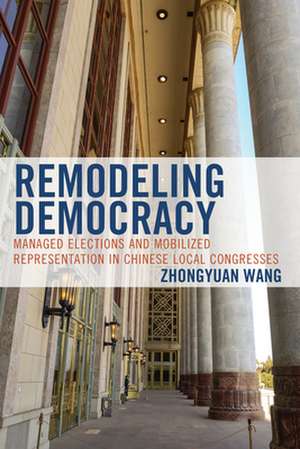
Remodeling Democracy: Managed Elections and Mobilized Representation in Chinese Local Congresses: Challenges Facing Chinese Political Development
Autor Zhongyuan Wangen Limba Engleză Hardback – 6 oct 2020
Din seria Challenges Facing Chinese Political Development
- 34%
 Preț: 600.41 lei
 - 32%
 Preț: 660.36 lei
 - 23%
 Preț: 337.44 lei
 - 29%
 Preț: 344.70 lei
 - 29%
 Preț: 343.17 lei
 - 30%
 Preț: 328.93 lei
 - 23%
 Preț: 337.85 lei
 - 35%
 Preț: 742.45 lei
 - 33%
 Preț: 648.81 lei
 - 34%
 Preț: 633.75 lei
 - 34%
 Preț: 601.74 lei
 - 35%
 Preț: 744.19 lei
 - 34%
 Preț: 632.87 lei
 - 34%
 Preț: 633.67 lei
 - 34%
 Preț: 632.44 lei
 - 33%
 Preț: 711.29 lei
 - 33%
 Preț: 708.65 lei
 - 36%
 Preț: 730.32 lei
 - 29%
 Preț: 345.00 lei
 - 34%
 Preț: 601.30 lei
 - 38%
 Preț: 653.41 lei
 - 35%
 Preț: 594.98 lei
 - 35%
 Preț: 594.56 lei
 - 34%
 Preț: 634.19 lei
 - 34%
 Preț: 633.31 lei
 - 29%
 Preț: 343.17 lei
 - 33%
 Preț: 639.64 lei
 - 33%
 Preț: 582.81 lei
 - 33%
 Preț: 704.45 lei
 - 34%
 Preț: 593.11 lei
Preț: 699.73 lei
Preț vechi: 1055.13 lei
-34%
Puncte Express: 1050
Carte tipărită la comandă
Livrare economică 30 noiembrie-14 decembrie
Livrare prin curier în România Termenul estimat este afișat lângă disponibilitate.
Transport gratuit pentru acest produs Plată online sau ramburs, în funcție de opțiunile comenzii.
Retur gratuit în 14 zile Comandă securizată și suport în română.
Specificații
ISBN-13: 9781793621085
ISBN-10: 179362108X
Pagini: 344
Ilustrații: 17 b/w illustrations;17 tables;
Dimensiuni: 161 x 230 x 32 mm
Greutate: 0.67 kg
Editura: Bloomsbury Publishing
Colecția Lexington Books
Seria Challenges Facing Chinese Political Development
Locul publicării:New York, United States
ISBN-10: 179362108X
Pagini: 344
Ilustrații: 17 b/w illustrations;17 tables;
Dimensiuni: 161 x 230 x 32 mm
Greutate: 0.67 kg
Editura: Bloomsbury Publishing
Colecția Lexington Books
Seria Challenges Facing Chinese Political Development
Locul publicării:New York, United States
Cuprins
Chapter 1: Introduction and Overview
Chapter 2: Research Design and Methodologies
Chapter 3: Institutional Design and Development of Chinese Congress
Chapter 4: Playing by the Rules: How China's Party Regime Manufactures Certainties in Direct Congressional Elections
Chapter 5: Closing the Window of Opportunity: The Party Regime's Adapted Strategies for Managing Independent Candidates
Chapter 6: Engineering Representation:Mobilized Representation in Chinese Local Congresses
Chapter 7: Conditions for Regime Consolidation by Elections
Chapter 8: Conclusion and Looking Forward
Chapter 2: Research Design and Methodologies
Chapter 3: Institutional Design and Development of Chinese Congress
Chapter 4: Playing by the Rules: How China's Party Regime Manufactures Certainties in Direct Congressional Elections
Chapter 5: Closing the Window of Opportunity: The Party Regime's Adapted Strategies for Managing Independent Candidates
Chapter 6: Engineering Representation:Mobilized Representation in Chinese Local Congresses
Chapter 7: Conditions for Regime Consolidation by Elections
Chapter 8: Conclusion and Looking Forward
Recenzii
Legislatures in authoritarian regimes are commonly understood either as a potential means of democratization or as mere window dressing. Zhongyuan Wang's fascinating study of local legislatures in China presents a different argument. Township and county congresses, he suggests, can also play an important role in authoritarian resilience. By managing elections and mobilizing representation, the Chinese Communist party-state leverages legislatures for its own benefit. This is an original and informed study that offers valuable insight on the sources of regime strength in China and other authoritarian regimes.
This is a path-breaking book- and not just for those interested in the politics of the PRC. Wang manages to wrangle out of a comparison between the introduction and conduct of elections in mainland China and Taiwan, a convincing explanation for an enduring puzzle: why do single-party regimes bother to hold elections? And, he adds, what determines their longer-term consequences for their survival or transformation?
Remodeling Democracy is a brilliant and meticulously researched study of how China's local-level democratic institutions negotiate the shrinking gap between genuine political representation and Chinese Communist Party guidance and control. This is a must-read for anyone wishing to understand the realities of China's political system beyond the easy stereotype of illiberal authoritarian rule.
The major findings of this book contribute not only to the understanding of the party-state-society relations in China and its resilience to its political system, but also to politics at the local level and in general. Thus, it is conducive to the understanding of both the field of Chinese politics and the field of comparative politics.
How does representational authoritarianism work in present-day China? How does the Communist Party remold the representation function of local congresses, hence recalibrating the relationship between state and society? To what extent do managed elections and mobilized representation bring about regime legitimacy, and can they serve as an alternative model of representation in contemporary political systems? These are some of the core questions raised in Zhongyuan Wang's thought-provoking new book.
This is a path-breaking book- and not just for those interested in the politics of the PRC. Wang manages to wrangle out of a comparison between the introduction and conduct of elections in mainland China and Taiwan, a convincing explanation for an enduring puzzle: why do single-party regimes bother to hold elections? And, he adds, what determines their longer-term consequences for their survival or transformation?
Remodeling Democracy is a brilliant and meticulously researched study of how China's local-level democratic institutions negotiate the shrinking gap between genuine political representation and Chinese Communist Party guidance and control. This is a must-read for anyone wishing to understand the realities of China's political system beyond the easy stereotype of illiberal authoritarian rule.
The major findings of this book contribute not only to the understanding of the party-state-society relations in China and its resilience to its political system, but also to politics at the local level and in general. Thus, it is conducive to the understanding of both the field of Chinese politics and the field of comparative politics.
How does representational authoritarianism work in present-day China? How does the Communist Party remold the representation function of local congresses, hence recalibrating the relationship between state and society? To what extent do managed elections and mobilized representation bring about regime legitimacy, and can they serve as an alternative model of representation in contemporary political systems? These are some of the core questions raised in Zhongyuan Wang's thought-provoking new book.