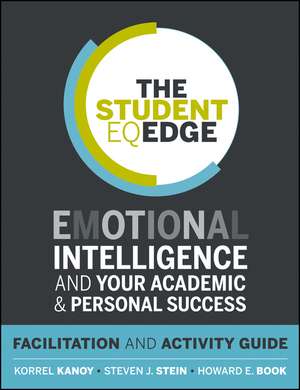
The Student Eq Edge
Autor Korrel Kanoy, Steven J. Stein, Howard E Booken Limba Engleză Paperback – 4 feb 2013
Considerăm că The Student Eq Edge reprezintă o resursă esențială în peisajul academic actual, propunând o abordare aplicată asupra succesului universitar care transcende simpla capacitate intelectuală. Lucrarea se distinge prin faptul că nu tratează inteligența emoțională ca pe un concept abstract, ci ca pe un set de competențe măsurabile și antrenabile, esențiale pentru studenții care se confruntă cu dificultăți în gestionarea timpului, a stresului sau în stabilirea unor relații interpersonale sănătoase. Găsim în această carte o structură riguroasă, ancorată în munca fundamentală a Dr. Reuven Bar-On, care ghidează cititorul prin cele cinci domenii ale inteligenței emoționale: de la conștientizarea de sine și asertivitate, până la empatie, rezolvarea problemelor și controlul impulsurilor. Această ediție subliniază importanța tranziției de la înțelegerea conceptuală la acțiunea concretă, oferind secțiuni de reflecție care transformă lectura într-un proces de autodescoperire. Comparativ cu Emotional Intelligence in Education, care oferă o perspectivă teoretică și instituțională asupra politicilor educaționale, The Student Eq Edge are o abordare mult mai practică și centrată pe experiența individuală a studentului. De asemenea, dacă Emotionally Intelligent Leadership se concentrează pe aplicarea acestor competențe strict în roluri de conducere, lucrarea de față este mai interdisciplinară, fiind relevantă pentru orice student care dorește să își îmbunătățească performanța academică generală și starea de bine. În contextul operei autorului Steven J. Stein, această carte adaptează principiile explorate în The Eq Edge — care viza succesul profesional și personal general — către nevoile specifice ale mediului universitar. Subliniem faptul că autorii reușesc să traducă mecanismele complexe ale psihologiei cognitive într-un limbaj accesibil, oferind un instrumentar necesar pentru a naviga provocările vieții de student.
Preț: 319.55 lei
Carte tipărită la comandă
Livrare economică 01-15 decembrie
Specificații
ISBN-10: 1118094611
Pagini: 320
Dimensiuni: 216 x 280 x 17 mm
Greutate: 0.81 kg
Editura: Wiley
Locul publicării:Hoboken, United States
V-ar putea interesa
-
 Descartes' ErrorAntonio Damasio-19%Preț: 75.95 lei93.46 lei
-
 IfJonathan Evans-33%Preț: 752.82 lei1122.03 lei
-
 Ruling Passions: A Theory of Practical ReasoningSimon Blackburn-13%Preț: 304.98 lei348.74 lei
-
 -27%Preț: 352.74 lei483.96 lei
-
 The g Factor: The Science of Mental AbilityArthur R. Jensen-33%Preț: 580.72 lei863.35 lei
-
 Emotional Intelligence Skills Assessment (EISA) SelfSteven J. SteinPreț: 163.90 lei
-
 The EQ Edge - Emotional Intelligence and Your Success 3eHoward E. BookPreț: 143.22 lei
-
 Preț: 85.07 lei
-
 Body Language for DummiesElizabeth KuhnkePreț: 152.41 lei
-
 Does Your Family Make You Smarter?James R. FlynnPreț: 193.35 lei
-
 Pocket PAL: Emotional IntelligenceSteve Bowkett-42%Preț: 43.37 lei75.18 lei
Public țintă
Primary: College students in cocurricular programs including first–year experience programs, student organizations and associations, and students in paraprofessional roles, such as resident advisors and orientation leaders; students in peer mentoring and peer support programs. Most colleges in the U.S. have a first–year experience program (also known as Freshman Seminar or similar), a student orientation, or mandatory/optional courses on college success strategies for first–year students. There are approximately 11 million full–time college students in the U.S. Secondary: Academic and student affairs faculty, administrators, and counselors at colleges and universities in charge of student recruitment, retention, and residence life. The American College Counseling Association has 1,400 members. Tertiary: High school students/youth market. There are 267,000 K–12 school counselors in the US. Supplementary text adoption potential in psychology and counseling courses.De ce să citești această carte
Recomandăm această carte studenților care doresc să își îmbunătățească nu doar notele, ci și calitatea vieții universitare. Cititorul câștigă strategii concrete pentru gestionarea stresului și a relațiilor sociale, elemente care adesea fac diferența între abandon și succes. Este un ghid practic care transformă inteligența emoțională dintr-un concept teoretic într-un avantaj competitiv real pentru viitoarea carieră.
Despre autor
Steven J. Stein este un expert recunoscut în domeniul inteligenței emoționale, fiind implicat atât în cercetare, cât și în dezvoltarea de instrumente de evaluare psihologică. În colaborare cu MHS, a contribuit la crearea unor sisteme de măsurare a coeficientului emoțional utilizate la nivel global. Experiența sa vastă este reflectată în lucrări precum The EQ Leader și The Eq Edge, unde explorează impactul competențelor emoționale asupra succesului în diverse sfere ale vieții. Prin The Student Eq Edge, Stein își aplică expertiza în contextul educațional, oferind studenților metode validate științific pentru dezvoltarea personală.
Descriere scurtă
This Facilitation and Activity Guide is a companion to the book The Student EQ Edge: Emotional Intelligence and Your Academic and Personal Success . It offers faculty and facilitators a hands-on resource for helping students reach their potential by tapping into the power of emotional intelligence. The Facilitation Guide includes exercises and activities which are designed to help students develop confidence, independence, the ability to set and meet goals, impulse control, social responsibility, problem-solving skills, stress tolerance, and much more--all of which help improve academic success. The Guide also contains a wealth of illustrative case studies, questions for student reflection, movie selections and TV shows that illustrate emotional intelligence, and a self-development plan.
"The single best resource on emotional intelligence in student affairs, The Student EQ Edge: Student Workbook and Facilitation and Activity Guide are well organized, creative, and offer everything an emotional intelligence facilitator would need in a fast-paced student affairs environment. The examples are soundly constructed and resonate with students. These materials are my go-to resources."--Candice Johnston, associate director of student leadership and organizations, Wake Forest University"If I were building a new course to improve student success, it would be founded on emotional intelligence. All the instruction in the world on 'study skills' cannot touch the advantages that come to students who are able to manage their emotional intelligence. And the best news of all is that these skills can be taught. EQ skills make the difference." --Randy L. Swing, executive director, Association for Institutional Research
"This Facilitation and Activity Guide is particularly useful, offering options from which the facilitator can draw in preparing assignments or learning community meetings. The focus on learners' needs, and particularly an authentic exploration of self and purpose, is practical yet has the potential to draw students to a deeper understanding of self that will draw them to high performance and contribution to others."--Dennis Roberts, assistant vice president for faculty and student services for the Qatar Foundation
Notă biografică
Descriere
Cuprins
Preface ix
About the Authors xi
1 Introduction to Emotional Intelligence 1
Emotional Intelligence Overview 2
A Word About EI Scales and Skills 4
The Student EQ Edge: Student Workbook: An Overview 4
Why Reflection? 5
2 Case Studies of Emotionally Intelligent (and Not Emotionally Intelligent!) Behavior 7
Case Study #1: Why Can't I Make an A? 7
Case Study #2: 15 Years to Graduate 8
Case Study #3: But I'm Good! 10
Case Study #4: Starting College 11
Case Study #5: Shared Responsibilities 12
Case Study #6: A Costly Decision 13
Case Study #7: First Job Jitters 14
Case Study #8: No Way 15
Case Study #9: Twins? 17
3 Emotional Self-Awareness 19
Worksheet 3.1: Feelings Journal 21
Worksheet 3.2: Hot Buttons 22
Worksheet 3.3: ABCDE Exercise-Th e Impact of Th oughts on
Emotions and Behaviors 24
Worksheet 3.4: Hot Buttons on Reality TV 26
Worksheet 3.5: Positive and Negative Aff ect 27
Worksheet 3.6: Self-Development Plan for Emotional Self-Awareness 28
4 Self-Regard 29
Worksheet 4.1: Who Am I? 31
Worksheet 4.2: Locus of Control Scale (Rotter, 1966) 32
Worksheet 4.3: Positive and Negative Self-Talk 35
Worksheet 4.4: 3600 Feedback 36
Worksheet 4.5: Modern Family 37
Worksheet 4.6: Self-Development Plan for Self-Regard 38
5 Self-Actualization 39
Worksheet 5.1: Who Am I? 41
Worksheet 5.2: Emotions Meter 42
Worksheet 5.3: Quotes, Sayings, and Songs-A Window into You! 43
Worksheet 5.4: Defi ning Your Personal Mission Statement 44
Worksheet 5.5: Th e Amazing Race 45
Worksheet 5.6: Self-Development Plan for Self-Actualization 46
6 Emotional Expression 47
Worksheet 6.1: Observing Emotions 50
Worksheet 6.2: Observing Your Emotions 51
Worksheet 6.3: Follow the Leader 53
Worksheet 6.4: "I" Messages 57
Worksheet 6.5: TV Emotions 60
Worksheet 6.6: Self-Development Plan for Emotional Expression 62
7 Independence 63
Worksheet 7.1: Private Eye 66
Worksheet 7.2: By Yourself 69
Worksheet 7.3: Please Do Th is for Me! 70
Worksheet 7.4: Reality TV-Too Needy, Too Alone, or Just Right? 71
Worksheet 7.5: On My Own 72
Worksheet 7.6: Self-Development Plan for Independence 74
8 Assertiveness 75
Worksheet 8.1: Assertive, Aggressive, or Passive? 78
Worksheet 8.2: It Seems So Easy When Others Do It 80
Worksheet 8.3: Giving Feedback 81
Worksheet 8.4: Controversial Issues 83
Worksheet 8.5: Assertiveness Quiz 84
Worksheet 8.6: Self-Development Plan for Assertiveness 86
9 Interpersonal Relationship 87
Worksheet 9.1: My Favorite Person 90
Worksheet 9.2: Sharing Secrets 92
Worksheet 9.3: Scaling the Intimacy Wall 93
Worksheet 9.4: Beginning a Relationship 94
Worksheet 9.5: Getting Closer 95
Worksheet 9.6: Self-Development Plan for Interpersonal Relationship 96
10 Empathy 97
Worksheet 10.1: What Is Empathy? 99
Worksheet 10.2: Th e Art of Questions 100
Worksheet 10.3: Refl ective Listening 102
Worksheet 10.4: Empathy Assessment 103
Worksheet 10.5: Listening Even When It's Hard to Do! 106
Worksheet 10.6: Self-Development Plan for Empathy 108
11 Social Responsibility 109
Worksheet 11.1: Doing What's Right 112
Worksheet 11.2: Cooperation 114
Worksheet 11.3: A Company's Social Responsibility Policy 115
Worksheet 11.4: My Social Responsibility Policy 116
Worksheet 11.5: Take Action! 117
Worksheet 11.6: Self-Development Plan for Social Responsibility 118
12 Reality Testing 119
Worksheet 12.1: My Big Decision 122
Worksheet 12.2: Th e Mirrors Around You 124
Worksheet 12.3: Failed Reality Testing 126
Worksheet 12.4: Decision-Making Interviews 127
Worksheet 12.5: Reality-Testing Scenarios 128
Worksheet 12.6: Self-Development Plan for Reality Testing 130
13 Problem Solving 131
Worksheet 13.1: What Is My Emotion? 134
Worksheet 13.2: Failed Decisions Revisited 136
Worksheet 13.3: Solving Your Problems 137
Worksheet 13.4: But Can I Really Change My Emotion? 139
Worksheet 13.5: One Fine Day 140
Worksheet 13.6: Self-Development Plan for Problem Solving 141
14 Impulse Control 143
Worksheet 14.1: Marshmallow Cravings 146
Worksheet 14.2: But I Want . . . 147
Worksheet 14.3: Survivor 148
Worksheet 14.4: No Regrets? 149
Worksheet 14.5: Strategies for Success 150
Worksheet 14.6: Self-Development Plan for Impulse Control 151
15 Flexibility 153
Worksheet 15.1: Refl ections About Change 156
Worksheet 15.2: Flexibility Survey 157
Worksheet 15.3: Th e Price of Infl exibility 159
Worksheet 15.4: Stretching Yourself 161
Worksheet 15.5: Flexibility Forecasting 162
Worksheet 15.6: Self-Development Plan for Flexibility 164
16 Stress Tolerance 165
Worksheet 16.1: Identifying Your Stressors 168
Worksheet 16.2: Understanding Why You Get Stressed 169
Worksheet 16.3: Irrational Th inking and Stress 170
Worksheet 16.4: Resources for Coping 172
Worksheet 16.5: Stress Busters 173
Worksheet 16.6: Self-Development Plan for Stress Tolerance 174
17 Optimism 175
Worksheet 17.1: Optimism Begins with Framing 179
Worksheet 17.2: De-motivators-Watch Your Self-Talk 180
Worksheet 17.3: Assessing Your Optimism 182
Worksheet 17.4: Pep Talks and Persistence 184
Worksheet 17.5: Perseverance Defi ned 186
Worksheet 17.6: Self-Development Plan for Optimism 187
18 Happiness 189
Worksheet 18.1: Taking Stock of Your Happiness Level 192
Worksheet 18.2: Laugh a Little, Laugh a Lot 193
Worksheet 18.3: Does Money Buy Happiness? 194
Worksheet 18.4: Well-Being Indicators 195
Worksheet 18.5: Th e Pursuit of Happyness 197
Worksheet 18.6: One Commitment-Self-Development Plan for Happiness 198
References 199
Appendix A KISS Strategies for Improving Emotional Intelligence 201
Appendix B Movie Selections for Learning About Emotional Intelligence 213