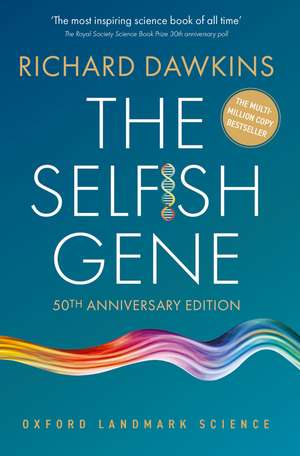
The Selfish Gene: 50th Anniversary Edition: Oxford Landmark Science
Autor Richard Dawkinsen Limba Engleză Paperback – iun 2026
Din seria Oxford Landmark Science
- 18%
 Preț: 70.52 lei
 - 19%
 Preț: 74.58 lei
 - 15%
 Preț: 87.52 lei
 - 13%
 Preț: 92.63 lei
 - 18%
 Preț: 77.30 lei
 - 16%
 Preț: 86.19 lei
 - 18%
 Preț: 76.82 lei
 - 16%
 Preț: 86.74 lei
 - 19%
 Preț: 74.54 lei
 - 19%
 Preț: 68.84 lei
 - 19%
 Preț: 74.95 lei
 - 19%
 Preț: 75.26 lei
 - 15%
 Preț: 95.14 lei
 - 15%
 Preț: 101.48 lei
 - 19%
 Preț: 68.69 lei
 - 17%
 Preț: 90.79 lei
 - 18%
 Preț: 76.53 lei
 - 23%
 Preț: 76.88 lei
Preț: 81.34 lei
Preț vechi: 96.14 lei
-15%
Puncte Express: 122
Carte disponibilă
Livrare economică 13-24 noiembrie
Livrare express 30 octombrie-05 noiembrie pentru 46.47 lei
Livrare prin curier în România Termenul estimat este afișat lângă disponibilitate.
Transport gratuit de la 400.00 lei Plată online sau ramburs, în funcție de opțiunile comenzii.
Retur gratuit în 14 zile Comandă securizată și suport în română.
Specificații
ISBN-13: 9780198985389
ISBN-10: 019898538X
Pagini: 544
Ilustrații: 9 black and white images
Dimensiuni: 130 x 195 x 40 mm
Greutate: 0.47 kg
Ediția:5th edition
Editura: OUP OXFORD
Colecția OUP Oxford
Seria Oxford Landmark Science
Locul publicării:Oxford, United Kingdom
ISBN-10: 019898538X
Pagini: 544
Ilustrații: 9 black and white images
Dimensiuni: 130 x 195 x 40 mm
Greutate: 0.47 kg
Ediția:5th edition
Editura: OUP OXFORD
Colecția OUP Oxford
Seria Oxford Landmark Science
Locul publicării:Oxford, United Kingdom
V-ar putea interesa
-
 XNORTHANGER ABBEY_CLASSICS PBJane AustenPreț: 28.01 lei
 -
 The AwakeningKate ChopinPreț: 28.01 lei
 -
 Tales of Mystery and ImaginationEdgar Allan PoePreț: 28.01 lei
 -
 Preț: 67.84 lei
 -
 Thinking, Fast and SlowDaniel Kahneman-27%Preț: 90.79 lei123.57 leiRecomandat
 -
 The Fall of the House of Usher and Other WritingsEdgar Allan Poe-22%Preț: 63.19 lei81.25 lei
 -
 Misbehaving : The Making of Behavioral EconomicsRichard H. ThalerPreț: 124.22 lei
 -
 Panzer CommanderHans Von LuckPreț: 57.69 lei
 -
 Preț: 151.33 lei
 -
 Excel 2016 BibleJohn Walkenbach-20%Preț: 294.59 lei368.24 lei
 -
 My Brilliant FriendElena FerrantePreț: 108.16 lei
 -
 Rich Dad's Increase your financial IQRobert KiyosakiPreț: 47.29 lei
 -
 -29%Preț: 62.36 lei88.22 lei
 -
 Homo Deus: A Brief History of TomorrowYuval Noah Harari-16%Preț: 80.85 lei96.07 lei
 -
 Why Him? Why Her?Helen FisherPreț: 79.95 lei
 -
 Think and Grow Rich - Original EditionNapoleon HillPreț: 67.92 lei
 -
 The Richest Man in Babylon - Original EditionGeorge S. ClasonPreț: 47.36 lei
Recenzii
Dawkins's prose is lucid and powerful, his argument difficult to contend ... The Selfish Gene has attained its own literary and scientific immortality: as long as we study life, it will be read.
highly readable and entertaining ... exhilarating gene's-eye-view of life
Books about science tend to fall into two categories: those that explain it to lay people in the hope of cultivating a wide readership, and those that try to persuade fellow scientists to support a new theory, usually with equations. Books that achieve both changing science and reaching the public are rare. Charles Darwin's On the Origin of Species (1859) was one. The Selfish Gene by Richard Dawkins is another. From the moment of its publication 40 years ago, it has been a sparkling best-seller and a scientific game-changer
Richard Dawkins' magnificent introduction to the world of popular science writing ... Punchy, elegant, self-righteous, devotional (at least in a Darwinian way), it showed that genetics was absorbing, challenging and important
A genuine cultural landmark of our time.
This book should be read, can be read, by almost everyone. It describes with great skill a new face of the theory of evolution.
Learned, witty, and very well written ... exhilaratingly good.
The sort of popular science writing that makes the reader feel like a genius.
The elegantly written The Selfish Gene has inspired multiple generations, explaining and embellishing the most beautiful idea of biology.
Richard Dawkins has an exceptional gift, not just to explain clearly but to bring out the marvel of the evolutionary process.
Richard Dawkins's clear exposition and sparkling prose destined The Selfish Gene to be a classic when it came out fifty years ago. Many of its terms made it into our cultural vocabulary, and it allowed millions to understand the details of how evolution works and gives rise to the amazing diversity of life. Fifty years on, this updated edition is welcome not only to discuss new developments and ideas, but as an antidote to many of the misconceptions about evolution that still persist. It will be welcomed by generations both old and new.
The Selfish Gene is as vivid, gripping, and relevant today as it was fifty years ago. Read it if you want to understand how evolution works.
The Selfish Gene stands as one of the best nonfiction books of the two centuries it straddles. Fifty years later, this masterpiece deserves new readers and old re-readers. It is lucid, witty, and stylish, and its ideas, though superficially familiar, are subtle and profound.
For fifty years, Dawkins has been the modern-day voice of Darwin, and The Selfish Gene will continue to play this role, educating and entertaining a wide readership about the powerful theory of evolution, as an explanation of the natural world, including ourselves.
You won't find a better explanation of the logic of natural selection than The Selfish Gene.
Dawkins's Selfish Gene variously startled, confronted, and sometimes disquieted its first readers, but in doing so educated them all, and has continued to educate readers to this day-not just in the science it explains with such elegance and clarity, but in the important philosophical implications that follow from it. It is a classic and should be required reading everywhere.
[O]ne of the most thrilling popular books on evolution ever written.
[The Selfish Gene] is one of the greatest popular science books. And where most scientists live to see their work superseded, The Selfish Gene has endured.
The Selfish Gene has gained a reach few scientific works have managed. Returning to it today, one has the sense that more than biology is at stake in Dawkins' writing - that the theory of evolution carries deep existential implications... The Selfish Gene remains essential reading.
The Selfish Gene is a book to read on paper, with a pencil or, better yet, a ballpoint pen in your hand for scribbling in the margins. It demands engagement in a way that few others can. It has an enormous amount to teach.
highly readable and entertaining ... exhilarating gene's-eye-view of life
Books about science tend to fall into two categories: those that explain it to lay people in the hope of cultivating a wide readership, and those that try to persuade fellow scientists to support a new theory, usually with equations. Books that achieve both changing science and reaching the public are rare. Charles Darwin's On the Origin of Species (1859) was one. The Selfish Gene by Richard Dawkins is another. From the moment of its publication 40 years ago, it has been a sparkling best-seller and a scientific game-changer
Richard Dawkins' magnificent introduction to the world of popular science writing ... Punchy, elegant, self-righteous, devotional (at least in a Darwinian way), it showed that genetics was absorbing, challenging and important
A genuine cultural landmark of our time.
This book should be read, can be read, by almost everyone. It describes with great skill a new face of the theory of evolution.
Learned, witty, and very well written ... exhilaratingly good.
The sort of popular science writing that makes the reader feel like a genius.
The elegantly written The Selfish Gene has inspired multiple generations, explaining and embellishing the most beautiful idea of biology.
Richard Dawkins has an exceptional gift, not just to explain clearly but to bring out the marvel of the evolutionary process.
Richard Dawkins's clear exposition and sparkling prose destined The Selfish Gene to be a classic when it came out fifty years ago. Many of its terms made it into our cultural vocabulary, and it allowed millions to understand the details of how evolution works and gives rise to the amazing diversity of life. Fifty years on, this updated edition is welcome not only to discuss new developments and ideas, but as an antidote to many of the misconceptions about evolution that still persist. It will be welcomed by generations both old and new.
The Selfish Gene is as vivid, gripping, and relevant today as it was fifty years ago. Read it if you want to understand how evolution works.
The Selfish Gene stands as one of the best nonfiction books of the two centuries it straddles. Fifty years later, this masterpiece deserves new readers and old re-readers. It is lucid, witty, and stylish, and its ideas, though superficially familiar, are subtle and profound.
For fifty years, Dawkins has been the modern-day voice of Darwin, and The Selfish Gene will continue to play this role, educating and entertaining a wide readership about the powerful theory of evolution, as an explanation of the natural world, including ourselves.
You won't find a better explanation of the logic of natural selection than The Selfish Gene.
Dawkins's Selfish Gene variously startled, confronted, and sometimes disquieted its first readers, but in doing so educated them all, and has continued to educate readers to this day-not just in the science it explains with such elegance and clarity, but in the important philosophical implications that follow from it. It is a classic and should be required reading everywhere.
[O]ne of the most thrilling popular books on evolution ever written.
[The Selfish Gene] is one of the greatest popular science books. And where most scientists live to see their work superseded, The Selfish Gene has endured.
The Selfish Gene has gained a reach few scientific works have managed. Returning to it today, one has the sense that more than biology is at stake in Dawkins' writing - that the theory of evolution carries deep existential implications... The Selfish Gene remains essential reading.
The Selfish Gene is a book to read on paper, with a pencil or, better yet, a ballpoint pen in your hand for scribbling in the margins. It demands engagement in a way that few others can. It has an enormous amount to teach.
Notă biografică
Professor Richard Dawkins was the first holder of the Charles Simonyi Chair of the Public Understanding of Science at Oxford, a position he held from 1995 until 2008, and is now Emeritus Fellow of New College, Oxford.His bestselling books include The Extended Phenotype (1982) and its sequel The Blind Watchmaker (1986), River Out of Eden (1995), Climbing Mount Improbable (1996), Unweaving the Rainbow (1998), A Devil's Chaplain (2004), The Ancestor's Tale (2004), The God Delusion (2007), The Magic of Reality (2011), and The Genetic Book of the Dead (2024).He has won numerous literary and scientific awards, including the 1987 Royal Society of Literature Award, the 1990 Michael Faraday Award of the Royal Society, the 1994 Nakayama Prize for Human Science, the 1997 International Cosmos Prize, and the Nierenberg Prize for Science in the Public Interest in 2009.
Cuprins
- Introduction to 30th anniversary edition
- Preface to 1989 2nd edition
- Foreword to 1976 1st edition
- Preface to 1976 1st edition
- 1: Why are people?
- 2: The replicators
- 3: Immortal coils
- 4: The gene machine
- 5: Aggression: stability and the selfish machine
- 6: Genesmanship
- 7: Family planning
- 8: Battle of the generations
- 9: Battle of the sexes
- 10: You scratch my back, I'll ride on yours
- 11: Memes: the new replicators
- 12: Nice guys finish first
- 13: The long reach of the gene
- Epilogue to 40th Anniversary Edition
- Epilogue to 50th Anniversary Edition
- Appendix
- Endnotes
- Updated bibliography
- Index and key to bibliography