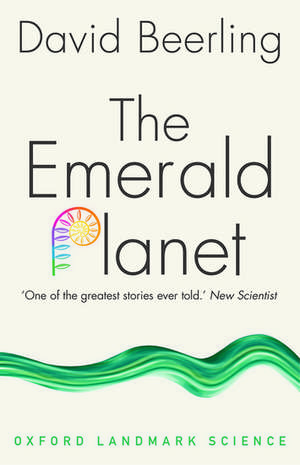
The Emerald Planet: How plants changed Earth's history: Oxford Landmark Science
Autor David Beerlingen Limba Engleză Paperback – 23 feb 2017
Din seria Oxford Landmark Science
- 18%
 Preț: 70.61 lei
 - 15%
 Preț: 81.53 lei
 - 19%
 Preț: 74.58 lei
 - 16%
 Preț: 87.19 lei
 - 13%
 Preț: 92.63 lei
 - 18%
 Preț: 77.37 lei
 - 16%
 Preț: 86.57 lei
 - 18%
 Preț: 76.82 lei
 - 16%
 Preț: 86.82 lei
 - 19%
 Preț: 74.54 lei
 - 19%
 Preț: 68.84 lei
 - 19%
 Preț: 74.95 lei
 - 18%
 Preț: 76.61 lei
 - 15%
 Preț: 95.14 lei
 - 15%
 Preț: 101.48 lei
 - 19%
 Preț: 68.69 lei
 - 18%
 Preț: 76.53 lei
 - 23%
 Preț: 76.88 lei
Preț: 90.79 lei
Preț vechi: 109.14 lei
-17%
Puncte Express: 136
Carte tipărită la comandă
Livrare economică 10-15 decembrie
Livrare prin curier în România Termenul estimat este afișat lângă disponibilitate.
Transport gratuit de la 400.00 lei Plată online sau ramburs, în funcție de opțiunile comenzii.
Retur gratuit în 14 zile Comandă securizată și suport în română.
Specificații
ISBN-13: 9780198798323
ISBN-10: 0198798326
Pagini: 416
Ilustrații: 13 line diagrams, and 8pp B&W plate section
Dimensiuni: 130 x 196 x 30 mm
Greutate: 0.39 kg
Editura: OUP OXFORD
Colecția OUP Oxford
Seria Oxford Landmark Science
Locul publicării:Oxford, United Kingdom
ISBN-10: 0198798326
Pagini: 416
Ilustrații: 13 line diagrams, and 8pp B&W plate section
Dimensiuni: 130 x 196 x 30 mm
Greutate: 0.39 kg
Editura: OUP OXFORD
Colecția OUP Oxford
Seria Oxford Landmark Science
Locul publicării:Oxford, United Kingdom
V-ar putea interesa
-
 The Life of the CosmosLee SmolinPreț: 171.07 lei
 -
 Knowing: The Nature of Physical LawMichael Munowitz-18%Preț: 285.25 lei348.66 lei
 -
 Sex, Lies, and Brain Scans: How fMRI reveals what really goes on in our mindsBarbara J. SahakianPreț: 154.73 lei
 -
 -20%Preț: 73.84 lei92.36 lei
 -
 Measurement: A Very Short IntroductionDavid J. Hand-19%Preț: 57.46 lei71.12 lei
 -
 The Problems of PhysicsAnthony Leggett-17%Preț: 358.09 lei429.76 lei
 -
 The Story of Pain: From Prayer to PainkillersJoanna Bourke-17%Preț: 84.67 lei101.74 lei
 -
 Genghis Khan: And the Making of the Modern WorldJack Weatherford-34%Preț: 98.65 lei149.23 lei
 -
 The Sixth Extinction: An Unnatural HistoryElizabeth Kolbert-25%Preț: 69.89 lei93.77 lei
 -
 Berserk Deluxe Volume 7Kentaro Miura-18%Preț: 328.48 lei400.60 lei
 -
 -49%Preț: 47.06 lei92.93 lei
 -
 Cum am ajuns aici: Șase inovații care au făcut lumea modernăSteven JohnsonPreț: 47.00 lei
Descriere
The Emerald Planet is the tale of our world's past - and future - as revealed by plants. Over the immensity of geological time, plants have been powerful agents of change, shaping the climate, the planet, and affecting the evolutionary path of all life. Here, David Beerling tells how.
Recenzii
A fascinating insight into the way life -- especially plants -- evolved on our planet.
Review from previous edition Within these pages is one of the greatest stories ever told... It is as fascinating as it is important.
Here at last is David Beerling as the Green Knight, revealing the extraordinary story of the construction of our emerald planet. Rigorous science joins hands with an enthusiastic delivery to re-awaken our fascination in plants, while engaging anecdotes provide a thrilling background to an extraordinary story of climate change and our current environmental crisis.
Beerling gives us the big picture of how plants have changed our planet - and poses the key question of how we will manage the emerald planet to ensure the kind of future we desire.
If I can find a fault with this book it is that each subsequent chapter is so engrossing that it drives the author's previous deliberations from my head... I will return to this book again and again.
David Beerling's book is both fascinating and important.
An illuminating account of the ways "greenhouse gases, genes, and geochemistry" are linked.
My favourite non-fiction book this year...[a] highly readable history of the last half-billion years on earth
David Beerling tells two stories in parallel. Both are eloquently and engagingly merged in a scholarly, yet generally accessible book...Beerling provides for the reader a fascinating history of the discovery of fossils and the inferences drawn from them...this book is a wonderful example of the nascent field of Earth systems science.
...of great value and relevance to all interested in plants, climate and, equally, the future of our 'emerald planet'.
David Beerling's fascinating new book offers a new global perspective on the evolution of our planet...[a] vivid account...The environmental legacy of the plant kingdom upon our world can only be better appreciated after reading this book.
A beautifully detailed account...a gorgeous book.
[A] fascinating overview of green evolution.
Within these pages is one of the greatest stories ever told ... It is as fascinating as it is important.
The Emerald Planet is a serious talking-to about why plants must not be ignored.
Review from previous edition Within these pages is one of the greatest stories ever told... It is as fascinating as it is important.
Here at last is David Beerling as the Green Knight, revealing the extraordinary story of the construction of our emerald planet. Rigorous science joins hands with an enthusiastic delivery to re-awaken our fascination in plants, while engaging anecdotes provide a thrilling background to an extraordinary story of climate change and our current environmental crisis.
Beerling gives us the big picture of how plants have changed our planet - and poses the key question of how we will manage the emerald planet to ensure the kind of future we desire.
If I can find a fault with this book it is that each subsequent chapter is so engrossing that it drives the author's previous deliberations from my head... I will return to this book again and again.
David Beerling's book is both fascinating and important.
An illuminating account of the ways "greenhouse gases, genes, and geochemistry" are linked.
My favourite non-fiction book this year...[a] highly readable history of the last half-billion years on earth
David Beerling tells two stories in parallel. Both are eloquently and engagingly merged in a scholarly, yet generally accessible book...Beerling provides for the reader a fascinating history of the discovery of fossils and the inferences drawn from them...this book is a wonderful example of the nascent field of Earth systems science.
...of great value and relevance to all interested in plants, climate and, equally, the future of our 'emerald planet'.
David Beerling's fascinating new book offers a new global perspective on the evolution of our planet...[a] vivid account...The environmental legacy of the plant kingdom upon our world can only be better appreciated after reading this book.
A beautifully detailed account...a gorgeous book.
[A] fascinating overview of green evolution.
Within these pages is one of the greatest stories ever told ... It is as fascinating as it is important.
The Emerald Planet is a serious talking-to about why plants must not be ignored.
Notă biografică
David Beerling is Professor of Palaeoclimatology at the Department of Animal and Plant Sciences University of Sheffield. Before this he held a Royal Society University Research Fellowship, where his work on the evolution of life and the physical environment was recognized by the award of a prestigious Philip Leverhulme Prize in earth sciences (2001). In 2014 he was elected Fellow of the Royal Society, and from 2009-2014 he held the Royal Society-Wolfson Research Merit Award. He has published over 100 papers in international scientific journals and is co-author of Vegetation and the Global Carbon Cycle: Modelling the first 400 million years (CUP, 2001).
Cuprins
- Preface
- 1: Introduction
- 2: Leaves, genes, and greenhouse gases
- 3: Oxygen and the lost world of giants
- 4: An ancient ozone catastrophe?
- 5: Global warming ushers in the dinosaur era
- 6: The flourishing forests of Antarctica
- 7: Paradise lost
- 8: Nature's green revolution
- 9: Through a glass darkly
- Notes
- Index