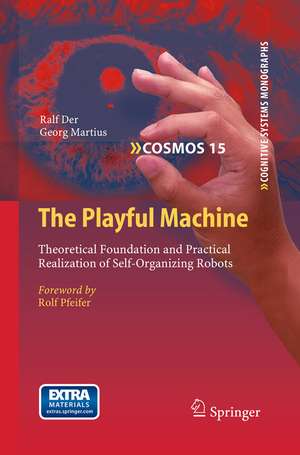
The Playful Machine: Cognitive Systems Monographs, cartea 15
Autor Ralf Der, Georg Martiusen Limba Engleză Paperback – 23 aug 2016
Analizând bazele de date academice și literatura de specialitate din seria Cognitive Systems Monographs, descoperim în The Playful Machine o abordare inovatoare a roboticii autonome, fundamentată pe conceptul de homeokineză. Autorii Ralf Der și Georg Martius investighează o problemă centrală a ingineriei moderne: cum pot mașinile complexe să își genereze propriul comportament fără programare explicită pentru fiecare sarcină. Premisa este inspirată din natură, unde mamiferele superioare învață să își stăpânească sistemul corp-creier prin joc. Structura volumului reflectă o progresie riguroasă, pornind de la fundamentele auto-organizării și bucla senzoriomotorie (capitolele 2-3), trecând prin analiza matematică a fluxurilor de punct fix și a oscilatorilor de histerezis, până la implementări algoritmice concrete. Observăm o tranziție de la sistemele robotice cu dimensiuni reduse la cele complexe, înalt dimensionale, unde homeokineza permite roboților humanoizi sau celor de tip șarpe să dezvolte moduri de locomoție emergente, precum cățărarea sau încolăcirea, în mod spontan. Spre deosebire de abordările pur tehnice, această lucrare oferă două niveluri de parcurgere. Pentru cercetători, textul furnizează o analiză matematică profundă a principiilor de autoreglare. Pentru publicul larg interesat de robotică, includerea simulatorului LPZROBOTS transformă conceptele teoretice în experimente vizuale accesibile. Ca alternativă la Self-Organizing Robots de Satoshi Murata pentru cursurile de robotică și sisteme dinamice, acest volum vine cu avantajul integrării „auto-organizării ghidate”, o metodă care canalizează libertatea creativă a mașinii către obiective funcționale în lumea reală, rezolvând paradoxul dintre control și autonomie.
Din seria Cognitive Systems Monographs
- 15%
 Preț: 622.59 lei
 - 20%
 Preț: 668.25 lei
 - 20%
 Preț: 942.75 lei
 - 18%
 Preț: 993.09 lei
 - 15%
 Preț: 635.22 lei
 - 15%
 Preț: 640.89 lei
 - 15%
 Preț: 619.12 lei
 - 20%
 Preț: 1453.01 lei
 - 15%
 Preț: 605.45 lei
 - 15%
 Preț: 666.53 lei
 - 15%
 Preț: 662.13 lei
 - 20%
 Preț: 665.83 lei
 - 15%
 Preț: 643.87 lei
 - 15%
 Preț: 668.28 lei
 - 5%
 Preț: 1060.90 lei
 - 15%
 Preț: 659.28 lei
 - 15%
 Preț: 674.64 lei
 - 20%
 Preț: 673.39 lei
 -
 Preț: 404.04 lei
 - 15%
 Preț: 666.11 lei
 - 20%
 Preț: 687.99 lei
 - 20%
 Preț: 675.79 lei
 - 20%
 Preț: 723.79 lei
 - 15%
 Preț: 663.25 lei
 - 20%
 Preț: 681.34 lei
 - 20%
 Preț: 1005.29 lei
 - 20%
 Preț: 671.16 lei
 - 18%
 Preț: 924.79 lei
 - 20%
 Preț: 670.28 lei
 - 20%
 Preț: 674.03 lei
Preț: 646.82 lei
Preț vechi: 760.96 lei
-15%
Carte tipărită la comandă
Livrare economică 03-17 decembrie
Specificații
ISBN-10: 3662506335
Pagini: 356
Ilustrații: XX, 335 p.
Dimensiuni: 155 x 235 x 20 mm
Greutate: 0.54 kg
Ediția:Softcover reprint of the original 1st edition 2012
Editura: Springer
Colecția Cognitive Systems Monographs
Seria Cognitive Systems Monographs
Locul publicării:Berlin, Heidelberg, Germany
V-ar putea interesa
-
 Arduino Robot BonanzaGordon McComb-38%Preț: 210.57 lei339.85 lei
 -
 Robotics: A Very Short IntroductionAlan Winfield-20%Preț: 57.20 lei71.12 lei
 -
 The Technological SingularityMurray Shanahan-20%Preț: 97.77 lei122.92 lei
 -
 Optimal ControlFrank L Lewis-9%Preț: 992.25 lei1090.39 lei
 -
 Practical Field RoboticsRobert H Sturges-8%Preț: 658.21 lei715.44 lei
 -
 Iterative Learning Control for Deterministic SystemsKevin L. MoorePreț: 396.24 lei
 -
 Nonlinear Process Control:Peter L. LeePreț: 389.23 lei
 -
 Expert Aided Control System DesignColin D. TebbuttPreț: 367.92 lei
 -
 Optimal Sampled-Data Control SystemsTongwen Chen-18%Preț: 760.14 lei926.99 lei
 -
 Trends in ControlAlberto IsidoriPreț: 399.70 lei
 -
 State Models of Dynamic SystemsN. H. McClamrochPreț: 374.14 lei
 -
 Human-Robot Interaction in Social RoboticsTakayuki Kanda-18%Preț: 1666.19 lei2031.93 lei
 -
 Parallel Robots: Mechanics and ControlHamid D. Taghirad-20%Preț: 1784.20 lei2230.26 lei
 -
 Process Control: Problems, Techniques and ApplicationsSamuel P. Werther-27%Preț: 1165.46 lei1585.77 lei
 -
 Modelling and Performance Evaluation MethodologyF. BaccelliPreț: 411.07 lei
 -
 Embodied Artificial IntelligenceFumiya Iida-20%Preț: 324.66 lei405.83 lei
 -
 “Two Butterflies on My Head...”: Psychoanalysis in the Interdisciplinary Scientific DialogueMarianne Leuzinger-Bohleber-15%Preț: 617.57 lei726.55 lei
 -
 Cognitive -Affective ProcessesUlrich Moser-15%Preț: 638.15 lei750.76 lei
 -
 50 Years of Artificial IntelligenceMax Lungarella-20%Preț: 328.10 lei410.13 lei
 -
 Failsafe Control SystemsK. WarwickPreț: 374.38 lei
De ce să citești această carte
Recomandăm această carte cercetătorilor în robotică și studenților la matematică aplicată care doresc să depășească limitele algoritmilor de control clasici. Cititorul câștigă o înțelegere profundă a modului în care autonomia poate apărea prin interacțiunea dinamică corp-mediu. Este o resursă rară care îmbină rigoarea matematică a editurii Springer cu instrumente practice de simulare, oferind o perspectivă unică asupra viitorului roboților companioni.
Despre autor
Ralf Der și Georg Martius sunt cercetători de renume în domeniul sistemelor complexe și al inteligenței artificiale autonome. Ralf Der a fost un pionier în aplicarea principiilor fizicii statistice și ale sistemelor dinamice în robotică, dezvoltând conceptul de homeokineză. Georg Martius și-a concentrat activitatea pe învățarea automată și auto-organizare la Institutul Max Planck. Împreună, au creat un cadru teoretic ce permite mașinilor să „învețe să învețe” prin explorare activă, contribuind semnificativ la dezvoltarea roboticii cognitive moderne, așa cum este prezentată în acest volum din seria Cognitive Systems Monographs.
Descriere scurtă
The book provides two levels of presentation. Students and scientific researchers interested in the field of robotics, self-organization and dynamical systems theory may be satisfied by the in-depth mathematical analysis of the principle, the bootstrapping scenarios, and the emerging behaviors. But the book additionally comes with a robotics simulator inviting also the non- scientific reader to simply enjoy the fabulous world of playful machines by performing the numerous experiments.
Cuprins
Recenzii
“Stressed on robots, the book presents the new tendencies of self-evaluation, self-organization and control of different type of technical systems, including the cognitive control theory as a new control language. The book is intended for students and researchers interested in self-organization on both the practical and theoretical level. … The book can be also a source for courses, which can be part of the academic program of electrical, control and computer science departments.” (Clementina Mladenova, Zentralblatt MATH, Vol. 1243, 2012)