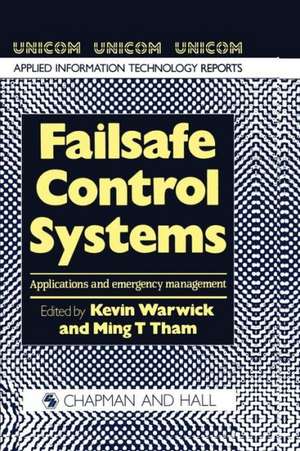
Failsafe Control Systems
Editat de K. Warwick, M. T. Thamen Limba Engleză Paperback – 3 noi 2011
Preț: 374.38 lei
Puncte Express: 562
Carte tipărită la comandă
Livrare economică 30 noiembrie-14 decembrie
Livrare prin curier în România Termenul estimat este afișat lângă disponibilitate.
Transport gratuit de la 400.00 lei Plată online sau ramburs, în funcție de opțiunile comenzii.
Retur gratuit în 14 zile Comandă securizată și suport în română.
Specificații
ISBN-13: 9789401066778
ISBN-10: 9401066779
Pagini: 264
Ilustrații: 246 p.
Dimensiuni: 155 x 235 x 15 mm
Greutate: 0.41 kg
Ediția:1991
Editura: Springer
Locul publicării:Dordrecht, Netherlands
ISBN-10: 9401066779
Pagini: 264
Ilustrații: 246 p.
Dimensiuni: 155 x 235 x 15 mm
Greutate: 0.41 kg
Ediția:1991
Editura: Springer
Locul publicării:Dordrecht, Netherlands
V-ar putea interesa
-
 Introduction to VHDLR. D. Hunter-15%Preț: 629.64 lei740.75 lei
 -
 Foundations of ElectrodynamicsParry MoonPreț: 107.91 lei
 -
 Neural Network Applications in ControlG W Irwin-18%Preț: 859.16 lei1047.76 lei
 -
 Artificial Intelligence Techniques in Power SystemsKevin Warwick-18%Preț: 709.28 lei864.98 lei
 -
 -18%Preț: 2912.76 lei3552.14 lei
 -
 Distributed Sensor Networks: Image and Sensor Signal Processing (Volume One)S. Sitharama Iyengar-20%Preț: 605.17 lei756.47 lei
 -
 -18%Preț: 1127.37 lei1374.85 lei
 -
 Preț: 384.68 lei
 -
 -18%Preț: 1356.86 lei1654.71 lei
 -
 -14%Preț: 1321.93 lei1537.13 lei
 -
 -14%Preț: 1328.41 lei1544.66 lei
 -
 Fundamentals of Electromagnetic LevitationAlan J Sangster-18%Preț: 855.16 lei1042.88 lei
 -
 Optical Methods in Engineering MetrologyD. C. WilliamsPreț: 388.21 lei
 -
 The New Superconducting ElectronicsH. WeinstockPreț: 388.39 lei
 -
 Preț: 374.71 lei
 -
 VLSI PlanarizationV Z Feinberg-15%Preț: 660.76 lei777.37 lei
 -
 A Programmed Review for Electrical EngineeringJames H. Bentley-15%Preț: 634.92 lei746.96 lei
 -
 Direct and Inverse Methods in Radar PolarimetryW.M BoernerPreț: 417.78 lei
 -
 Communication Systems and Random Process TheoryJ.K. SkwirzynskiPreț: 419.62 lei
 -
 Advances in Information Technologies for ElectromagneticsLuciano Tarricone-18%Preț: 916.49 lei1117.67 lei
 -
 -15%Preț: 502.41 lei591.06 lei
Public țintă
ResearchCuprins
1 Fail-safe control systems: an introduction.- References.- 2 Software fault tolerance.- 2.1 Introduction.- 2.2 What is software fault tolerance?.- 2.3 Sequential, concurrent and real-time systems.- 2.4 Analysis and synthesis tool.- 2.5 An overview of software fault tolerance techniques.- 2.6 Software fault tolerance in sequential systems.- 2.7 Software fault tolerance in concurrent systems.- 2.8 Transaction processing and distributed decisionmechanisms in distributed systems.- References.- 3 Software reliability: the way forward.- 3.1 Advantages and disadvantages of programmable systems.- 3.2 Features of software related failures.- 3.3 Reliability/integrity in design.- 3.4 The approach to safety/reliability assessment.- 3.5 Limitations and drawbacks of software assessments.- 3.6 The way forward.- References.- 4 Design principles for diagnostics decision support systems.- 4.1 Introduction.- 4.2 The operators’model.- 4.3 Diagnostic support.- 4.4 Conclusions.- 5 A fault tolerant control scheme.- 5.1 Summary.- 5.2 Introduction.- 5.3 Feedback path.- 5.4 Controller assessment.- 5.5 Decision and monitoring.- 5.6 Conclusions.- References.- 6 Fault tolerant procedures for boiler control systems design.- 6.1 Introduction.- 6.2 Motivation and design criteria.- 6.3 Scope of the problem.- 6.4 Computer architecture.- 6.5 Control loop structure.- 6.6 Scanners and data input.- 6.7 Output commands and actuator drives.- 6.8 Control algorithm.- 6.9 Operator interface.- 6.10 Software structure.- 6.11 Conclusions.- References.- 7 Framework for the design and assessment of safety related control systems.- 7.1 Introduction.- 7.2 Systems under consideration.- 7.3 Considerations underlying the guidelines.- 7.4 Safety principles.- 7.5 Design and assessment general framework.- 7.6 Applicationof the safety principles.- 7.7 Total system environment.- 7.8 Protection systems.- 7.9 Safety cases for CIMAH.- 7.10 Future development: General.- 7.11 Future development: Application-specific guidelines.- 7.12 Future development: Standards.- 7.13 Summary.- References.- 8 Failure-to-safety in turbine-generator control.- 8.1 Introduction.- 8.2 Modes of failure.- 8.3 Provisions to assure failure-to-safety.- 8.4 Fault detection requirements.- 8.5 Condition monitoring.- 8.6 Conclusion.- References.- 9 Expert systems for monitoring process control.- 9.1 Introduction.- 9.2 Benefits of the expert system.- 9.3 Process monitoring.- 9.4 Speed considerations.- 9.5 The use of history.- 9.6 Trending and forecasting.- 9.7 Supporting data acquisition.- 9.8 Meta process control.- References.- 10 Robust fault diagnosis in dynamic systems.- 10.1 Introduction.- 10.2 Problem specification.- 10.3 Robust fault detection.- 10.4 The sensor fault detection problem.- 10.5 IFD system design example.- 10.6 IFD simulation results.- 10.7 Conclusion.- References.- 11 Prediction of failure conditions.- 11.1 Introduction.- 11.2 Study objectives.- 11.3 Approach to analysis.- 11.4 Presentation and discussion of results.- 11.5 Conclusions.- 12 Accident management and failure analysis.- 12.1 Introduction.- 12.2 Nuclear safety.- 12.3 The accident.- 12.4 The accident response.- 12.5 The automatic response.- 12.6 The tailored response.- 12.7 The emergency plan.- 13 Decision support systems and emergency management.- 13.1 Introduction.- 13.2 The problem.- 13.3 The multiple-criteria approach.- 13.4 Overview of the l3-decision support software.- 13.5 A case study from chemical industry.- 13.6 Conclusions.- References.- 14 Safety integrity management using expert systems.- 14.1 Introduction.- 14.2 Safety and risk analysis.- 14.3 The effects of applying safety and risk analysis.- 14.4 Safety integrity management.- 14.5 Knowledge-base contents.- 14.6 Summary of system functions.- 14.7 Discussion.- References.- 15 Power system alarm analysis and fault diagnosis using expert Systems.- 15.1 Introduction.- 15.2 Expert systems for power system alarm analysis already developed.- 15.3 Existing substation control arrangements.- 15.4 Discussion of alarm data flow.- 15.5 Expert system requirements.- 15.6 User interface.- 15.7 Requirements under different fault conditions.- 15.8 Data structure.- 15.9 Expert system structure.- 15.10 Demonstrator phase objective.- References.- 16Intelligent process control.- 16.1 Introduction.- 16.2 Why an expert system for process control?.- 16.3 What should an expert system for process control consist of?.- 16.4 Integrating the expert system in the control system of the plant.- 16.5 Conclusions.- References.- 17 New technology for improved quality control and security of process operations.- 17.1 Introduction.- 17.2 Conventional regulation and its limitations.- 17.3 Techniques that can address product control.- 17.4 A simple comparison of conventional and predictive control.- 17.5 Discussion.- References.