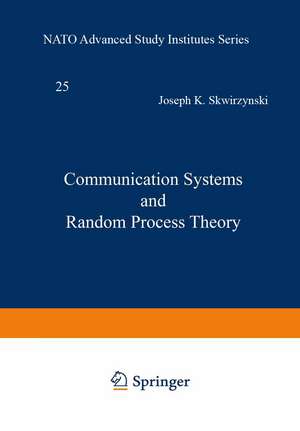
Communication Systems and Random Process Theory: NATO Science Series E:, cartea 25
Autor J.K. Skwirzynskien Limba Engleză Paperback – 14 mar 2012
Din seria NATO Science Series E:
-
 Preț: 374.84 lei
 -
 Preț: 386.34 lei
 - 20%
 Preț: 349.72 lei
 -
 Preț: 408.17 lei
 - 18%
 Preț: 1176.56 lei
 - 18%
 Preț: 1764.96 lei
 - 18%
 Preț: 1181.44 lei
 - 18%
 Preț: 1228.34 lei
 -
 Preț: 368.86 lei
 -
 Preț: 393.75 lei
 - 18%
 Preț: 1769.50 lei
 - 5%
 Preț: 355.87 lei
 -
 Preț: 391.71 lei
 - 18%
 Preț: 1766.62 lei
 -
 Preț: 412.56 lei
 -
 Preț: 388.01 lei
 -
 Preț: 387.28 lei
 - 18%
 Preț: 2920.23 lei
 -
 Preț: 377.01 lei
 - 5%
 Preț: 376.18 lei
 - 18%
 Preț: 1186.30 lei
 - 18%
 Preț: 1186.68 lei
 - 18%
 Preț: 1186.41 lei
 - 5%
 Preț: 3393.87 lei
 - 18%
 Preț: 1768.29 lei
 - 5%
 Preț: 367.92 lei
 - 18%
 Preț: 1180.06 lei
 -
 Preț: 382.33 lei
 -
 Preț: 384.16 lei
 - 18%
 Preț: 2392.01 lei
 - 5%
 Preț: 1379.35 lei
 -
 Preț: 384.40 lei
 - 5%
 Preț: 2058.97 lei
 - 18%
 Preț: 1772.54 lei
 -
 Preț: 388.20 lei
 -
 Preț: 398.39 lei
 -
 Preț: 402.06 lei
 - 20%
 Preț: 331.65 lei
 - 18%
 Preț: 913.16 lei
 - 18%
 Preț: 1182.47 lei
 - 18%
 Preț: 1229.56 lei
 - 20%
 Preț: 1838.25 lei
 - 18%
 Preț: 1186.11 lei
Preț: 419.62 lei
Puncte Express: 629
Carte tipărită la comandă
Livrare economică 16-30 noiembrie
Livrare prin curier în România Termenul estimat este afișat lângă disponibilitate.
Transport gratuit pentru acest produs Plată online sau ramburs, în funcție de opțiunile comenzii.
Retur gratuit în 14 zile Comandă securizată și suport în română.
Specificații
ISBN-13: 9789401175791
ISBN-10: 9401175799
Pagini: 996
Ilustrații: 1004 p.
Dimensiuni: 170 x 244 x 52 mm
Greutate: 1.55 kg
Ediția:Softcover reprint of the original 1st ed. 1978
Editura: SPRINGER NETHERLANDS
Colecția Springer
Seria NATO Science Series E:
Locul publicării:Dordrecht, Netherlands
ISBN-10: 9401175799
Pagini: 996
Ilustrații: 1004 p.
Dimensiuni: 170 x 244 x 52 mm
Greutate: 1.55 kg
Ediția:Softcover reprint of the original 1st ed. 1978
Editura: SPRINGER NETHERLANDS
Colecția Springer
Seria NATO Science Series E:
Locul publicării:Dordrecht, Netherlands
V-ar putea interesa
-
 Introduction to VHDLR. D. Hunter-15%Preț: 629.64 lei740.75 lei
 -
 Foundations of ElectrodynamicsParry MoonPreț: 107.91 lei
 -
 -18%Preț: 2816.24 lei3434.44 lei
 -
 Distributed Sensor Networks: Image and Sensor Signal Processing (Volume One)S. Sitharama Iyengar-20%Preț: 605.17 lei756.47 lei
 -
 -18%Preț: 1614.22 lei1968.56 lei
 -
 -18%Preț: 1127.37 lei1374.85 lei
 -
 -18%Preț: 1356.86 lei1654.71 lei
 -
 -14%Preț: 1321.93 lei1537.13 lei
 -
 -14%Preț: 1328.41 lei1544.66 lei
 -
 Fundamentals of Electromagnetic LevitationAlan J Sangster-18%Preț: 833.00 lei1015.85 lei
 -
 Integral Equation Methods for ElectromagneticsJohn L. Volakis-18%Preț: 996.64 lei1215.41 lei
 -
 Performance Limits in Communication Theory and PracticeJ.K. Skwirzynski-18%Preț: 1182.77 lei1442.40 lei
 -
 Multivariable Control: New Concepts and ToolsS.G. TzafestasPreț: 390.23 lei
 -
 Solid State ImagingP. JespersPreț: 403.52 lei
 -
 Optical Methods in Engineering MetrologyD. C. WilliamsPreț: 388.21 lei
 -
 Preț: 374.71 lei
 -
 Failsafe Control SystemsK. WarwickPreț: 374.38 lei
 -
 Manprint: An Approach to Systems IntegrationH.R. BooherPreț: 390.81 lei
 -
 A Programmed Review for Electrical EngineeringJames H. Bentley-15%Preț: 634.92 lei746.96 lei
 -
 The Impact of Processing Techniques on CommunicationsJ.K. SkwirzynskiPreț: 396.71 lei
 -
 -18%Preț: 922.72 lei1125.26 lei
 -
 Preț: 414.04 lei
Public țintă
ResearchCuprins
I. Some Aspects of Data Communication.- 1. Stochastic problems of multiple communication.- 2. Multi-user communication networks.- 3. Spread spectrum signals and bandwidth utilization.- 4. Extension of an adaptive distributed routing algorithm to mixed media networks.- II. Multiple Communication.- 1. From theory to practice: Advances in communications discussed at Eurocon ‘77 in Venice.- 2. The Optimum transmission signal for digital transmission systems.- 3. Timing recovery problems in data communication.- 4. Interference and jamming prone communication.- III. Algebraic Coding.- 1. Algebraic coding and combinatorics: a tutorial survey.- 2. Codes associated with finite geometries.- 3. Soft-decision minimum-distance decoding.- 4. Algebraic codes constructed from other algebraic codes: a short survey and some recent results.- IV. Probabilistic Coding.- 1. Nonprobabilistic and partly probabilistic channel coding and time varying channels.- 2. Sequential decoding for burst-error-channels.- 3. Synchronization recovery and error correcting codes.- V. Integrated Coding and Rate Distortion Theory.- 1. Joint source and channel coding.- 2. Rate distortion theory: the influences of the source and distortion measure in structuring source coding.- 3. Convolutional-codes for integrated coding.- 4. Robust low bit rate voice encoding.- 5. Integrated data communication systems with data compression and error correcting codes.- 6. Source encoding with Kaiman filters.- Panel Discussion, The practicality of source coding.- VI. Dispersive and Fading Channels.- 1. Review of methods for description of random transmission channels: applications to identification and optimisation of detection and transmission processes.- 2. Performance capabilities of the Viterbi algorithm for combattingintersymbol interference on fading multipath channels.- 3. Channel evaluation techniques for dispersive communications paths.- 4. Some results in simultaneous detection and estimation.- 5. Phase compensation receivers for optical communication.- 6. Modelling of the sea surface scattering channel and undersea communications.- Panel Discussion, Channel statistics and models.- VII. Non-Stationary and Non-Gaussian Signal/Noise Analysis.- 1. Representation of bivariate distributions with applications.- 2. Simulation of signal and noise in a nonlinear channel.- 3. Digital transmission over nonlinear channels: a Volterra series analysis.- 4. The output signal and noise from a bandpass nonlinearity involving AM-to-PM conversion.- 5. Moment space error bounds in digital communication systems.- 6. Modelling and analysis of impulsive noise.- VIII. Adaptive Signal Processing.- 1. Adaptive signal processing for detection and communication.- 2. Adaptive filters.- Panel Discussion, Adaptive filtering for high-speed modems.- IX. Stochastic Calculus.- 1. Martingale integrals and stochastic calculus.- 2. Detection, mutual information and feedback encoding: applications of stochastic calculus.- 3. The design of robust approximations to the stochastic differential equations of nonlinear filtering.- 4. A view at stochastic calculus for point processes.- Panel Discussion, “Are Ito calculus and Martingale theory useful in practice?”.- X. Signal Processing Applications of Stochastic Calculus.- 1. A Martingale approach to random fields.- 2. Jumps processes in filtering and detection.- 3. Applications of stochastic calculus for point process models arising in optical communication.- 4. Statistical modelling and analysis for adaptive routing in computer networks.- XI. The Shape TechnicalCentre Session.- 1. Introduction: Research activities on communications at the SHAPE Technical Centre.- 2. Code division multiplexing for satellite systems.- 3. The potential of meteor-burst communications with particular reference to the COMET system.- 4. New HF data transmission techniques.- 5. Speech processing for low data rate digital voice communications.- 6. Characterization of troposcatter channels for digital transmission.- List of Lecturers and Delegates.