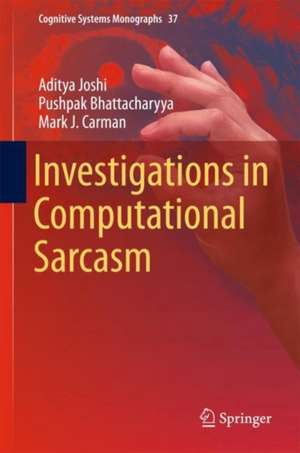
Investigations in Computational Sarcasm: Cognitive Systems Monographs, cartea 37
Autor Aditya Joshi, Pushpak Bhattacharyya, Mark J. Carmanen Limba Engleză Hardback – 3 apr 2018
În Investigations in Computational Sarcasm, descoperim o explorare riguroasă a modului în care inteligența artificială poate descifra și replica una dintre cele mai nuanțate forme de comunicare umană. Autorii Aditya Joshi, Pushpak Bhattacharyya și Mark J. Carman fundamentează această cercetare pe conceptul de incongruență, utilizând tehnici avansate de procesare a limbajului natural (NLP) și machine learning, precum word embeddings și modele de topicuri. Într-o eră a automatizării monitorizării rețelelor sociale, înțelegerea mecanismelor prin care un text afirmă ceva dar transmite opusul devine esențială pentru acuratețea analizei sentimentelor.
Structura volumului reflectă o progresie logică, de la definirea fenomenului prin studii de adnotare realizate de non-nativi, până la propunerea unor soluții tehnice complexe. Reținem abordarea duală a detecției: incongruența intra-textuală, care analizează contradicțiile interne ale mesajului, și incongruența de context, care extrage indicii din istoricul autorului sau din fluxul conversațional. Cititorul care a aplicat deja conceptele din A Practical Guide to Sentiment Analysis va găsi aici completarea necesară pentru a depăși limitările sistemelor clasice care eșuează adesea în fața ironiei. Spre deosebire de A Multimodal Study of Sarcasm in Interactional Humor, care se concentrează pe elemente non-verbale și lingvistică cognitivă, această lucrare din seria Cognitive Systems Monographs oferă un cadru computațional aplicat, culminând cu prezentarea primei tehnici de generare automată a răspunsurilor sarcastice.
Această lucrare consolidează expertiza autorului Aditya Joshi în domeniul tehnologiei informației, făcând trecerea de la fundamentele prezentate în Hands-on Machine Learning with Python către o nișă de cercetare extrem de specifică și complexă. Este un volum tehnic, esențial pentru cei care doresc să implementeze algoritmi capabili să proceseze limbajul figurativ cu o precizie superioară.
Din seria Cognitive Systems Monographs
- 15%
 Preț: 622.59 lei
 - 20%
 Preț: 942.75 lei
 - 18%
 Preț: 920.45 lei
 - 15%
 Preț: 619.12 lei
 - 20%
 Preț: 1396.76 lei
 - 15%
 Preț: 605.45 lei
 - 15%
 Preț: 608.59 lei
 - 20%
 Preț: 618.64 lei
 - 15%
 Preț: 620.07 lei
 - 15%
 Preț: 616.95 lei
 - 5%
 Preț: 1060.90 lei
 - 15%
 Preț: 613.00 lei
 - 20%
 Preț: 625.27 lei
 -
 Preț: 376.17 lei
 - 15%
 Preț: 618.64 lei
 - 20%
 Preț: 967.37 lei
 - 15%
 Preț: 617.89 lei
 - 18%
 Preț: 907.54 lei
 - 18%
 Preț: 699.04 lei
 - 20%
 Preț: 1004.93 lei
 - 15%
 Preț: 613.49 lei
 - 20%
 Preț: 946.13 lei
 - 20%
 Preț: 615.45 lei
 - 18%
 Preț: 904.83 lei
 - 20%
 Preț: 962.57 lei
 - 20%
 Preț: 1232.88 lei
Preț: 620.38 lei
Preț vechi: 775.47 lei
-20%
Carte disponibilă
Livrare economică 23 mai-06 iunie
Specificații
ISBN-10: 9811083959
Pagini: 145
Ilustrații: XII, 143 p. 12 illus., 4 illus. in color.
Dimensiuni: 155 x 235 mm
Greutate: 0.41 kg
Ediția:1st ed. 2018
Editura: Springer Nature Singapore
Colecția Springer
Seria Cognitive Systems Monographs
Locul publicării:Singapore, Singapore
V-ar putea interesa
-
 It's ComplicatedPhilippa FoundPreț: 89.68 lei
 -
 Macroanalysis: Digital Methods and Literary HistoryMatthew L. Jockers-20%Preț: 663.49 lei829.36 lei
 -
 Irony and SarcasmRoger Kreuz-18%Preț: 80.34 lei97.62 lei
 -
 Innovations and Challenges in Social Media Discourse AnalysisMichele ZappavignaPreț: 327.38 lei
 -
 ChatGPT for DummiesPam Baker-20%Preț: 93.44 lei116.81 lei
 -
 Liars and OutliersBruce SchneierPreț: 119.40 lei
 -
 Agentic AI For DummiesPam Baker-20%Preț: 139.09 lei173.87 lei
 -
 The Essential Book of AIAnne Rooney-20%Preț: 71.24 lei89.04 lei
 -
 The Ambivalent InternetWhitney Phillips-20%Preț: 115.37 lei144.21 lei
 -
 -25%Preț: 68.60 lei91.54 lei
 -
 -18%Preț: 85.66 lei104.97 lei
 -
 -22%Preț: 88.97 lei113.49 lei
 -
 EnshittificationCory DoctorowPreț: 163.91 lei
 -
 The Importance of Being EarnestOscar WildePreț: 31.83 lei
 -
 Decoding AntisemitismMatthias J. BeckerPreț: 308.44 lei
 -
 The Pros and Cons of Using ChatbotsAdrian Wallwork-20%Preț: 169.36 lei211.71 lei
 -
 A Practical Guide to Sentiment AnalysisErik Cambria-5%Preț: 1055.83 lei1111.40 lei
 -
 -31%Preț: 97.60 lei141.55 lei
 -
 Beat the BotsJane K Cleland-23%Preț: 116.81 lei151.85 lei
De ce să citești această carte
Această carte este o resursă tehnică indispensabilă pentru cercetătorii în NLP și dezvoltatorii care lucrează la sisteme de analiză a sentimentelor pentru social media. Cititorul câștigă acces la metodologii concrete de detecție a incongruenței semantice și, în premieră, la tehnici de generare a sarcasmului. Este un ghid practic pentru a transforma un fenomen lingvistic evaziv într-un model computațional predictibil și utilizabil în automatizări complexe.
Despre autor
Aditya Joshi și Pushpak Bhattacharyya sunt cercetători recunoscuți în domeniul inteligenței artificiale și al procesării limbajului natural. Aditya Joshi are o experiență vastă în aplicarea tehnicilor de machine learning, fiind și autorul volumului Hands-on Machine Learning with Python, unde pune accent pe utilizarea bibliotecilor Pytorch și Scikit-learn pentru analiză de date. Pushpak Bhattacharyya este o figură centrală în comunitatea de cercetare NLP, contribuind constant la dezvoltarea algoritmilor de analiză a sentimentelor. Împreună cu Mark J. Carman, aceștia combină expertiza tehnică cu observația lingvistică pentru a aborda provocările computaționale ale sarcasmului.
Descriere scurtă
Cuprins
Notă biografică
Dr. Pushpak Bhattacharyya is the current president of The Association for Computational Linguistics (ACL) (2016–17). He is the Director of the Indian Institute of Technology Patna (IIT Patna) and Vijay and Sita Vashee Chair Professor at the Department of Computer Science and Engineering, Indian Institute of Technology Bombay (IIT Bombay). He was educated at the Indian Institute of Technology Kharagpur (IIT Kharagpur) (B.Tech), Indian Institute of Technology Kanpur (IIT Kanpur) (M.Tech.) and IIT Bombay (PhD).
He has been a visiting scholar and faculty member at the Massachusetts Institute of Technology (MIT), Stanford, UT Houston and University Joseph Fouriere (France). Prof. Bhattacharyya’s research areas include natural language processing, machine learning and artificial intelligence (AI). Loved by his students for his inspiring teaching and mentorship, he has guided more than 250 students (PhD, Masters and Bachelors). He has published over 250 research papers, is author of the textbook ‘Machine Translation’ and has led government and industry projects of international and national importance. His significant contributions in the field include multilingual lexical knowledge bases and projection. Prof. Bhattacharyya is a fellow of the National Academy of Engineering and recipient of the IIT Bombay Patwardhan Award and the Indian Institute of Technology Roorkee (IIT Roorkee) VNMM award,both for technology development. He has also received IBM, Microsoft, Yahoo and United Nations faculty grants.
Dr. Mark J. Carman is a senior lecturer at the Faculty of Information Technology, Monash University, Australia. He obtained a Ph.D. from the University of Trento, Italy in 2004. His research and interests span theoretical studies (e.g. investigating statistical properties of information retrieval measures), to practical applications (e.g. technology for assisting police during digital forensic investigations). Dr. Carman has authored a large number of publications in prestigious venues, including full papers at SIGIR, KDD, IJCAI, CIKM, WSDM, CoNLL, and ECIR, and articles in TOIS, IR, JMLR, ML, PR, JAIR and IP&M.