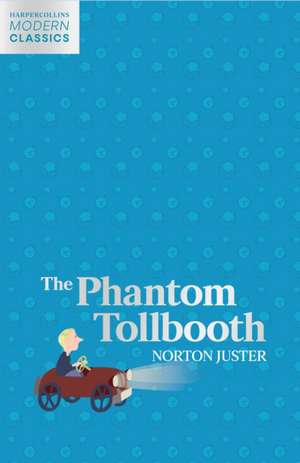
The Phantom Tollbooth: HarperCollins Children's Modern Classics
Autor Norton Justeren Limba Engleză Paperback – 2031
Ritmul narațiunii în The Phantom Tollbooth este dictat de o joacă lingvistică fascinantă, unde jocurile de cuvinte și logică transformă fiecare capitol într-o enigmă jucăușă. Credem că această ediție aniversară, care marchează 35 de ani de la prima publicare, rămâne una dintre cele mai inventive lecturi pentru copiii de peste 10 ani. Povestea începe cu Milo, un băiat pentru care totul este o sursă de plictiseală, până când o cabină de taxare misterioasă apare în camera sa, oferindu-i acces către Regatul Înțelepciunii. Însoțit de Tock, un „câine de pază” care ticăie la propriu, Milo pornește într-o misiune aparent imposibilă: eliberarea prințeselor Ritm și Rațiune. Putem afirma că farmecul acestei cărți rezidă în modul în care Norton Juster materializează concepte abstracte, precum „Săritul la Concluzii” sau întâlnirea cu personaje ca Matematicianul. Atmosfera amintește de Mulrox and the Malcognitos prin explorarea creativității și a ideilor care prind viață, dar aici mizele sunt mult mai ancorate în educația intelectuală și rigoarea limbajului, oferind un strat de profunzime filosofică rar întâlnit. Spre deosebire de alte lucrări ale autorului, cum ar fi The Hello, Goodbye Window, care se concentrează pe emoția pură a copilăriei timpurii, această operă provoacă intelectul cititorului, transformând învățarea dintr-o corvoadă într-o aventură fantastică. Ilustrațiile clasice în alb-negru realizate de Jules Feiffer completează perfect tonul plin de umor și căldură al textului.


Preț: 50.77 lei
Preț vechi: 58.02 lei
-12% Nou
Carte nepublicată încă
Specificații
ISBN-10: 0008523320
Pagini: 272
Dimensiuni: 129 x 198 x 17 mm
Greutate: 0.27 kg
Editura: HarperCollins Publishers
Colecția HarperCollins Children's Modern Classics
Seria HarperCollins Children's Modern Classics
V-ar putea interesa
-
 The Giving TreeShel SilversteinPreț: 115.36 lei
 -
 The Last KingdomBernard CornwellPreț: 103.13 lei
 -
 The Pale HorsemanBernard CornwellPreț: 102.73 lei
 -
 The Empty ThroneBernard CornwellPreț: 101.19 lei
 -
 The Female of the SpeciesMindy McginnisPreț: 105.22 lei
 -
 Survivors Box Set: Volumes 1 to 3Erin HunterPreț: 172.38 lei
 -
 The Hate U GiveAngie ThomasPreț: 129.39 lei
 -
 The Dark SideJane MayerPreț: 107.54 lei
 -
 The Night CircusErin MorgensternPreț: 111.08 lei
 -
 The Obelisk GateN K JemisinPreț: 112.69 lei
 -
 Wrede, P: Enchanted Forest ChroniclesPatricia C. WredePreț: 244.90 lei
 -
 The Night FairyLaura Amy SchlitzPreț: 52.20 lei
 -
 The Dark TalentBrandon SandersonPreț: 131.71 lei
 -
 The Orphan's TalePam JenoffPreț: 98.41 lei
 -
 Preț: 136.26 lei
 -
 Preț: 177.59 lei
 -
 The Girl Who Drank the MoonKelly BarnhillPreț: 114.73 lei
 -
 The KeyJennifer Anne DavisPreț: 133.27 lei
 -
 Preț: 205.05 lei
De ce să citești această carte
Recomandăm această carte părinților care doresc să le cultive copiilor curiozitatea pentru cuvinte și logică. Este mai mult decât o aventură; este un instrument educațional deghizat într-o poveste captivantă. Cititorul va învăța, alături de Milo, că plictiseala este doar lipsa curiozității și că lumea devine magică atunci când începi să îi înțelegi mecanismele interioare.
Despre autor
Norton Juster (1929–2021) a fost un arhitect, academician și scriitor american, a cărui pregătire tehnică se reflectă în structura ingenioasă a operelor sale. Este cel mai bine cunoscut pentru The Phantom Tollbooth și The Dot and the Line. Stilul său se remarcă prin utilizarea jocurilor de cuvinte complexe și a metaforelor matematice, reușind să facă subiectele academice accesibile și amuzante pentru tinerii cititori. Lucrările sale ulterioare, precum Neville, continuă să exploreze adaptarea copiilor la medii noi prin soluții creative.
Descriere
Notă biografică
Jules Feiffer is the author of several books for young readers, including The Man in the Ceiling and A Barrel of Laughs, a Vale of Tears, I Lost My Bear, Bark, George, and Meanwhile.... He has won a number of prizes for his cartoons, plays, and screenplays. Mr. Feiffer lives in New York City.
Extras
There was once a boy named Milo who didn’t know what to do with himself — not just sometimes, but always.
When he was in school he longed to be out, and when he was out he longed to be in. On the way he thought about coming home, and coming home he thought about going. Wherever he was he wished he were somewhere else, and when he got there he wondered why he’d bothered. Nothing really interested him — least of all the things that should have.
“It seems to me that almost everything is a waste of time,” he remarked one day as he walked dejectedly home from school. “I can’t see the point in learning to solve useless problems, or subtracting turnips from turnips, or knowing where Ethiopia is or how to spell February.” And, since no one bothered to explain otherwise, he regarded the process of seeking knowledge as the greatest waste of time of all.
As he and his unhappy thoughts hurried along (for while he was never anxious to be where he was going, he liked to get there as quickly as possible) it seemed a great wonder that the world, which was so large, could sometimes feel so small and empty.
“And worst of all,” he continued sadly, “there’s nothing for me to do, nowhere I’d care to go, and hardly anything worth seeing,” He punctuated this last thought with such a deep sigh that a house sparrow singing nearby stopped and rushed home to be with his family.
Without stopping or looking up, Milo dashed past the buildings and busy shops that lined the street and in a few minutes reached home — dashed through the lobby — hopped onto the elevator — two, three, four, five, six, seven, eight, and off again — opened the apartment door — rushed into his room — flopped dejectedly into a chair, and grumbled softly, “Another long afternoon.”
He looked glumly at all the things he owned. The books that were too much trouble to read, the tools he’d never learned to use, the small electric automobile he hadn’t driven in months — or was it years? — and the hundreds of other games and toys, and bats and balls, and bits and pieces scattered around him. And then, to one side of the room, just next to the phonograph, he noticed something he had certainly never seen before.
Who could possibly have left such an enormous package and such a strange one? For, while it was not quite square, it was definitely not round, and for its size it was larger than almost any other big package of smaller dimension that he’d ever seen.
Attached to one side was a bright-blue envelope which said simply: “FOR MILO, WHO HAS PLENTY OF TIME.”
Of course, if you’ve ever gotten a surprise package you can imagine how puzzled and excited Milo was; and if you’ve never gotten one, pay close attention, because someday you might.
“I don’t think it’s my birthday,” he puzzled, “and Christmas must be months away, and I haven’t been outstandingly good, or even good at all.” (He had to admit this even to himself.) “Most probably I won’t like it anyway, but since I don’t know where it came from, I can’t possibly send it back.” He thought about it for quite a while and then opened the envelope, but just to be polite.
“ONE GENUINE TURNPIKE TOLLBOOTH,” it stated — and then it went on:
“EASILY ASSEMBLED AT HOME, AND FOR USE BY THOSE WHO HAVE NEVER TRAVELED IN LANDS BEYOOND.”
“Beyond what?” thought Milo as he continued to read.
“THIS PACKAGE CONTAINS THE FOLLOWING ITEMS:
“One (1) genuine turnpike tollbooth to be erected according to directions.
“Three (3) precautionary signs to be used in a precautionary fashion.
“Assorted coins for use in paying tolls.
“One (1) map, up to date and carefully drawn by master cartographers, depicting natural and man-made features.
“One (1) book of rules and traffic regulations, which may not be bent or broken.”
And in smaller letters at the bottom it concluded:
“RESULTS ARE NOT GUARANTEED, BUT IF NOT PERFECTLY SATISFIED, YOUR WASTED TIME WILL BE REFUNDED.”
Following the instructions, which told him to cut here, lift there, and fold back all around, he soon had the tollbooth unpacked and set up on its stand. He fitted the windows in place and attached the roof, which extended out on both sides, and fastened on the coin box. It was very much like the tollbooths he’d seen many times on family trips, except of course it was much smaller and purple.
“What a strange present,” he thought to himself. “The least they could have done was to send a highway with it, for it’s terribly impractical without one.” But since, at the time, there was nothing else he wanted to play with, he set up the three signs,
SLOW DOWN APPROACHING TOLLBOOTH
PLEASE HAVE YOUR FARE READY
HAVE YOUR DESTINATION IN MIND
And slowly unfolded the map.
As the announcement stated, it was a beautiful map, in many colors, showing principal roads, rivers and seas, towns and cities, mountains and valleys, intersections and detours, and sites of outstanding interest both beautiful and historic.
The only trouble was that Milo had never heard of any of the places it indicated, and even the names sounded most peculiar.
“I don’t think there really is such a country,” he concluded after studying it carefully. “Well, it doesn’t matter anyway.” And he closed his eyes and poked a finger at the map.
“Dictionopolis,” read Milo slowly when he saw what his finger had chosen. “Oh, well, I might as well go there as anywhere.”
He walked across the room and dusted the car off carefully. Then, taking the map and rule book with him, he hopped in and, for lack of anything better to do, drove slowly up to the tollbooth. As he deposited his coin and rolled past he remarked wistfully, “I do hope this is an interesting game, otherwise the afternoon will be so terribly dull.”
From the Trade Paperback edition.
Recenzii
--Anna Quindlen, The New York Times
"A classic... Humorous, full of warmth and real invention."
--The New Yorker
From the Trade Paperback edition.