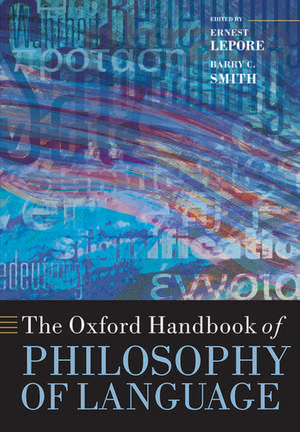
The Oxford Handbook of Philosophy of Language: Oxford Handbooks
Editat de Ernest Lepore, Barry C. Smithen Limba Engleză Paperback – 25 sep 2008
| Toate formatele și edițiile | Preț | Express |
|---|---|---|
| Paperback (1) | 363.36 lei 45-50 zile | |
| OUP OXFORD – 25 sep 2008 | 363.36 lei 45-50 zile | |
| Hardback (1) | 1109.82 lei 45-50 zile | |
| OUP OXFORD – 28 sep 2006 | 1109.82 lei 45-50 zile |
Din seria Oxford Handbooks
-
 Preț: 227.59 lei
 - 11%
 Preț: 279.91 lei
 - 24%
 Preț: 898.66 lei
 - 34%
 Preț: 1001.76 lei
 - 33%
 Preț: 884.45 lei
 - 30%
 Preț: 1002.70 lei
 - 29%
 Preț: 930.00 lei
 - 30%
 Preț: 912.02 lei
 - 30%
 Preț: 372.77 lei
 - 30%
 Preț: 371.63 lei
 - 18%
 Preț: 300.31 lei
 - 15%
 Preț: 333.75 lei
 - 33%
 Preț: 915.88 lei
 - 33%
 Preț: 1157.37 lei
 - 29%
 Preț: 1015.72 lei
 - 14%
 Preț: 1061.25 lei
 - 33%
 Preț: 985.61 lei
 - 20%
 Preț: 286.14 lei
 -
 Preț: 285.18 lei
 - 20%
 Preț: 389.24 lei
 - 33%
 Preț: 789.64 lei
 - 11%
 Preț: 331.31 lei
 - 33%
 Preț: 1175.72 lei
 -
 Preț: 520.05 lei
 - 33%
 Preț: 884.94 lei
 - 11%
 Preț: 374.76 lei
 - 33%
 Preț: 897.57 lei
 - 33%
 Preț: 1016.64 lei
 - 29%
 Preț: 887.40 lei
 - 30%
 Preț: 1106.73 lei
 - 29%
 Preț: 1003.53 lei
 - 27%
 Preț: 1180.95 lei
 - 33%
 Preț: 933.61 lei
 -
 Preț: 524.79 lei
 - 19%
 Preț: 386.30 lei
 - 24%
 Preț: 1156.40 lei
 - 33%
 Preț: 777.06 lei
 - 23%
 Preț: 1063.19 lei
 - 33%
 Preț: 927.48 lei
 - 29%
 Preț: 925.80 lei
 - 30%
 Preț: 1417.55 lei
 - 28%
 Preț: 849.38 lei
 - 19%
 Preț: 447.66 lei
 - 33%
 Preț: 1104.66 lei
 - 11%
 Preț: 286.64 lei
 - 13%
 Preț: 1105.96 lei
 - 20%
 Preț: 309.11 lei
 - 19%
 Preț: 295.13 lei
 - 33%
 Preț: 931.26 lei
 - 12%
 Preț: 271.67 lei
Preț: 363.36 lei
Preț vechi: 529.90 lei
-31% Nou
Puncte Express: 545
Preț estimativ în valută:
64.31€ • 75.42$ • 56.38£
64.31€ • 75.42$ • 56.38£
Carte tipărită la comandă
Livrare economică 29 ianuarie-03 februarie 26
Preluare comenzi: 021 569.72.76
Specificații
ISBN-13: 9780199552238
ISBN-10: 0199552231
Pagini: 1100
Dimensiuni: 170 x 246 x 59 mm
Greutate: 1.81 kg
Editura: OUP OXFORD
Colecția OUP Oxford
Seria Oxford Handbooks
Locul publicării:Oxford, United Kingdom
ISBN-10: 0199552231
Pagini: 1100
Dimensiuni: 170 x 246 x 59 mm
Greutate: 1.81 kg
Editura: OUP OXFORD
Colecția OUP Oxford
Seria Oxford Handbooks
Locul publicării:Oxford, United Kingdom
V-ar putea interesa
-
 The Philosophy of David KaplanJoseph Almog-7%Preț: 828.30 lei889.39 lei
 -
 The Situated SelfJ. T. IsmaelPreț: 317.84 lei
 -
 Knowing Our Own MindsCrispin Wright-14%Preț: 369.10 lei429.27 lei
 -
 Ignorance of LanguageMichael Devitt-18%Preț: 331.11 lei402.16 lei
 -
 The Compositionality PapersJerry A. Fodor-23%Preț: 452.20 lei587.80 lei
 -
 Thoughts: Papers on Mind, Meaning, and ModalityStephen YabloPreț: 324.24 lei
 -
 The Oxford Handbook of CompositionalityMarkus Werning-30%Preț: 829.05 lei1184.61 lei
 -
 Donald Davidson's Truth-Theoretic SemanticsErnest Lepore-18%Preț: 463.69 lei566.46 lei
 -
 Preț: 345.55 lei
 -
 -10%Preț: 264.17 lei293.83 lei
 -
 When Truth Gives OutMark Richard-10%Preț: 272.52 lei302.71 lei
 -
 Figuratively Speaking: Revised EditionRobert FogelinPreț: 259.43 lei
 -
 Holism – A Shopper′s GuideJ. FodorPreț: 369.56 lei
 -
 John Searle and his CriticsE LeporePreț: 378.44 lei
 -
 What is Cognitive Science?E LeporePreț: 497.25 lei
 -
 Deleuze and PragmatismSimone BignallPreț: 436.47 lei
 -
 -18%Preț: 1117.16 lei1362.39 lei
 -
 Conceptual Conflicts in Metaphors and Figurative LanguageMichele Prandi-18%Preț: 1123.97 lei1370.71 lei
 -
 -34%Preț: 788.03 lei1194.30 lei
 -
 Using Words and Things: Language and Philosophy of TechnologyMark Coeckelbergh-18%Preț: 1017.85 lei1241.28 lei
 -
 Language IsolatesLyle Campbell-18%Preț: 1990.73 lei2427.73 lei
 -
 -18%Preț: 906.39 lei1105.36 lei
 -
 Preț: 347.90 lei
 -
 Language and Meaning in the Age of ModernismJames Mcelvenny-22%Preț: 568.70 lei731.12 lei
 -
 Preț: 518.99 lei
Recenzii
This mammoth book should be read by anyone with an interest not only in philosophy of language, but in semantics and pragmatics, and even, though less centrally, in syntax. Though not introductory in the sense that it could be read by a first year student, it is well worth the effort of reading and, given the overall clarity of the chapters, accessible. The quality of the papers is sustained throughout and is of the highest sandard.