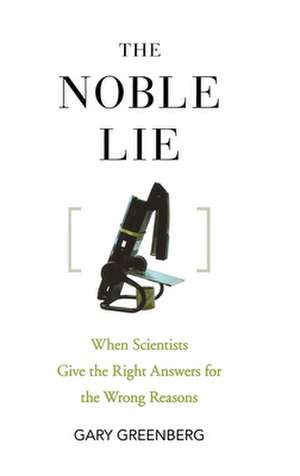
The Noble Lie
Autor Gary Greenbergen Limba Engleză Paperback – sep 2008
Preț: 87.49 lei
Puncte Express: 131
Carte disponibilă
Livrare economică 22 octombrie-05 noiembrie
Livrare prin curier în România Termenul estimat este afișat lângă disponibilitate.
Transport gratuit de la 400.00 lei Plată online sau ramburs, în funcție de opțiunile comenzii.
Retur gratuit în 14 zile Comandă securizată și suport în română.
Specificații
ISBN-13: 9781630269159
ISBN-10: 1630269158
Pagini: 252
Dimensiuni: 151 x 228 x 20 mm
Greutate: 0.35 kg
Editura: Turner Publishing Company
ISBN-10: 1630269158
Pagini: 252
Dimensiuni: 151 x 228 x 20 mm
Greutate: 0.35 kg
Editura: Turner Publishing Company
V-ar putea interesa
-
 Physical Theory: Method and InterpretationLawrence Sklar-31%Preț: 594.56 lei862.79 lei
 -
 -11%Preț: 362.53 lei407.34 lei
 -
 -15%Preț: 338.33 lei399.73 lei
 -
 -28%Preț: 518.47 lei719.17 lei
 -
 The Theoretical Practices of Physics: Philosophical EssaysR. I. G. Hughes-13%Preț: 303.26 lei347.22 lei
 -
 -21%Preț: 66.37 lei83.83 lei
 -
 Persistence and SpacetimeYuri Balashov-13%Preț: 301.82 lei346.46 lei
 -
 Geometric PossibilityGordon Belot-13%Preț: 290.85 lei336.15 lei
 -
 Interpreting Quantum TheoriesLaura Ruetsche-11%Preț: 354.01 lei399.05 lei
 -
 How Big is Big and How Small is Small: The Sizes of Everything and WhyTimothy Paul Smith-11%Preț: 353.40 lei398.00 lei
 -
 Scientists as Prophets: A Rhetorical GenealogyLynda Walsh-11%Preț: 374.49 lei422.77 lei
 -
 Systematicity: The Nature of SciencePaul Hoyningen-Huene-31%Preț: 678.12 lei984.08 lei
 -
 -35%Preț: 564.63 lei863.80 lei
 -
 The Philosophy of PhysicsDean RicklesPreț: 232.40 lei
 -
 The Moses MysteryGary GreenbergPreț: 128.48 lei
 -
 King David Versus IsraelGary GreenbergPreț: 126.15 lei
 -
 The Werewolf of Wall StreetGary GreenbergPreț: 93.76 lei
 -
 Preț: 91.55 lei
 -
 The Physics of TheismJeffrey KoperskiPreț: 252.39 lei
Descriere
Descriere de la o altă ediție sau format:
"What is an illness? What is good health? What, for that matter, is medical science really for? Greenberg will make you think about these questions in ways that I′m willing to bet you haven′t. Along the way, he will enlighten and amuse and provoke you in equal measure. A wonderful book from a terrific writer."
William Finnegan, author of Cold New World: Growing Up in a Harder Country
When a doctor tells you that you have bronchitis and should take an antibiotic, you′d probably say that this is an unbiased medical opinion based on an impartial reading of your symptoms, and it makes sense for you to follow your physician′s advice. Should you have the same confidence if you are diagnosed with depression and told to take antidepressants, or informed that a loved one is brain–dead and it′s time to harvest her organs for transplant?
In The Noble Lie, acclaimed and controversial science writer Gary Greenberg takes a penetrating look at common and accepted medical practices and opinions that, while they may be beneficial for society and help us deal with the unfathomable, are essentially the product of moral judgments and not supported by scientific evidence. In a series of riveting true stories, Greenberg examines the processes through which alcoholism and depression came to be accepted as diseases, asks why serial killer Ted Kaczynski was diagnosed as schizophrenic, and examines medical pronouncements on when life begins and ends. He also explains why there is no proof that homosexuality is genetic, and there never will be.
These real–life science fictions may be well intentioned, but do they cause more harm than good? Read The Noble Lie, then judge for yourself.
"What is an illness? What is good health? What, for that matter, is medical science really for? Greenberg will make you think about these questions in ways that I′m willing to bet you haven′t. Along the way, he will enlighten and amuse and provoke you in equal measure. A wonderful book from a terrific writer."
William Finnegan, author of Cold New World: Growing Up in a Harder Country
When a doctor tells you that you have bronchitis and should take an antibiotic, you′d probably say that this is an unbiased medical opinion based on an impartial reading of your symptoms, and it makes sense for you to follow your physician′s advice. Should you have the same confidence if you are diagnosed with depression and told to take antidepressants, or informed that a loved one is brain–dead and it′s time to harvest her organs for transplant?
In The Noble Lie, acclaimed and controversial science writer Gary Greenberg takes a penetrating look at common and accepted medical practices and opinions that, while they may be beneficial for society and help us deal with the unfathomable, are essentially the product of moral judgments and not supported by scientific evidence. In a series of riveting true stories, Greenberg examines the processes through which alcoholism and depression came to be accepted as diseases, asks why serial killer Ted Kaczynski was diagnosed as schizophrenic, and examines medical pronouncements on when life begins and ends. He also explains why there is no proof that homosexuality is genetic, and there never will be.
These real–life science fictions may be well intentioned, but do they cause more harm than good? Read The Noble Lie, then judge for yourself.
Cuprins
Acknowledgments. Introduction. Chapter 1: Addiction: Visions of Healing. Chapter 2: Depression: In the Magic Factory. Chapter 3: Sexual Orientation: Gay Science. Chapter 4: Schizophrenia: In the Kingdom of the Unabomber. Chapter 5: Brain Death: As Good as Dead. Chapter 6: Persistent Vegetative State: Back From the Dead. Chapter 7: Mortality: We'll All Wake Up Together. Afterword. Notes. Index.
Recenzii
Has science replaced religion for a modern society unwilling to bear moral responsibility? Questions of life and death lie in doctors′ hands. Even a diagnosis, says science writer and psychologist Greenberg, is a moral statement: the doctor is telling you what′s wrong with your life and how to fix it. This unconvincing statement exemplifies Greenberg′s difficulties in his muddled attempt to grapple with our faith in scientific truth. Diseases are invented, not discovered, he claims. By exploring various medical issues such as addiction, depression, brain death he tries to demonstrate that deciding which suffering should be relieved and how is not as simple as applying a stethoscope to a chest hardly an original idea. The truth becomes a casualty of organized medicine′s need to provide relief to all who say they are suffering, and that need is institutionalized and commercialized by structures like the FDA and the drug industry. The noble lie inherent in the treatments offered for common diagnoses can′t last, says the author. But while Greenberg′s questions about the scientific validity of medical research and treatments are urgent, they have been explored more capably and cogently elsewhere. (Sept.) (Publishers Weekly, July 28, 2007)
"...impressive and fascinating round–up" (New Scientist, September 13, 2008)
"...impressive and fascinating round–up" (New Scientist, September 13, 2008)
Notă biografică
GARY GREENBERG has written about the intersection of science, politics, and ethics for many magazines, include Harper′s, the New Yorker, Wired, Discover, Rolling Stone, and Mother Jones, where he′s a contributing writer. His reporting has been widely reprinted and anthologized, including in The Best American Science and Nature Writing 2002. He is also a practicing psychotherapist in Connecticut.