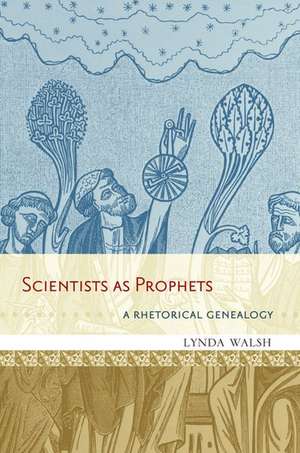
Scientists as Prophets: A Rhetorical Genealogy
Autor Lynda Walshen Limba Engleză Paperback – aug 2013
Preț: 387.02 lei
Preț vechi: 430.19 lei
-10%
Puncte Express: 581
Carte tipărită la comandă
Livrare economică 10-15 decembrie
Livrare prin curier în România Termenul estimat este afișat lângă disponibilitate.
Transport gratuit de la 400.00 lei Plată online sau ramburs, în funcție de opțiunile comenzii.
Retur gratuit în 14 zile Comandă securizată și suport în română.
Specificații
ISBN-13: 9780199857111
ISBN-10: 0199857113
Pagini: 276
Ilustrații: 7 black-and-white; 2 color
Dimensiuni: 155 x 231 x 20 mm
Greutate: 0.41 kg
Editura: Oxford University Press
Colecția OUP USA
Locul publicării:New York, United States
ISBN-10: 0199857113
Pagini: 276
Ilustrații: 7 black-and-white; 2 color
Dimensiuni: 155 x 231 x 20 mm
Greutate: 0.41 kg
Editura: Oxford University Press
Colecția OUP USA
Locul publicării:New York, United States
V-ar putea interesa
-
 The Infinite BookJohn D. Barrow-18%Preț: 76.40 lei93.73 lei
 -
 The Scenes of Inquiry: On the Reality of Questions in the SciencesNicholas Jardine-27%Preț: 439.24 lei604.26 lei
 -
 -35%Preț: 441.66 lei682.78 lei
 -
 -19%Preț: 132.89 lei164.44 lei
 -
 Visual Cultures in Science and Technology: A Comparative HistoryKlaus Hentschel-32%Preț: 817.98 lei1205.99 lei
 -
 Philosophy of Science TodayPeter Clark-20%Preț: 288.93 lei362.54 lei
 -
 -27%Preț: 369.47 lei503.22 lei
 -
 -32%Preț: 815.71 lei1192.95 lei
 -
 -11%Preț: 284.88 lei319.89 lei
 -
 Evidence, Explanation, and Realism: Essays in Philosophy of SciencePeter Achinstein-27%Preț: 524.91 lei719.99 lei
 -
 -28%Preț: 377.50 lei521.84 lei
 -
 Does Santa Exist?Eric Kaplan-26%Preț: 68.50 lei92.80 lei
 -
 The Logic of Scientific DiscoveryKarl PopperPreț: 237.24 lei
 -
 Problems of EmpiricismPaul K. FeyerabendPreț: 246.29 lei
 -
 Realism, Rationalism and Scientific MethodPaul K. FeyerabendPreț: 216.75 lei
 -
 Science and Ultimate RealityJohn. D. Barrow-9%Preț: 791.99 lei870.32 lei
 -
 The Turning PointFritjof CapraPreț: 157.38 lei
 -
 -16%Preț: 196.36 lei233.92 lei
 -
 World of Our GrandchildrenBert Koene-11%Preț: 126.85 lei143.25 lei
Recenzii
On contentious issues like climate change and the teaching of evolution in schools, public officials seek out scientific advisers for guidance, oftentimes pulling scientists into the spotlight away from their comfort zones. Some win widespread acclaim for their efforts to shape public policy, while others are denounced as subverters of traditional values. In Scientists as Prophets, Lynda Walsh shows that across history-Francis Bacon, Robert Boyle, Rachel Carson, J. Robert Oppenheimer, Steven Jay Gould, Carl Sagan-scientists who venture into public policy arenas are immersed in the discourse of prophecy. In this ambitious and insightful book, Walsh raises our appreciation of prophecy as a pragmatic and rational genre for experts doing their best to interpret the unknowable.
Walsh shows that the prophetic function of the science adviser is as old as science itself, not a contemporary add-on. She uses an ingenious adaptation of Kenneth Burke's Pentad to trace its history and to show how the prophetic ethos has shaped contemporary controversies over nuclear security, pesticides, and global warming. The work is deeply informed, engagingly written, and convincingly argued; it enriches our understanding of the rhetoric of science and of the relations between science and the polity.
This book is interesting, nuanced and stimulating.
Walsh shows that the prophetic function of the science adviser is as old as science itself, not a contemporary add-on. She uses an ingenious adaptation of Kenneth Burke's Pentad to trace its history and to show how the prophetic ethos has shaped contemporary controversies over nuclear security, pesticides, and global warming. The work is deeply informed, engagingly written, and convincingly argued; it enriches our understanding of the rhetoric of science and of the relations between science and the polity.
This book is interesting, nuanced and stimulating.
Notă biografică
Lynda Walsh is an Associate Professor of English at the University of Nevada, Reno.