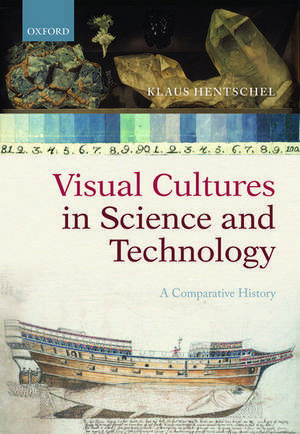
Visual Cultures in Science and Technology: A Comparative History
Autor Klaus Hentschelen Limba Engleză Hardback – 30 oct 2014
Preț: 817.98 lei
Preț vechi: 1205.99 lei
-32%
Puncte Express: 1227
Carte disponibilă
Livrare economică 06-17 noiembrie
Livrare prin curier în România Termenul estimat este afișat lângă disponibilitate.
Transport gratuit pentru acest produs Plată online sau ramburs, în funcție de opțiunile comenzii.
Retur gratuit în 14 zile Comandă securizată și suport în română.
Specificații
ISBN-13: 9780198717874
ISBN-10: 0198717873
Pagini: 512
Ilustrații: 126 b/w illustrations, 16pp colour plates
Dimensiuni: 182 x 253 x 33 mm
Greutate: 1.23 kg
Editura: OUP OXFORD
Colecția OUP Oxford
Locul publicării:Oxford, United Kingdom
ISBN-10: 0198717873
Pagini: 512
Ilustrații: 126 b/w illustrations, 16pp colour plates
Dimensiuni: 182 x 253 x 33 mm
Greutate: 1.23 kg
Editura: OUP OXFORD
Colecția OUP Oxford
Locul publicării:Oxford, United Kingdom
V-ar putea interesa
-
 The Oxford Illustrated History of ScienceIwan Rhys Morus-16%Preț: 211.26 lei252.44 lei
 -
 Image Science: Iconology, Visual Culture, and Media AestheticsProfessor W. J. T. MitchellPreț: 235.40 lei
 -
 Preț: 232.27 lei
 -
 Preț: 118.51 lei
 -
 Preț: 122.98 lei
 -
 Picturing AuraJeremy StolowPreț: 368.03 lei
 -
 Functional Art, TheAlberto CairoPreț: 330.64 lei
 -
 Art + Science NowStephen Wilson-21%Preț: 155.99 lei196.91 lei
 -
 NanocosmosMichael BensonPreț: 412.11 lei
 -
 Images at the CrossroadsJudith M Barringer-9%Preț: 223.79 lei245.43 lei
 -
 The Power of Images - Siena, 1338Patrick BoucheronPreț: 156.97 lei
 -
 Forms of the VisiblePhilippe DescolaPreț: 290.51 lei
 -
 A Short History of Nearly Everything 2.0Bill BrysonPreț: 142.00 lei
 -
 The Book of TreesManuel Lima-8%Preț: 132.55 lei143.66 lei
 -
 MicrocosmsJill PflugheberPreț: 345.27 lei
 -
 -15%Preț: 560.94 lei659.93 lei
 -
 Astrology. The Library of EsotericaAndrea RichardsPreț: 130.50 lei
 -
 The Incomplete Vol. 2GestaltenPreț: 362.40 lei
Recenzii
This fine work is a survey of the history, use, and function of the image in the practice of science. ... The book is very readable, amply illustrated, and carefully documented; the biography alone exceeds 80 pages. Highly recommended.
a very useful synthesis of the study of the history and historiography of visual representation in the early modern and modern periods up to the late 20th century within the Western tradition
The spotlight that Hentschel casts on members of the latter group, a diverse cast of woodcutters, illustrators, illuminators, and other technicians, is a particular strength of the book.
a timely but colossal endeavour to take stock of the literature on visual cultures of science ... He has written a work that operates both as a major resource, friendly to those who want to merely dip in and out, and as a major scholarly contribution with a sustained argument about what constitutes visual cultures in science. Indeed, Hentschel must be congratulated on a fine contribution, one that actually gives much-needed shape to the field of visual cultures and the sciences.
Hentschel's is a clear and useful book which critically discusses and compares a bulk of historical case studies to reveal general principles within a broad pattern. The book is supplemented with remarkable pictures, which perfectly illustrate the notion of layered visual culture, as well as a rich bibliography and suggestions for further reading. ... Hentschel's book can be recommended to both students and specialized scholars.
Visual Cultures in Science and Technology is intended to provide a systematic and integrative account of the formation and development of a plurality of visual cultures throughout the history of Western science, technology, and medicine. At the core of its methodology is an exhaustive -- and new -- comparative approach based on a large number of case studies covering a period that extends from the early modern era to the present day. The selection and range of examples is indeed phenomenal. And so are the visual materials and bibliography that support the argument.
a very useful synthesis of the study of the history and historiography of visual representation in the early modern and modern periods up to the late 20th century within the Western tradition
The spotlight that Hentschel casts on members of the latter group, a diverse cast of woodcutters, illustrators, illuminators, and other technicians, is a particular strength of the book.
a timely but colossal endeavour to take stock of the literature on visual cultures of science ... He has written a work that operates both as a major resource, friendly to those who want to merely dip in and out, and as a major scholarly contribution with a sustained argument about what constitutes visual cultures in science. Indeed, Hentschel must be congratulated on a fine contribution, one that actually gives much-needed shape to the field of visual cultures and the sciences.
Hentschel's is a clear and useful book which critically discusses and compares a bulk of historical case studies to reveal general principles within a broad pattern. The book is supplemented with remarkable pictures, which perfectly illustrate the notion of layered visual culture, as well as a rich bibliography and suggestions for further reading. ... Hentschel's book can be recommended to both students and specialized scholars.
Visual Cultures in Science and Technology is intended to provide a systematic and integrative account of the formation and development of a plurality of visual cultures throughout the history of Western science, technology, and medicine. At the core of its methodology is an exhaustive -- and new -- comparative approach based on a large number of case studies covering a period that extends from the early modern era to the present day. The selection and range of examples is indeed phenomenal. And so are the visual materials and bibliography that support the argument.
Notă biografică
Prior to his current full professorship in the history of science and technology at the University of Stuttgart, Klaus Hentschel was a Lecturer/Researcher at the Universities of Berlin, Göttingen and Berne, a Fellow at the Dibner Institute for the History of Science & Technology at MIT in Cambridge, Massachusetts 1996/97 and Ernst Cassirer Guest Professor at the University of Hamburg 2003.
Cuprins
- 1: Introduction
- 2: Historiographic layers of visual science cultures
- 3: Formation of visual science cultures
- 4: Pioneers of visual science cultures
- 5: Transfer of visual techniques
- 6: Support by illustrators and image technicians
- 7: One image rarely comes alone
- 8: Practical training in visual skills
- 9: Mastery of pattern recognition
- 10: Visual thinking in scientic and technological practice
- 11: Recurrent color taxonomies
- 12: Aesthetic fascination as a visual culture's binding glue
- 13: Issues of visual perception
- 14: Visuality through and through