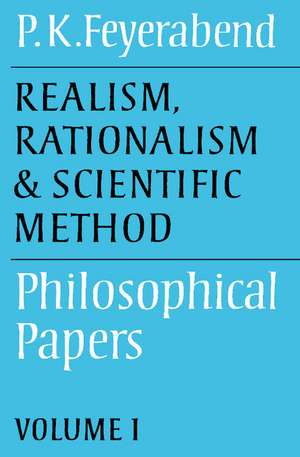
Realism, Rationalism and Scientific Method: Volume 1: Philosophical Papers
Autor Paul K. Feyerabenden Limba Engleză Paperback – 29 iun 1985
Bazându-ne pe arhivele Cambridge University Press și pe corpusul teoretic al unuia dintre cei mai radicali gânditori ai secolului XX, notăm cu interes apariția primului volum din Realism, Rationalism and Scientific Method: Volume 1. Această ediție revizuită nu este doar o simplă antologie, ci o reconstrucție sistematică a evoluției lui Paul K. Feyerabend, oferind perspective istorice asupra dezbaterilor care au modelat filozofia științei contemporane. Considerăm că forța argumentației rezidă în capacitatea autorului de a extrage concluzii filozofice profunde direct din analiza riguroasă a istoriei fizicii, respingând rigiditatea metodologică în favoarea unui pluralism teoretic.
Textul acoperă aceeași arie tematică precum Knowledge, Science and Relativism, dar cu o abordare mai aplicată pe fundamentele fizicii și pe interpretarea entităților teoretice. În timp ce volumul menționat anterior explorează relația cu raționalismul critic al lui Popper, volumul de față detaliază mecanismele prin care teoriile științifice sunt interpretate și validate în practică. Merită menționat că această lucrare consolidează temele abordate în Against Method și The Tyranny of Science, oferind însă baza analitică și academică necesară pentru a înțelege scepticismul său față de o metodă științifică universală.
Structura este una densă, specifică scrierilor academice, dar rămâne accesibilă prin noile introduceri care contextualizează fiecare secțiune. Feyerabend demonstrează aici o erudiție remarcabilă, navigând între problemele tehnice ale mecanicii cuantice și implicațiile politice ale autorității științifice. Este o resursă esențială pentru cercetătorii care doresc să înțeleagă rădăcinile realismului științific și criticile aduse raționalismului abstract.
Preț: 205.86 lei
Carte disponibilă
Livrare economică 15-29 mai
Specificații
ISBN-10: 0521316421
Pagini: 368
Ilustrații: 12 b/w illus.
Dimensiuni: 152 x 229 x 21 mm
Greutate: 0.56 kg
Ediția:Revised
Editura: Cambridge University Press
Colecția Cambridge University Press
Locul publicării:New York, United States
V-ar putea interesa
-
 -11%Preț: 335.18 lei376.60 lei
 -
 Preț: 97.25 lei
 -
 Problems of Empiricism: Volume 2: Philosophical PapersPaul K. FeyerabendPreț: 238.48 lei
 -
 Kant: Metaphysical Foundations of Natural ScienceImmanuel KantPreț: 319.68 lei
 -
 The Cambridge Companion to the Philosophy of BiologyDavid L. HullPreț: 324.54 lei
 -
 Science and Ultimate RealityJohn. D. Barrow-9%Preț: 717.20 lei788.13 lei
 -
 Three Dialogues on KnowledgeFeyerabendPreț: 238.23 lei
 -
 What is Life? (Canto Classics)Erwin SchrodingerPreț: 102.60 lei
 -
 The Two CulturesC. P. SnowPreț: 105.95 lei
 -
 A Philosophical Guide to ChanceToby HandfieldPreț: 236.80 lei
 -
 Against MethodPaul FeyerabendPreț: 127.99 lei
De ce să citești această carte
Această carte este indispensabilă pentru studenții și cercetătorii în filozofia științei care doresc să depășească viziunile simpliste asupra progresului academic. Cititorul câștigă o înțelegere nuanțată a modului în care pluralismul ideatic poate stimula rigoarea științifică. Este un instrument critic pentru oricine analizează relația dintre certitudinea teoretică și realitatea istorică a practicii de laborator.
Despre autor
Paul K. Feyerabend (1924–1994) a fost profesor de filozofie la UC Berkeley și profesor de filozofia științei la Institutul Federal de Tehnologie din Zurich. Recunoscut drept unul dintre cei mai influenți și iconoclaști filozofi ai științei din a doua jumătate a secolului XX, Feyerabend a provocat normele academice prin lucrări precum Against Method și Farewell to Reason. Opera sa se distinge prin apărarea pluralismului metodologic și prin critica acerbă a dogmatismului științific, integrând adesea perspective din istorie, artă și politică în analiza epistemologică.
Descriere scurtă
Cuprins
Recenzii
'The importance of Feyerabend is that he shows this easy way out cannot be taken for granted. As long as we had at the back of our minds the idea of an independent reality to pull thought in the right direction, Feyerabend's insistence on the inexhaustible diversity of possible standards seemed merely provocative. But without such a reality the onus of argument has shifted. Little as we may like it, Feyerabend is in the driving seat. He has actually done the historical work to show that sane men with good ideas, both within Western science and without, have hewn all kinds of different intellectual values. After Feyerabend, simply gesturing in the direction of some supposed common intellectual commitment is no longer going to hold relativism at bay. Indeed Fayerband has made it very difficult to see how we can continue to believe in the one true theoretical way. The Times Literary Supplement