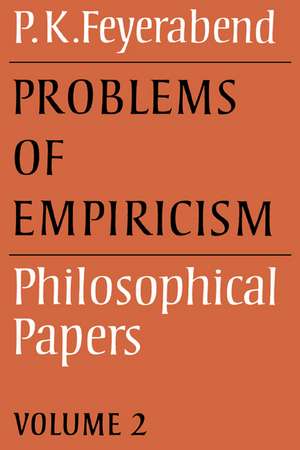
Problems of Empiricism: Volume 2: Philosophical Papers
Autor Paul K. Feyerabenden Limba Engleză Paperback – 29 iun 1985
Literatura academică dedicată filozofiei științei a suferit mult timp de o separare rigidă între rigoarea logică și realitatea istorică a practicii științifice, o lacună pe care Problems of Empiricism: Volume 2 o adresează frontal. Ne-a atras atenția modul în care Paul K. Feyerabend demontează mitul unei metode științifice unitare, propunând în schimb un pluralism metodologic ce refuză dogmatismul raționalist. Această ediție revizuită, publicată de Cambridge University Press, nu este doar o colecție de eseuri, ci o demonstrație de forță intelectuală care integrează implicațiile politice și practice ale științei.
Suntem de părere că structura volumului indică o progresie de la fundamentele istorice ale empirismului clasic către o critică acerbă a contemporanilor săi. Autorul examinează „decadența” filozofiei științei și oferă perspective originale asupra lui Mach și Einstein, culminând cu analize de o actualitate surprinzătoare despre cercetările lui Popper și Laudan. Spre deosebire de abordarea din Physics and Philosophy: Volume 4, care se concentrează strict pe filozofia fizicii cuantice din prima sa perioadă de creație, acest volum reflectă maturitatea gândirii sale, făcând tranziția către temele de relativism și pluralism cultural explorate ulterior în Farewell to Reason.
Merită menționat că această lucrare reprezintă o alternativă necesară la Realism, Rationalism and Scientific Method: Volume 1 pentru cursurile de filozofia științei, având avantajul că mută accentul de pe interpretarea teoriilor pe dinamica schimbării epistemice și pe conflictul dintre teoria abstractă și practica de laborator. Stilul lui Paul K. Feyerabend rămâne provocator, folosind istoria științei nu ca decor, ci ca instrument de demistificare a autorității intelectuale.
Preț: 238.48 lei
Carte tipărită la comandă
Livrare economică 04-18 iunie
Specificații
ISBN-10: 0521316413
Pagini: 268
Dimensiuni: 152 x 229 x 15 mm
Greutate: 0.38 kg
Ediția:Revised
Editura: Cambridge University Press
Colecția Cambridge University Press
Locul publicării:New York, United States
V-ar putea interesa
-
 New Waves in Philosophy of TechnologyJan Kyrre Berg Olsen-15%Preț: 618.05 lei727.12 lei
 -
 Realism, Rationalism and Scientific Method: Volume 1: Philosophical PapersPaul K. FeyerabendPreț: 205.86 lei
 -
 The Cambridge Companion to the Philosophy of BiologyDavid L. HullPreț: 324.54 lei
 -
 Science and Ultimate RealityJohn. D. Barrow-9%Preț: 717.20 lei788.13 lei
 -
 Three Dialogues on KnowledgeFeyerabendPreț: 238.23 lei
 -
 What is Life? (Canto Classics)Erwin SchrodingerPreț: 102.60 lei
 -
 The Two CulturesC. P. SnowPreț: 105.95 lei
 -
 A Philosophical Guide to ChanceToby HandfieldPreț: 236.80 lei
 -
 On Space and TimeShahn MajidPreț: 168.52 lei
 -
 An Introduction to Science and Technology StudiesSergio SismondoPreț: 249.34 lei
 -
 Critique of Intelligent DesignJohn Bellamy FosterPreț: 118.97 lei
 -
 Against MethodPaul FeyerabendPreț: 127.99 lei
 -
 The Ascent of ManJacob Bronowski-20%Preț: 81.74 lei102.61 lei
 -
 Operating Manual for Spaceship EarthR. Buckminster Fuller-14%Preț: 103.98 lei121.20 lei
De ce să citești această carte
Această carte este esențială pentru studenții și cercetătorii care doresc să înțeleagă rădăcinile pluralismului epistemologic. Cititorul câștigă o perspectivă critică asupra limitărilor raționalismului abstract și învață cum istoria reală a științei contrazice adesea normele rigide ale manualelor. Este un instrument fundamental pentru a deconstrui dogmele metodologice și pentru a înțelege știința ca pe o activitate umană complexă, ancorată în context politic și social.
Despre autor
Paul K. Feyerabend (1924–1994) a fost una dintre cele mai influente și controversate figuri ale filozofiei științei din secolul XX. Profesor la UC Berkeley și la Institutul Federal de Tehnologie din Zürich, el a devenit celebru prin critica adusă normelor metodologice rigide. Opera sa, care include titluri fundamentale precum Against Method și The Tyranny of Science, pledează pentru libertatea intelectuală și recunoașterea diversității formelor de cunoaștere. Prezentul volum reflectă erudiția sa vastă, combinând rigoarea filozofică cu o cunoaștere profundă a istoriei fizicii și a științelor naturii.
Descriere scurtă
Over the past thirty years Paul Feyerabend has developed an extremely distinctive and influentical approach to problems in the philosophy of science. The most important and seminal of his published essays are collected here in two volumes, with new introductions to provide an overview and historical perspective on the discussions of each part. Volume 1 presents papers on the interpretation of scientific theories, together with papers applying the views developed to particular problems in philosophy and physics. The essays in volume 2 examine the origin and history of an abstract rationalism, as well as its consequences for the philosophy of science and methods of scientific research. Professor Feyerabend argues with great force and imagination for a comprehensive and opportunistic pluralism. In doing so he draws on extensive knowledge of scientific history and practice, and he is alert always to the wider philosophical, practical and political implications of conflicting views. These two volumes fully display the variety of his ideas, and confirm the originality and significance of his work.
Cuprins
1. Historical background: some observations on the decay of the philosophy of science; 2. Classicl empiricism; 3. The structure of science; 4. Two models of epistemic change: Mill and Hegel; 5. Philosophy of science versus scientific practice: observations on Mach, his followers and his opponents; 6. Mach, Einstein and the Popperians; 7. Wittgenstein's Philosophical Investigations; 8. Consolations for the specialist; 9. Popper's Objective Knowledge; 10. The methodology of scientific research programmes; 11. More clothes from the emperor's bargain basement: a review of Laudan's Progress and its Problems; Sources; Name index; Subject index.
Recenzii
'The importance of Feyerabend is that he shows this easy way out cannot be taken for granted. As long as we had at the back of our minds the idea of an independent reality to pull thought in the right direction, Feyerabend's insistence on the inexhaustible diversity of possible standards seemed merely provocative. But without such a reality the onus of argument has shifted. Little as we may like it, Feyerabend is in the driving seat. He has actually done the historical work to show that sane men with good ideas, both within Western science and without, have hewn all kinds of different intellectual values. After Feyerabend, simply gesturing in the direction of some supposed common intellectual commitment is no longer going to see how we can continue believing in the one true theoretical way.' The Times Literary Supplement