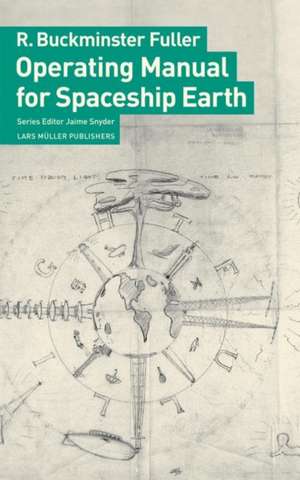
Operating Manual for Spaceship Earth
Autor R. Buckminster Fuller Editat de Jaime Snyderen Limba Engleză Paperback – iun 2008
Analizând volumele de referință din portofoliul Lars Müller Publishers și datele de arhivă despre opera lui R. Buckminster Fuller, redescoperim Operating Manual for Spaceship Earth, o sinteză vizionară a filozofiei sistemice. Publicat inițial în 1969, acest text depășește granițele unui simplu manifest ecologist, fiind conceput ca un ghid tehnic și filozofic pentru gestionarea resurselor finite ale planetei. Remarcăm în această ediție intervenția editorială a lui Jaime Snyder, care adaugă un aparat critic esențial, actualizând conceptele de acum cinci decenii pentru contextul crizei climatice actuale. Abordarea lui Fuller este una de inginerie socială și design comprehensiv. Putem afirma că nucleul argumentației sale este respingerea specializării, pe care o consideră o barieră în calea înțelegerii holistice a sistemului terestru. Autorul propune o „revoluție a designului” prin care tehnologia să permită realizarea a „mai mult cu mai puțin”, o premisă care anticipează dezbaterile contemporane despre sustenabilitate și automatizare. Cartea acoperă aceeași arie tematică precum Critical Path, însă Operating Manual for Spaceship Earth are o structură mai accesibilă și mai concentrată pe principii de navigație planetară, spre deosebire de caracterul monumental și retrospectiv al titlului menționat. Comparativ cu You Belong to the Universe de Jonathon Keats, care oferă o perspectivă biografică și critică asupra eșecurilor și succeselor inventatorului, volumul de față reprezintă vocea directă a lui Fuller, păstrând acel ton specific de optimism tehnologic. Cele 151 de pagini, completate de 7 ilustrații alb-negru, transformă lectura într-o experiență densă, dar clară, ideală pentru cei care doresc să înțeleagă rădăcinile gândirii ecologice moderne și ale designului sustenabil.
Preț: 112.39 lei
Preț vechi: 127.24 lei
-12%
Carte disponibilă
Livrare economică 17-24 noiembrie
Livrare express 31 octombrie-06 noiembrie pentru 33.12 lei
Specificații
ISBN-10: 3037781262
Pagini: 151
Ilustrații: 7 schwarz-weiße Abbildungen
Dimensiuni: 121 x 190 x 15 mm
Greutate: 0.18 kg
Ediția:Nachdruck
Editura: Lars Müller Publishers
V-ar putea interesa
-
 Preț: 403.05 lei
 -
 Critical PathR Buckminster FullerPreț: 165.58 lei
 -
 -19%Preț: 28.85 lei35.52 lei
 -
 -19%Preț: 28.85 lei35.52 lei
 -
 Wild Predators (Wild Kratts)Chris Kratt-19%Preț: 26.15 lei32.13 lei
 -
 -19%Preț: 51.78 lei64.06 lei
 -
 Acres of DiamondsRussell ConwellPreț: 26.53 lei
 -
 The Decline and Fall of the Human EmpireHenry Gee-34%Preț: 80.86 lei122.38 lei
 -
 -27%Preț: 151.28 lei206.93 lei
 -
 Our StoryColin Butfield-20%Preț: 134.77 lei168.13 lei
 -
 In Praise of the EarthByung-Chul HanPreț: 113.34 lei
 -
 Here and BeyondHal LaCroix-26%Preț: 79.86 lei107.39 lei
 -
 A Short History of Nearly Everything 2.0Bill BrysonPreț: 142.00 lei
 -
 Once Upon a Time in SpaceJames BluemelPreț: 216.27 lei
 -
 Dangerous MiracleLiam ShawPreț: 123.50 lei
 -
 Human NatureKate MarvelPreț: 136.91 lei
 -
 Cut-out Curiosities Space, Science & Technology: A Collage BookMaximillian Malone-18%Preț: 126.31 lei153.75 lei
 -
 Ideas and IntegritiesBuckminster R. Fuller-49%Preț: 123.52 lei244.29 lei
 -
 James Lovelock et alJames LovelockPreț: 130.50 lei
 -
 Life on a Little-Known PlanetElizabeth KolbertPreț: 193.02 lei
De ce să citești această carte
Recomandăm această carte oricărui cititor interesat de sustenabilitate, design industrial sau filozofia științei. Veți câștiga o perspectivă unică asupra modului în care resursele globale pot fi gestionate ca un sistem unitar. Este un titlu fundamental pentru a înțelege de ce viziunea lui Fuller despre „nava spațială Pământ” rămâne un instrument critic în efortul actual de a evita colapsul ecologic și de a asigura supraviețuirea umanității prin inovație.
Despre autor
R. Buckminster Fuller (1895–1983) a fost un polimat american, activând ca arhitect, inginer, inventator și futurist. Este recunoscut la nivel mondial pentru popularizarea domului geodezic și pentru conceptele sale revoluționare în cartografie și geometrie. De-a lungul carierei sale, Fuller s-a dedicat întrebării dacă umanitatea are capacitatea de a supraviețui pe termen lung pe planeta Pământ și cum poate tehnologia să faciliteze acest proces. Ideile sale despre designul comprehensiv și utilizarea eficientă a resurselor au influențat generații de arhitecți și activiști de mediu, rămânând repere esențiale în gândirea sistemică modernă.