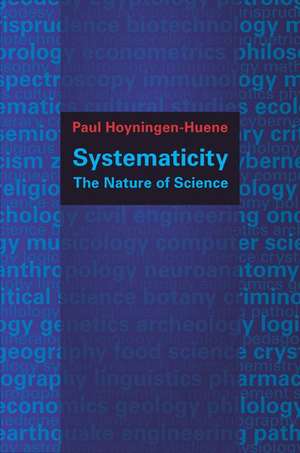
Systematicity: The Nature of Science: Oxford Studies in Philosophy of Science
Autor Paul Hoyningen-Hueneen Limba Engleză Hardback – 2 mai 2013
Din seria Oxford Studies in Philosophy of Science
- 33%
 Preț: 667.47 lei
 - 30%
 Preț: 526.98 lei
 - 30%
 Preț: 461.45 lei
 - 11%
 Preț: 361.53 lei
 - 22%
 Preț: 342.90 lei
 - 31%
 Preț: 647.26 lei
 - 31%
 Preț: 588.32 lei
 - 11%
 Preț: 353.80 lei
 - 29%
 Preț: 397.36 lei
 - 28%
 Preț: 358.72 lei
 - 19%
 Preț: 353.51 lei
 - 31%
 Preț: 659.96 lei
 - 19%
 Preț: 361.96 lei
 - 31%
 Preț: 626.06 lei
 - 21%
 Preț: 257.28 lei
 - 20%
 Preț: 260.86 lei
 - 18%
 Preț: 346.18 lei
 - 31%
 Preț: 536.23 lei
 - 32%
 Preț: 537.44 lei
 - 34%
 Preț: 609.37 lei
 - 20%
 Preț: 303.65 lei
 - 31%
 Preț: 638.59 lei
 - 33%
 Preț: 660.31 lei
 - 30%
 Preț: 683.18 lei
 - 19%
 Preț: 150.58 lei
 - 24%
 Preț: 178.94 lei
Preț: 694.28 lei
Preț vechi: 1001.48 lei
-31%
Puncte Express: 1041
Carte tipărită la comandă
Livrare economică 27 noiembrie-08 decembrie
Livrare prin curier în România Termenul estimat este afișat lângă disponibilitate.
Transport gratuit pentru acest produs Plată online sau ramburs, în funcție de opțiunile comenzii.
Retur gratuit în 14 zile Comandă securizată și suport în română.
Specificații
ISBN-13: 9780199985050
ISBN-10: 0199985057
Pagini: 304
Dimensiuni: 236 x 165 x 33 mm
Greutate: 0.53 kg
Ediția:New.
Editura: Oxford University Press
Colecția OUP USA
Seria Oxford Studies in Philosophy of Science
Locul publicării:New York, United States
ISBN-10: 0199985057
Pagini: 304
Dimensiuni: 236 x 165 x 33 mm
Greutate: 0.53 kg
Ediția:New.
Editura: Oxford University Press
Colecția OUP USA
Seria Oxford Studies in Philosophy of Science
Locul publicării:New York, United States
V-ar putea interesa
-
 Emergence: From Chaos to OrderJohn H. Holland-16%Preț: 166.67 lei199.49 lei
 -
 The Metaphysics of Quantum TheoryHenry Krips-22%Preț: 143.56 lei183.18 lei
 -
 -21%Preț: 66.37 lei83.83 lei
 -
 How Big is Big and How Small is Small: The Sizes of Everything and WhyTimothy Paul Smith-11%Preț: 353.40 lei398.00 lei
 -
 The Oxford Handbook of Philosophy of BiologyMichael Ruse-29%Preț: 405.24 lei567.29 lei
 -
 What is This Thing Called Science?Alan Chalmers-27%Preț: 199.81 lei273.20 lei
 -
 Does Santa Exist?Eric Kaplan-28%Preț: 66.18 lei91.32 lei
 -
 Science Set FreeRupert SheldrakePreț: 103.51 lei
 -
 -13%Preț: 100.49 lei115.43 lei
 -
 Science in a Free SocietyPaul FeyerabendPreț: 112.58 lei
 -
 Naturalism and PragmatismJay SchulkinPreț: 407.21 lei
 -
 -16%Preț: 196.36 lei233.92 lei
 -
 Philosophical Chemistry: Genealogy of a Scientific FieldProfessor Manuel DeLanda-23%Preț: 367.29 lei474.53 lei
 -
 Preț: 97.04 lei
 -
 Handbook of Risk TheoryRafaela Hillerbrand-24%Preț: 4725.55 lei6217.83 lei
 -
 World of Our GrandchildrenBert Koene-11%Preț: 126.85 lei143.25 lei
Recenzii
Systematicity constitutes a welcome contribution to the general philosophy of science. The research agenda for general philosophy of science has been shifting over the last three decades as many philosophers of science have focused on issues in the philosophy of the special sciences, philosophy of physics, philosophy of biology, and the like. In Systematicity, Hoyningen-Huene shows that there is still important and interesting work to be done in general philosophy of science. One leaves the book with a deeper appreciation for the nature of science, as the subtitle suggests, and why science rightly holds the important place it does in contemporary Western cultures. The book has the marks of being written by a mature scholar, erudite, wide ranging, and carefully argued.
Hoyningen-Huene presents a thought-provoking image of science that is very useful for the debate on the nature of science within science education.
provides a fresh perspective on science ... Recommended.
This is a well-organized, well-written, and compellingly argued text on a topic of considerable importance.
This book is a pleasure to read. It is well written, delicately crafted, scrupulously sign-posted, and very carefully and closely argued including of course the appropriate hedging at crucial points. Its perspective on the histories of both Science and philosophy is expansive, and its author strikes an impeccably impartial tone on disputes that are purely intramural in character
or irrelevant to the subject at hand.
Hoyningen-Huene presents a thought-provoking image of science that is very useful for the debate on the nature of science within science education.
provides a fresh perspective on science ... Recommended.
This is a well-organized, well-written, and compellingly argued text on a topic of considerable importance.
This book is a pleasure to read. It is well written, delicately crafted, scrupulously sign-posted, and very carefully and closely argued including of course the appropriate hedging at crucial points. Its perspective on the histories of both Science and philosophy is expansive, and its author strikes an impeccably impartial tone on disputes that are purely intramural in character
or irrelevant to the subject at hand.
Notă biografică
Paul Hoyningen-Huene is a philosopher of science with a PhD in theoretical physics teaching at the Institute of Philosophy at the Leibniz University of Hannover, Germany. He is best known for his book Reconstructing Scientific Revolutions: Thomas S. Kuhn's Philosophy of Science (1993).
Cuprins
- Preface
- 1 Introduction
- 1.1 Historical Remarks
- 1.2 The Question "What Is Science?" in Focus
- 2 The Main Thesis
- 2.1 Science and Systematicity
- A) A Little History
- B) Preliminary Remarks
- 2.2 The Concept of Systematicity
- 2.3 The Structure of the Argument
- 3 The Systematicity of Science Unfolded
- 3.1 Descriptions
- A) Some Preliminaries
- B) Axiomatization
- C) Classification, Taxonomy, and Nomenclature
- D) Periodization
- E) Quantification
- F) Empirical Generalizations
- G) Historical Descriptions
- 3.2 Explanations
- A) Some Preliminaries
- B) Explanations Using Empirical Generalizations
- C) Explanations Using Theories
- D) Explanations of Human Actions
- E) Reductive Explanations
- F) Historical Explanations
- G) Explanation and Understanding in the Humanities in General
- H) Explanations in the Study of Literature
- 3.3 Predictions
- A) Some Preliminaries
- B) Predictions Based on Empirical Regularities of the Data in Question
- C) Predictions Based on Correlations with Other Data Sets
- D) Predictions Based on (Fundamental) Theories or Laws
- E) Predictions Based on Models
- F) Predictions Based on Delphi Methods
- 3.4 The Defense of Knowledge Claims
- A) Some Preliminaries
- B) Non-Evidential Considerations
- C) Empirical Generalizations, Models, and Theories
- D) Causal Influence
- E) The Verum Factum Principle
- F) The Role of Mathematics in the Sciences
- G) Historical Sciences
- 3.5 Critical Discourse
- A) Some Preliminaries
- B) Norms and Institutions
- C) Practices in Science Fostering Critical Discourse
- 3.6. Epistemic Connectedness
- A) Preliminaries: The Problem
- B) Failing Answers
- C) The Concept of Epistemic Connectedness
- D) Revisiting the Examples
- 3.7 The Ideal of Completeness
- A) Some Preliminaries
- B) Examples
- 3.8 The Generation of New Knowledge
- A) Some Preliminaries
- B) Data Collection
- C) The Exploitation of Knowledge from Other Domains
- D) The Generation of New Knowledge as an Autocatalytic Process
- 3.9 The Representation of Knowledge
- A) Some Preliminaries
- B) Examples
- 4 Comparison with Other Positions
- 4.1 Aristotle
- A) The Position
- B) Comparison with Systematicity Theory
- 4.2 René Descartes
- A) The Position
- B) Comparison with Systematicity Theory
- 4.3 Immanuel Kant
- A) The Position
- B) Comparison with Systematicity Theory
- 4.4 Logical Empiricism
- A) The Position
- B) Comparison with Systematicity Theory
- 4.5 Karl R. Popper
- A) The Position
- B) Comparison with Systematicity Theory
- 4.6 Thomas S. Kuhn
- A) The Position
- B) Comparison with Systematicity Theory
- 4.7 Paul K. Feyerabend
- A) The Position
- B) Comparison with Systematicity Theory
- 4.8 Nicholas Rescher
- A) The Position
- B) Comparison with Systematicity Theory
- 5 Consequences for Scientific Knowledge
- 5.1 The Genesis and Dynamics of Science
- A) Conceptual Clarifications
- B) The Genesis of a Science
- C) The Dynamics of Science
- 5.2 Science and Common Sense
- A) The Preservation of Common Sense
- B) The Deviations from Common Sense
- C) Additional Remarks
- 5.3 Normative Consequences
- 5.4 Demarcation from Pseudo-Science
- A) A Little History
- B) Systematicity Theory's Demarcation Criterion
- 6 Conclusion
- Notes
- Literature
- Literature