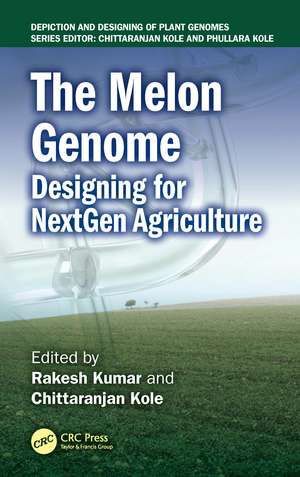
The Melon Genome: Designing for NextGen Agriculture: Depiction and Designing of Plant Genomes
Editat de Rakesh Kumar, Chittaranjan Koleen Limba Engleză Hardback – 26 mar 2026
The Melon Genome: Designing for NextGen Agriculture presents the latest research as a foundation for future melon crop improvement. Without effective breeding programs, sustaining melon production becomes challenging. This book integrates various aspects of melon breeding, including genetic diversity, genomics, and germplasm resources, for improving yield, quality, and resistance to biotic stresses.
Key features:
- Wide biodiversity, classes, and molecular diversity exist in melon germplasm
- Utilization of advanced sequencing technologies in melon breeding
- Germplasm resources and strategies for improving the melon crop for various traits


Preț: 1117.64 lei
Preț vechi: 1451.48 lei
-23%
Puncte Express: 1676
Carte tipărită la comandă
Livrare economică 25 noiembrie-01 decembrie
Livrare prin curier în România Termenul estimat este afișat lângă disponibilitate.
Transport gratuit pentru acest produs Plată online sau ramburs, în funcție de opțiunile comenzii.
Retur gratuit în 14 zile Comandă securizată și suport în română.
Specificații
ISBN-13: 9781041202448
ISBN-10: 104120244X
Pagini: 152
Ilustrații: 20
Dimensiuni: 156 x 234 mm
Greutate: 0.44 kg
Ediția:1
Editura: CRC Press
Colecția CRC Press
Seria Depiction and Designing of Plant Genomes
ISBN-10: 104120244X
Pagini: 152
Ilustrații: 20
Dimensiuni: 156 x 234 mm
Greutate: 0.44 kg
Ediția:1
Editura: CRC Press
Colecția CRC Press
Seria Depiction and Designing of Plant Genomes
V-ar putea interesa
-
 A Vision for Continental-Scale BiologyNational Academies of Sciences Engineering and MedicinePreț: 189.01 lei
 -
 Temperate Tree Fruits and NutsGeorge Manganaris-33%Preț: 643.05 lei953.49 lei
 -
 Principles of Plant Genetics and BreedingGeorge Acquaah-19%Preț: 445.21 lei549.64 lei
 -
 Mushroom Biotechnology for Improved Agriculture and Human HealthCharles Oluwaseun Adetunji-23%Preț: 1166.25 lei1514.62 lei
 -
 On ExtinctionMelanie ChallengerPreț: 109.95 lei
 -
 TomatoesEp Heuvelink-19%Preț: 417.78 lei515.78 lei
 -
 AlmondsRafel Socias I Company-23%Preț: 1070.67 lei1390.49 lei
 -
 CucurbitsNarinder P S DhillonPreț: 480.86 lei
 -
 The Future of AgricultureSarah BearchellPreț: 70.02 lei
 -
 -23%Preț: 812.13 lei1054.72 lei
 -
 Tropical Fruits, Volume 2Odilo Duarte-19%Preț: 426.87 lei527.01 lei
 -
 CitrusL Gene Albrigo-19%Preț: 439.84 lei543.01 lei
 -
 Organic Fruit Production and ViticultureStella CubisonPreț: 209.00 lei
 -
 Advances in Plant Breeding Strategies: Vegetable CropsJameel M. Al-Khayri-24%Preț: 1015.74 lei1336.50 lei
 -
 Breeding and Biotechnology of Leaf, Fruit, and Seed Fiber CropsKhaled F. M. Salem-18%Preț: 1476.12 lei1800.14 lei
 -
 Wild Crop Relatives: Genomic and Breeding ResourcesChittaranjan Kole-24%Preț: 916.58 lei1206.03 lei
 -
 Fundamentals of Field Crop BreedingDevendra Kumar Yadava-17%Preț: 584.88 lei704.67 lei
 -
 Compendium of Crop Genome Designing for NutraceuticalsChittaranjan Kole-20%Preț: 4972.88 lei6216.10 lei
 -
 Fruit and Nut CropsP. E. Rajasekharan-18%Preț: 1743.87 lei2126.67 lei
 -
 Pearl Millet in the 21st CenturyVilas A Tonapi-18%Preț: 1628.28 lei1985.71 lei
Public țintă
Postgraduate and Professional ReferenceCuprins
1. Challenges Facing the Melon Industry 2. Genetic Diversity and Classification of Melon (Cucumis melo L.) 3. Melon Genomics 4. Genomics of Sex Expression – An Important Factor in Melon Breeding 5. Breeding for Virus Resistance in Melon (Cucumis melo) 6. Breeding for Fungal Pathogens in Melon (Cucumis melo L.) 7. Breeding for High Yield and Fruit Quality in Melon
Notă biografică
Rakesh Kumar is a globally renowned breeder at Syngenta with 16 years of experience in commercial breeding. The cultivars he has developed have had a worldwide impact and are grown on nearly every continent. His varieties have received the ‘Most Innovative Product’ award from Seed World and the ‘Fruit Logistica Silver Innovation Award’.
Chittaranjan Kole is an internationally renowned academician with a spectacular professional career spanning over 40 years. His lifetime original scientific contributions, specifically in the fields of plant genomics and biotechnology, have been globally appreciated. His scholarly publications include 170 research articles, mostly published in peer-reviewed international journals, 35 book chapters, and over 200 books with globally reputed publishers. His academic contributions have been profusely appreciated by seven Noble laureates. His research contributions have been recognized with several international awards and fellowships. Professor Kole has worked as a faculty member, head of department, dean, or vice chancellor in three universities in India and as a visiting professor in three universities in the United States. Currently, Professor Kole is acting as the founder president of Genome India International and of two other international organizations, including the International Climate Resilient Crop Genomics Consortium and the International Phytomedomics and Nutriomics Consortium.
Chittaranjan Kole is an internationally renowned academician with a spectacular professional career spanning over 40 years. His lifetime original scientific contributions, specifically in the fields of plant genomics and biotechnology, have been globally appreciated. His scholarly publications include 170 research articles, mostly published in peer-reviewed international journals, 35 book chapters, and over 200 books with globally reputed publishers. His academic contributions have been profusely appreciated by seven Noble laureates. His research contributions have been recognized with several international awards and fellowships. Professor Kole has worked as a faculty member, head of department, dean, or vice chancellor in three universities in India and as a visiting professor in three universities in the United States. Currently, Professor Kole is acting as the founder president of Genome India International and of two other international organizations, including the International Climate Resilient Crop Genomics Consortium and the International Phytomedomics and Nutriomics Consortium.
Descriere
Melon is a major cucurbit crop cultivated on 1.09 million hectares, producing 29.5 million tons. It is grown on nearly every continent, highlighting its significant economic value. Both public and private sectors operate dedicated melon breeding programs focused on crop improvement.