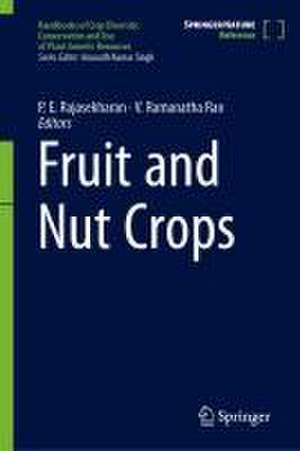
Fruit and Nut Crops: Handbooks of Crop Diversity: Conservation and Use of Plant Genetic Resources, cartea 8
Editat de P. E. Rajasekharan, V. Ramanatha Raoen Limba Engleză Hardback – 10 apr 2024
Recomandăm acest volum ca referință de nivel master și doctorat, fiind un instrument esențial pentru cercetătorii din domeniul botanicii și ameliorării plantelor. Publicată în 2024 sub egida Springer, lucrarea Fruit and Nut Crops reprezintă o sinteză actualizată a diversității genetice a culturilor de fructe și nucifere la nivel global. Structura volumului este organizată riguros pe specii, acoperind de la clasicele mere, căpșuni și struguri, până la culturi de nișă sau regionale precum litchi, caju și diverse specii de Pyrus și Syzygium. Subliniem faptul că textul nu se limitează la o simplă descriere botanică, ci analizează profund mecanismele de domesticire și evoluție a acestor culturi din strămoși sălbatici până la cultivarele moderne. Acoperă aceeași arie tematică precum Genetic Diversity of Fruits and Nuts de Hosakatte Niranjana Murthy, dar cu o abordare mult mai axată pe strategiile de conservare (ex situ și in situ) și pe reziliența în fața schimbărilor climatice. În timp ce alte lucrări din serie se pot concentra pe biotehnologie, acest volum prioritizează gestionarea resurselor genetice pentru securitatea alimentară. Progresia capitolelor permite cititorului să înțeleagă atât valoarea economică a resurselor, cât și metodologiile practice pentru îmbunătățirea randamentului și calității recoltelor prin programe de ameliorare durabile.
Preț: 1743.87 lei
Preț vechi: 2126.67 lei
-18%
Carte disponibilă
Livrare economică 16-30 noiembrie
Specificații
ISBN-10: 9819953472
Pagini: 680
Ilustrații: XX, 658 p. 40 illus., 39 illus. in color.
Dimensiuni: 160 x 241 x 40 mm
Greutate: 1.25 kg
Ediția:2024
Editura: Springer
Colecția Handbooks of Crop Diversity: Conservation and Use of Plant Genetic Resources
Seria Handbooks of Crop Diversity: Conservation and Use of Plant Genetic Resources
Locul publicării:Singapore, Singapore
De ce să citești această carte
Este o resursă indispensabilă pentru specialiștii în horticultură și politici agricole care doresc să înțeleagă cum poate fi protejată biodiversitatea vegetală. Cititorul câștigă acces la date recente despre conservarea resurselor genetice pentru zeci de specii, oferind soluții concrete pentru adaptarea agriculturii la noile provocări de mediu, într-un format academic riguros de peste 600 de pagini.
Despre autor
Volumul este coordonat de P. E. Rajasekharan și V. Ramanatha Rao, experți recunoscuți în conservarea resurselor genetice vegetale. P. E. Rajasekharan are o experiență vastă în cadrul institutelor de cercetare horticolă, concentrându-se pe tehnici de crioconservare și managementul biodiversității. Colaborarea lor pentru acest al optulea volum al seriei Handbooks of Crop Diversity reflectă o viziune interdisciplinară, combinând genetica aplicată cu necesitățile practice ale amelioratorilor moderni, facilitând astfel transferul de cunoștințe de la conservarea în bănci de gene la utilizarea lor în câmp.
Descriere scurtă
This book champions urgent conservation efforts in the face of threats like habitat loss and climate change. It delves into both ex situ and in situ strategies, emphasizing the importance of preserving genetic diversity for the future. Learn about domestication processes and the development of gene pools adapted to specific environments.
Discover the economic and social benefits of utilizing fruit and nut genetic resources, from breeding programs that empower communities to innovative techniques for enhancing yields and quality. This invaluable resource equips researchers, breeders, and policymakerswith the knowledge to safeguard and advance this critical agricultural sector
Cuprins
Notă biografică
Dr. Ramanatha Rao holdsa Ph.D. in Genetics and Plant Breeding, and his illustrious career has been marked by significant contributions to the field of genetic resources and plant breeding. From 1976 to 1989, he served at the International Crop Research Institute for the Semi-Arid Tropics, where he dedicated himself to the study of genetic resources of wild and cultivated groundnuts. During a year-long sabbatical at CENERGEN/EMBRAPA in Brasilia, Brazil (1983-84), he expanded his expertise in this domain. Throughout his tenure, Dr. Rao amassed a formidable collection of over 10,000 accessions, establishing himself as a leading authority in genetic diversity. Subsequently, from 1989 to 2007, he played a pivotal role at the International Board for Plant Genetic Resources, now known as Bioversity International. His assignments spanned diverse locations including Rome, Italy (1989-92), Singapore (1992-97), and Kuala Lumpur, Malaysia (1997-2007). Dr. Rao's work centered on the genetic diversity, conservation, and utilization of genetic resources for various crops, encompassing horticultural and forest species. His overarching goal was to contribute to the improvement of livelihoods in rural communities. A key aspect of his legacy is the instrumental role he played in establishing and enhancing National Plant Genetic Resources Programmes (NPGRS) in numerous countries across Asia and the Pacific. Post-retirement, Dr. Rao continued to make valuable contributions as an Honorary Research Fellow from 2007 to 2014. Notably, he assisted Bioversity International in developing and successfully implementing a proposal for the conservation and utilization of tropical tree fruits. This ambitious project, funded by the Global Environment Facility/United Nations Environment Programme (GEF/UNEP), built upon the foundations laid by an earlier fruit tree project funded by the Asian Development Bank (ADB). Dr. Ramanatha Rao's influence extends beyond his hands-on contributions, as reflected in his extensive publication record comprising over 300 publications. These encompass a variety of categories, including edited books published by esteemed institutions such as the National Museum, Osaka; Routledge, UK; the Centre for Agriculture and Bioscience International (CABI), UK; and Springer. His scholarly impact underscores his commitment to advancing the understanding and utilization of plant genetic resources on a global scale.