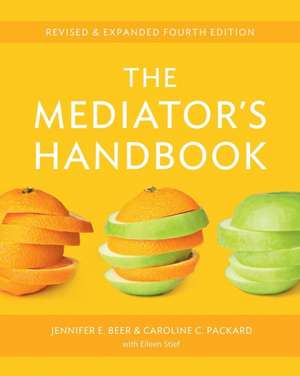
The Mediator's Handbook
Autor Caroline C. Packard, Jennifer E. Beer Ilustrat de Elizabeth Elwood Gatesen Limba Engleză Paperback – oct 2012
Observăm că, în literatura academică dedicată rezolvării conflictelor, există adesea o falie între teoriile abstracte ale negocierii și realitatea imprevizibilă a unei sesiuni de mediere. The Mediator's Handbook completează această lacună, oferind un cadru metodologic riguros, dar profund ancorat în practică. Ajuns la a patra ediție revizuită și extinsă, volumul semnat de Jennifer E Beer și Caroline C Packard nu este doar un manual de curs, ci un instrument de lucru esențial care integrează perspective din antropologie și drept. Suntem de părere că forța acestui volum rezidă în secțiunea „Toolbox”, care detaliază abilitățile specifice necesare pentru a ghida participanții către decizii sustenabile. Cartea este structurată logic, începând cu etapa „Getting to the Table” — unde se analizează oportunitatea medierii și selecția locației — și continuând cu explorarea situației și schimbul de perspective. Această abordare procesuală este susținută vizual de ilustrațiile realizate de Elizabeth Elwood Gates, care ajută la internalizarea conceptelor complexe. Remarcăm că lucrarea acoperă aceeași arie tematică precum How to Resolve Conflict de James E. Gilman, însă The Mediator's Handbook propune o abordare mult mai aplicată, axată pe modelul „Friends Conflict Resolution Programs”. În timp ce alte texte se concentrează pe teoria păcii, volumul de față oferă pași concreți pentru mediatori, manageri și educatori. De asemenea, dacă The Mediation Process de Christopher W Moore este considerat un ghid atotcuprinzător pentru profesioniști, handbook-ul de față se distinge prin accesibilitate și formatul de referință rapidă, fiind ideal pentru curriculumul universitar sau formarea continuă.
Preț: 196.68 lei
Carte disponibilă
Livrare economică 18 mai-01 iunie
Livrare express 01-07 mai pentru 36.49 lei
Specificații
ISBN-10: 0865717222
Pagini: 208
Ilustrații: black & white line drawings
Dimensiuni: 215 x 277 x 15 mm
Greutate: 0.56 kg
Ediția:Revizuită
Editura: New Society Publishers
Locul publicării:Canada
V-ar putea interesa
-
 MeditationsMarcus AureliusPreț: 31.49 lei
 -
 Bringing Peace Into the RoomDaniel BowlingPreț: 283.77 lei
 -
 Preț: 318.17 lei
 -
 The Handbook of Conflict ResolutionEric C. Marcus-23%Preț: 591.59 lei768.29 lei
 -
 MediationAlain LempereurPreț: 213.41 lei
 -
 The Mediation Handbook: Research, theory, and practiceAlexia Georgakopoulos-15%Preț: 593.88 lei698.69 lei
 -
 7 Principles of Conflict Resolution, TheLouisa WeinsteinPreț: 223.24 lei
 -
 -26%Preț: 1009.87 lei1364.69 lei
 -
 Contemporary Conflict ResolutionHarmonie TorosPreț: 273.70 lei
 -
 Holding the CalmHesha AbramsPreț: 101.54 lei
 -
 The Little Book of Dialogue for Difficult SubjectsLisa SchirchPreț: 42.25 lei
 -
 Everything Is WorkableDiane Musho Hamilton-29%Preț: 87.59 lei122.93 lei
 -
 The Mediator's Toolkit, Second EditionGerry O'SullivanPreț: 279.63 lei
 -
 -27%Preț: 191.20 lei260.52 lei
 -
 -21%Preț: 59.29 lei74.84 lei
 -
 Mediation Skills and Strategies: A Practical GuideTony Whatling-27%Preț: 189.35 lei259.33 lei
 -
 MindsightDaniel J. Siegel-20%Preț: 72.35 lei90.43 lei
 -
 Preț: 121.90 lei
 -
 Community Conflict MediationFabiana Marion Spengler-15%Preț: 669.41 lei787.53 lei
 -
 Humble Inquiry, 3rd editionEdgar H. ScheinPreț: 123.00 lei
De ce să citești această carte
Recomandăm această ediție oricărui student sau profesionist care dorește să stăpânească arta medierii. Dincolo de cadrul teoretic, câștigați acces la strategii testate în timp și la un set de instrumente practice pentru gestionarea tensiunilor în echipe sau organizații. Este o resursă indispensabilă pentru a transforma conflictul dintr-un blocaj într-o oportunitate de dialog, oferind claritate într-un domeniu marcat de ambiguitate.
Despre autor
Jennifer Beer este doctor în antropologie, facilitator și mediator cu o vastă experiență în mediul organizațional și comunitar, predând cursuri de negociere la renumita Wharton School. Caroline Packard, de profesie avocat, s-a specializat în mediere familială și organizațională după o carieră în litigii corporative, conducând timp de 15 ani programele Friends Conflict Resolution. Cele două autoare combină rigoarea academică cu decenii de practică directă în soluționarea disputelor, transformând experiența lor colectivă într-un reper metodologic pentru mediatori din întreaga lume.
Descriere scurtă
THE CLASSIC RESOURCE FOR EFFECTIVE MEDIATION - NOW FULLY UPDATED AND EXPANDED
A beautiful book, written with a deep understanding of the mediator's art... -- Hideaki Irie, Associate Professor, Faculty of Law, Kyushu UniversityThe Mediator's Handbook presents a time-tested, adaptable model for helping people work through conflict. Now extensively revised to incorporate recent practice and thinking, it lays out the process step by step, from first contact with the parties, to forging a resolution. The "Toolbox" section explains each concept and skill mediators need to guide the process, support the participants and help them reach decisions.
Can you really make the classic book in its field even better? Authors Jennifer Beer and Caroline Packard prove the answer is a resounding "Yes!" Bravo! -- G. Richard Shell, Thomas Gerrity Professor of Legal Studies and Business Ethics, Wharton School of Business; author of Bargaining for Advantage: Negotiation Strategies for Reasonable People
I have taught from previous editions for 25 years, and this new edition is even better, with new insights into conflict and new strategies that work. -- Susan Sgorbati, Director, The Conflict Resolution Program, Bennington College, Jones Chair for Social Activism.
Long a popular course textbook used by universities, high schools, and training programs, The Mediator's Handbook is also a valued desk reference for professional mediators, and a down-to-earth guide for managers, organizers, teachers and anyone working with clients, customers, volunteers, committees or teams.
Jennifer Beer, PhD, an anthropologist, trainer, and facilitator, mediates in communities and organizations and teaches Negotiation & Dispute Resolution at the Wharton School.
Caroline Packard, JD, a family and organizational mediator and trainer, led Friends Conflict Resolution Programs for fifteen years, and was before that a corporate litigator.
Eileen Stief was a key early developer of the Friends Conflict Resolution Programs model on which the Handbook is based, and trained a whole generation of mediators.
Recenzii
— G. Richard Shell, Thomas Gerrity Professor of Legal Studies and Business Ethics at the Wharton School of Business and author of Bargaining for Advantage: Negotiation Strategies for Reasonable People
The fourth edition of The Mediator’s Handbook continues to improve upon everything that made the original edition a success: user-friendly explanations for every step of the mediation process, starting with what mediation is, to dealing with the most difficult situations that can arise in the course of a dispute. While the Handbook presents itself as being for mediators, those who should have a copy of the Handbook on their shelf include lawyers representing clients in litigation, human resources executives, managers of complex international infrastructure projects, or school counselors dealing with difficult teenagers. In short, The Mediator’s Handbook is a comprehensive and practical guide for anyone who regularly deals with conflict.
— Michael McIlwrath, co-author of International Arbitration and Mediation:A Practical Guide, and host of the podcast “International Dispute Negotiation”
Plenty of mediation books will give you the kind of language ordinary mediators use – the same language we are used to hearing from other helping professions, such as lawyers, and therapists. What these authors let us in on – is the secret language of outstanding mediators. They generously share hundreds of examples of carefully chosen phrases mediators can use at every step that make the difference between knowing what needs to happen next in mediation, and being able to make it happen.
— Hideaki Irei, Associate Professor, Faculty of Law, Kyushu University
The upgrades done to the 4th edition make it a VERY usable manual and I will most definitely recommend it to anyone looking for this kind of manual. When I run my course next year this will be THE manual I have students buy. -- Jonathon Rudy, Elizabethtown College, Global Peacemaking Scholar-in-Residence
The Mediator’s Handbook is the basic primer for anyone who is seriously interested in resolving conflicts constructively. I have used it in my classroom for the last twenty years. This new edition gives us even more insights and practical suggestions for how to deal with the complexity of disputes in many different kinds of situations. Beer, Packard and Stief are masters in the mediation field and have much to offer us. An essential addition to the current scholarship and practice.
— Susan Sgorbati, Jones Chair for Social Activism, and former Dean of Faculty, Bennington College
The Mediator’s Handbook continues to be solid, and speaks to the needs of the participants.
— Mohammed Abu-Nimer, Ph.D., International Peace and Conflict Resolution, School of International Service, American University
Notă biografică
Caroline C Packard, JD, is an organizational change and conflict response specialist and mediator with 30 years' experience in the field. She led Friends Conflict Resolution Programs for 15 years, and has trained hundreds of mediators. A cum laude graduate of Yale College and NYU School of Law, and a former corporate litigator with extensive formal training in individual and group psychology, Caroline has a special interest in the evolutionary psychology of group conflict and cooperation. She provides mediation and conflict-resolution services and training to organizations, families, and family businesses.
Eileen Stief developed the mediation process and principles documented in The Mediator's Handbook, and trained a generation of mediators to work with community, multi-party, and environmental disputes. Now retired, she led the Friends Conflict Resolution Program's experiment in community dispute settlement and later specialized in environmental mediation.
Elizabeth Elwood Gates provided the delightful cartoon illustrations in honor of her aunt, Ann Richan, who was a passionate champion of community mediation.
Textul de pe ultima copertă
THE CLASSIC RESOURCE FOR EFFECTIVE MEDIATION – NOW FULLY UPDATED AND EXPANDED
…a comprehensive and practical guide for anyone who regularly deals with conflict. --- Michael Mcilwrath, co-author of International Arbitration and Mediation: A Practical Guide, and host of the podcast “International Dispute Negotiation”
The popular Mediator's Handbook presents a time-tested, adaptable model for helping people work through conflict. Extensively revised to incorporate recent practice and thinking, it lays out the process step-by-step, from opening conversations and exploring the situation, through the phases of finding lasting resolution.
The "Toolbox" section details the unique concepts and skills a mediator needs in order to:
• Understand the Conflict
• Support the people
• Facilitate the process
• Guide decision-making.
Throughout the book, the emphasis is on what the mediator can do or say NOW, and on the underlying principles and core methods that can help the mediator make wise choices.
Long a popular course textbook for high schools, universities, and training programs, The Mediator's Handbook is also a valued desk reference for professional mediators, and a practical guide for managers, organizers, teachers and anyone working with clients, customers, volunteers, committees or teams.
… the secret language of outstanding mediators… hundreds of examples of carefully chosen phrases mediators can use at every step that make the difference between knowing what needs to happen next in mediation, and being able to make it happen.-- Hideaki Irei, Associate Professor, Faculty of Law, Kyushu University
Beer, Packard and Stief are masters in the mediation field and have much to offer us. An essential addition to the current scholarship and practice.--- Susan Sgorbati, Jones Chair for Social Activism, and former Dean of Faculty, Bennington College
Jennifer E. Beer, PhD, mediates organizational conflicts, facilitates meetings, and offers related workshops, regularly teaching a negotiation course at Wharton (University of Pennsylvania).
Caroline C. Packard, JD led Friends Conflict Resolution Programs for 15 years, and is an organizational conflict response specialist and mediator based in Philadelphia.
Eileen Stief developed the mediation process presented in the Handbook, training a generation of mediators to work with community, multi-party and environmental disputes.
Cuprins
Overview
What is mediation?
A useful tool
What makes mediation work?
The mediator's role
The anatomy of the mediation process
The anatomy of a session
Process-centered mediation
Guiding principles
Mediation terms
THE PROCESS
Getting to the TableCan mediation help this situation?
How people find a mediator
Voluntary or mandatory?
Initial conversations
Do they want to participate?
Defining the scope
Approaching the other parties
Should I be the mediator?
Pre-mediation agreements and review
Choosing a location
The Mediation Session Part I: Exploring the Situation
Preparing yourself, co-mediators
Setting up
Opening
Opening: Welcome & warm-up
Opening: Logistics
Opening: Orientation
Opening: Participants' role, willingness
Listening to Each Perspective
The Exchange
The Exchange: Facilitating
The Exchange: Tasks & flow
Clarify information
Check out interpretations
Listen for their concerns
Example + impact
Restate their interests
Note other relevant interests
Encourage empathy and reconciliation
Transition to Reaching Resolution
Separate Conversations
Uses for Separate Conversations
Breaking for Separate Conversations
Separate Conversations: Template
The Mediation Session Part II: Reaching Resolution
Reaching Resolution
Reaching Resolution: Sequence
Topic List
Topic List: Why it is crucial
Topic List: Drafting
Topic List: Wording
Midpoint check-in
Options
Options: Together come up with ideas
Options: Gut, interests, workability
Options: Reality testing
Decisions
Decisions: Gut, interests, workability
Decisions: Emotions, hesitations
Writing the Agreement
Writing the Agreement: Specifics
Writing the Agreement: Positive framing
Closing
Afterwards: Wrapping up
Multiple sessions
THE TOOLBOX
Understanding ConflictDisputes & conflicts
Metaphors for understanding conflict
The conflict core
Common effects of conflict
The pleasures of conflict
When things heat up
The way out is through
The Conflict Triangle
People, Process, Problem
Which mode are you in?
Supporting the People
Supporting the people: Main skills
Setting the tone
Level of formality, taking notes
Confidentiality in practice
Giving your full attention
Elements of full attention
Acknowledging
Handling judgmental remarks
Protecting
From adversarial mode to cooperative mode
Avoid this Kettle of Fish
Attending to comfort & accessibility
Language and hearing difficulties
Working with people in all their variety
Finding commonalities
Scenarios: Emotionally difficult situations 111
Facilitating the Process
Facilitating the process
Impartial facilitation
Structuring the session
Structuring the discussion
When you can be directive
When to consult
Keeping on track
Crafting questions
Crafting questions: Word with care
Crafting questions: Spin it positive
Crafting questions: Follow up for clarification
Kinds of rewording
Reflecting back
Summarizing
Summarizing: Its many uses
Working visually
When to intervene
When to intervene: Stopping the momentum
When to intervene: Slowing the process down
Is it time to quit?
Ending a mediation
Scenarios: Facilitation challenges
Solving the Problem
Participants' starting point: Power & rights
Changing the "positions" mindset
Interests
Layers of interests
Why interests matter
Finding space for solutions
Reframing
Checking out (mis)interpretations
Lies, perceptions, deceptions
Plain description of facts and needs
Flip it! ? Outcome-focused interests
Tactful wording of interests and topics
Summary of interests
Topic List examples
Eliciting ideas: Brainstorming
Eliciting ideas: Opening up possibilities
Can mediators suggest options?
Visual aids for making decisions
Types of resolution
"Typical" or "good enough" resolutions
What-ifs
Fallbacks: Contingencies, uncertainties
Step-down agreements: Smaller scope
When there's no agreement
Final review: Workability
Final review: Future
Sample agreements
Scenarios: problem-solving challenges 173
Going Further
Going further
Adapting the process
Mediating with children & teens
Mediating across generations
Mediating family conflicts
Mediating employee conflicts
Participant evaluation
Mediator evaluation of a mediation
Evaluating yourself
The Handbook "soup pot"
Authors & contributors
Organizational support
Index