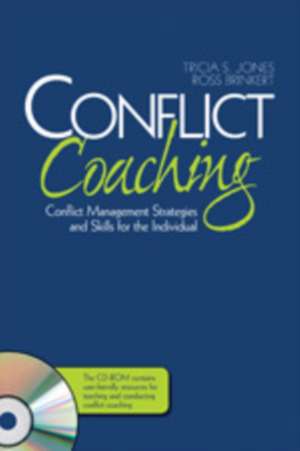
Conflict Coaching: Conflict Management Strategies and Skills for the Individual
Autor Tricia S. Jones, Ross Brinkerten Limba Engleză Paperback – 11 feb 2008
Manualul Conflict Coaching reprezintă o resursă academică și practică esențială pentru înțelegerea unei nișe în expansiune: gestionarea conflictelor prin intervenție individuală. Remarcăm faptul că autorii, Tricia S. Jones și Ross Brinkert, fundamentează necesitatea acestui volum pe o statistică îngrijorătoare: o mare parte din persoanele aflate în conflict refuză medierea clasică din cauza reticenței de a se întâlni direct cu cealaltă parte. Ne-a atras atenția modul în care lucrarea poziționează coaching-ul de conflict nu doar ca o etapă preliminară, ci ca o metodă autonomă, ancorată în teorii solide de comunicare și psihologie.
Structura este riguros organizată în trei secțiuni: teoretizarea conceptului, metodologia de desfășurare și integrarea acestui model în diverse contexte profesionale. Autorii reușesc să echilibreze rigoarea academică, necesară în curriculumul de studii interdisciplinare, cu instrumente aplicate, precum tabele și figuri alb-negru care sintetizează procesele decizionale. Cititorii familiarizați cu Conflict Management Coaching de Cinnie Noble vor aprecia faptul că Conflict Coaching oferă o perspectivă mai largă asupra integrării instituționale, fiind adaptată pentru studenții din domenii variate, de la asistență socială la managementul afacerilor. Spre deosebire de How to Resolve Conflict de James E. Gilman, care se concentrează pe medierea ca proces colectiv, volumul de față rafinează tehnicile necesare pentru a lucra individual cu un client, ajutându-l să-și dezvolte propriile strategii de rezolvare a disputelor interpersonale.
Preț: 1009.87 lei
Preț vechi: 1364.69 lei
-26%
Carte disponibilă
Livrare economică 28 septembrie-12 octombrie
Livrare express 12-18 septembrie pentru 29.10 lei
Specificații
ISBN-10: 141295083X
Pagini: 344
Ilustrații: black & white tables, figures
Dimensiuni: 152 x 229 x 13 mm
Greutate: 0.43 kg
Ediția:1
Editura: SAGE Publications
Colecția Sage Publications, Inc
Locul publicării:Thousand Oaks, United States
V-ar putea interesa
-
 Coaching for Improved Work Performance, Revised EditionFerdinand Fournies-11%Preț: 113.49 lei127.92 lei
 -
 -22%Preț: 226.88 lei289.08 lei
 -
 Preț: 97.37 lei
 -
 Brief Coaching for Lasting SolutionsInsoo Kim BergPreț: 233.07 lei
 -
 Coaching Plain & SimpleDaniel Meier-5%Preț: 153.57 lei161.65 lei
 -
 Sanford Meisner on ActingSanford MeisnerPreț: 101.50 lei
 -
 Building Conflict Competent TeamsCraig E RundePreț: 213.30 lei
 -
 Resolving Conflicts at WorkKenneth ClokePreț: 150.08 lei
 -
 The Mediator''s HandbookCaroline C. PackardPreț: 202.85 lei
 -
 Conflict Management CoachingCinnie NoblePreț: 170.44 lei
 -
 Key Topics in Coaching PsychologyRebecca J. JonesPreț: 205.75 lei
 -
 Preț: 247.83 lei
 -
 The Handbook of Conflict ResolutionEric C. Marcus-23%Preț: 611.25 lei793.84 lei
 -
 Interpersonal Conflict: 2025 Release ISEJoyce Hocker-4%Preț: 359.05 lei374.01 lei
 -
 7 Principles of Conflict Resolution, TheLouisa WeinsteinPreț: 215.25 lei
 -
 -22%Preț: 186.61 lei239.32 lei
 -
 Training Within Industry: The Foundation of LeanDonald Dinero-15%Preț: 441.01 lei518.84 lei
 -
 Everything Is WorkableDiane Musho Hamilton-28%Preț: 91.50 lei126.78 lei
 -
 -26%Preț: 199.68 lei268.71 lei
 -
 Mediation Skills and Strategies: A Practical GuideTony Whatling-26%Preț: 197.75 lei267.97 lei
De ce să citești această carte
Această carte se adresează studenților și profesioniștilor care au nevoie de o alternativă la medierea tradițională. Cititorul câștigă acces la un model practic, testat prin cercetare, pentru a ajuta persoanele care refuză confruntarea directă. Este un instrument valoros pentru cei care doresc să ofere soluții personalizate de comunicare în organizații, instituții de învățământ sau în consilierea psihologică.
Despre autor
Tricia S. Jones este un cercetător și consultant de renume, cu un doctorat la Ohio State University și o carieră de peste 25 de ani dedicată studiului conflictelor. A publicat peste 50 de articole de specialitate și a coordonat proiecte de cercetare finanțate cu peste 2 milioane de dolari. În prezent, ocupă poziția de editor al publicației de referință 'Conflict Resolution Quarterly', experiența sa academică fiind dublată de o prezență constantă în forurile internaționale de management al conflictelor.
Descriere scurtă
Recenzii
—Brian Polkinghorn, Ph.D.
Distinguished Professor and Director
Conflict Analysis and Dispute Resolution
Wilson Elkins Professor, University System of Maryland
Executive Director, Center for Conflict Resolution, Salisbury University
"Conflict Coaching is a book that should be in every corporate library and in every chief human resource officer’s desk so others can see it! Moreover, this book should be provided for every young, high-potential corporate manager and be required reading in business school executive education programs."
"Jones and Brinkert offer example case studies illustrating the subject of each chapter, scholarly research throughout, a wonderfully approachable text and a companion CD of tools that makes a perfect addition to any Ombudsperson’s library. Not only is this a terrific resource for us LTCOs, but also for Organizational Ombuds and other ADR professionals and practitioners seeking to clarify the whats and hows of empowering those we serve to better respond to the conflicts they face."
Cuprins
1. Conflict Coaching: Conflict Management Strategies and Skills for the Individual
A General Definition of Conflict Coaching
Sources of Development: An Overview of “Conflict” and “Coaching” in
Likely Drivers of Continued Development for Conflict Coaching
Conflict Coaching Principles
Major Reasons for the Conflict Resolution Field to Develop Conflict Coaching
2. The Comprehensive Conflict Coaching Model
An Overview of Coaching Models
The Comprehensive Conflict Coaching (CCC) Model
II. Conducting Conflict Coaching
3. Stage One – Discovering the Story
Narrative Theory
Narrative Theory Applied to Conflict Management
Discovering the Story
General Principles for Discovering the Story
Specific Approaches for Discovering the Story
4. Stage Two – The Identity Perspective
Identity in Relation to Emotion and Power
Overview of Research and Theory on Identity
A Model of Identity in Interpersonal Conflict in the Workplace
‘Facework’ as the Primary Means of Managing Identity
General Principles for Identity Work with Conflict Coaching Clients
Specific Approaches for Identity Work with Conflict Coaching Clients
5. The Emotion Perspective
Introduction to Emotion
Theories of Emotion
Emotional Competence
General Principles for Emotion Work with Conflict Coaching Clients
Specific Approaches for Emotion Work with Conflict Coaching Clients
6. Stage Two – The Power Perspective
Power in Relation to Identity and Emotion
Overview of Research and Theory on Power
Sources of Client Power in Conflict
Power Patterns in Conflict Interaction
Power Strategies and Tactics
Power and Culture
Working with Clients Who Feel and/or Act Disempowered
General Principles for Power Work with Conflict Coaching Clients
Specific Approaches for Power Work with Conflict Coaching Clients
7. Stage Three – Crafting the “Best” Story
Relevant Change Theories
The Link to Narrative Theory
General Principles for Crafting the “Best” Story
Specific Approaches for Crafting the “Best” Story
8. Stage Four – Communication Skills: Confrontation, Confirmation and Comprehension
Culture and Communication Skills
Key Conflict Communication Skills
General Principles for Communication Skills Work with Conflict Coaching Clients
General Approaches for Communication Skills Work with Conflict Coaching Clients
Specific Approaches for Confrontation, Confirmation and Comprehension Work with Conflict Coaching Clients
9. Stage Four – The Conflict Styles Opportunity
A Conflict Styles Framework
Focusing on the Me, You and We of Conflict Styles
Conflict Styles and Culture
General Principles for Conflict Styles Work with Conflict Coaching Clients
Specific Approaches to Conflict Styles Work with Conflict Coaching Clients
10. Stage Four – The Negotiation Opportunity
Basics of Negotiation
Two Major Approaches to Negotiation
11. Stage Four – Coordinating Coaching with Other Conflict Processes
Organizational Dispute Systems
The Role of Conflict Coaching in Leveraging Dispute Systems
General Principles for Coordinating Conflict Coaching with Other Conflict Processes
Specific Approaches for Coordinating Conflict Coaching with Other Conflict Processes
12. Learning Assessment in Conflict Coaching: The Parallel Process
Learning Assessment: Did the Conflict Coaching Work?
General Principles for Learning Assessment
Specific Approaches to Learning Assessment
III. Integrating Conflict Coaching Into Your Practice
13. Needs Assessment and Program Evaluation for Conflict Coaching
Needs Assessment: Will Conflict Coaching Meet “My” Needs?
Program Evaluation: Is Conflict Coaching Working for “You?”
Using Needs Assessment and Program Evaluation to Market a Conflict Coaching Practice
14. The Future of Conflict Coaching
A Research Agenda
Training and Delivery Mechanisms
Policy/Implementation Agenda
Notă biografică
Tricia S. Jones (Ph.D., The Ohio State University; M.S., ; B.S., ) has been a conflict scholar, practitioner, and consultant for 25 years. She has written, edited, or co-edited 5 books, published more than 50 articles or book chapters, presented more than 100 presentations at national or international conferences, and received more than $2.1 million in grant funding for her research in the area of conflict processes. She is currently editor of Conflict Resolution Quarterly and serves as a guest reviewer for other conflict management journals. Dr. Jones brings considerable knowledge of conflict theory and research that can be applied to conflict coaching. In addition, she has been an active conflict management trainer for a variety of Fortune 100 and national non-profit organization for the past 20 years. In recognition of her emphasis of theory and practice integration, she received the Jeffrey Z. Rubin Theory to Practice Award in conflict management from the International Association for Conflict Management in 2005. (She is also a co-author of a forthcoming introductory interpersonal communication textbook to be published by Houghton Mifflin.)