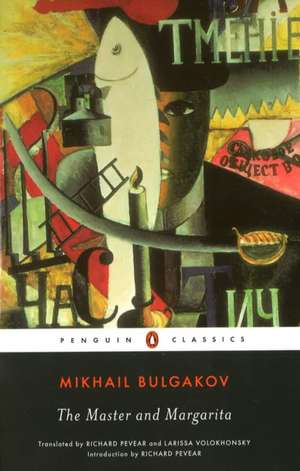
The Master and Margarita
Autor Mikhail Bulgakov Traducere de Richard Pevear, Larissa Volokhonskyen Limba Engleză Paperback – 2001
În peisajul literaturii clasice, puține opere reușesc să subverseze convențiile genului cu atâta vigoare precum The Master and Margarita. Suntem de părere că acest roman nu este doar o ficțiune istorică sau o satiră politică, ci o construcție arhitecturală complexă în care realismul magic servește drept lentilă pentru explorarea condiției umane sub opresiune. Structura cărții este împărțită riguros în două părți: prima ne introduce în haosul comic și macabru provocat de sosirea lui Woland în Moscova anilor '30, în timp ce a doua se concentrează pe figura tragică a Margaretei și pe sacrificiul Maestrului. Remarcăm modul în care Mikhail Bulgakov împletește trei planuri narative distincte: vizita diavolului în URSS, povestea de dragoste dintre un scriitor persecutat și muza sa, și o reinterpretare tulburătoare a procesului lui Iisus de către Ponțiu Pilat. Ca și The Heart Of A Dog, acest roman explorează absurdul birocrației și limitele experimentului social, dar dintr-o perspectivă mult mai vastă, cosmică și metafizică. Dacă în The White Guard Mikhail Bulgakov se ancora în ororile Războiului Civil Rus prin ochii unui medic, în The Master and Margarita el transcende realitatea imediată pentru a oferi o meditație despre libertate și adevăr. Apreciem ritmul narativ care alternează între episoade de o farsă burlească — cum sunt cascadoriile lui Koroviev și Behemoth — și momente de o frumusețe lirică profundă. Cuprinsul relevă o progresie de la „Să nu vorbești niciodată cu străini” până la „Iertare și refugiu etern”, indicând o călătorie spirituală completă. Este o operă în care fantasticul nu este un simplu decor, ci singura formă de rezistență în fața unei lumi care a pierdut contactul cu divinul și cu sine însăși.
Preț: 93.47 lei
Carte disponibilă
Livrare economică 31 octombrie-14 noiembrie
Specificații
ISBN-10: 0141180145
Pagini: 448
Dimensiuni: 128 x 195 x 22 mm
Greutate: 0.31 kg
Editura: Penguin Publishing Group
V-ar putea interesa
-
 Fragile ThingsNeil GaimanPreț: 57.24 lei
 -
 The Gods Will Have BloodAnatole France-38%Preț: 56.84 lei90.96 lei
 -
 The Fry ChroniclesStephen Fry-18%Preț: 76.72 lei93.70 lei
 -
 I Am the MessengerMarkus ZusakPreț: 99.10 lei
 -
 The AsylumJohan TheorinPreț: 125.21 lei
 -
 The Notebook: The love story to end all love storiesNicholas Sparks-27%Preț: 58.03 lei78.99 lei
 -
 On Love. Alain DeBottonAlain de BottonPreț: 93.36 lei
 -
 The Divine ComedyDante AlighieriPreț: 45.91 lei
 -
 Lamb: A NovelChristopher Moore-25%Preț: 59.78 lei79.69 lei
 -
 -27%Preț: 52.70 lei71.82 lei
 -
 Notes from Underground: New TranslationFyodor DostoevskyPreț: 50.06 lei
 -
 Wuthering HeightsEmily BrontePreț: 30.91 lei
 -
 FaustJohann Wolfgang GoethePreț: 67.14 lei
De ce să citești această carte
Recomandăm această carte oricărui cititor care dorește să descopere cum satira politică se poate transforma în poezie pură. Veți câștiga o perspectivă unică asupra curajului intelectual și a puterii artei de a supraviețui cenzurii. Este un roman esențial pentru a înțelege rădăcinile realismului magic european, oferind o experiență de lectură care rămâne la fel de actuală și provocatoare ca la prima sa publicare.
Despre autor
Mikhail Bulgakov (1891–1940) a fost un scriitor, medic și dramaturg rus de o importanță capitală pentru secolul XX. Cariera sa literară a fost marcată de un conflict constant cu cenzura stalinistă, multe dintre piesele și prozele sale, precum The White Guard sau Flight, fiind interzise sau ciuntite. Deși Stalin a apreciat personal unele dintre lucrările sale, Bulgakov a trăit mare parte din viață ca un autor marginalizat. Capodopera sa, The Master and Margarita, a fost scrisă în secret și publicată abia la decenii după moartea sa, devenind rapid un simbol al rezistenței prin spirit și imaginație.
Descriere scurtă
Cuprins
A Note on the Text and Acknowledgments
Further Reading
BOOK ONE
1. Never Talk with Strangers
2. Pontius Pilate
3. The Seventh Proof
4. The Chase
5. There were Doings at Griboedov's
6. Schizophrenia, as was Said
7. A Naughty Apartment
8. The Combat between the Professor and the Poet
9. Koroviev's Stunts
10. News from Yalta
11. Ivan Splits in Two
12. Black Magic and Its Exposure
13. The Hero Enters
14. Glory to the Cock!
15. Nikanor Ivanovich's Dream
16. The Execution
17. An Unquiet Day
18. Hapless Visitors
BOOK TWO
19. Margarita
20. Azazello's Dream
21. Flight
22. By Candlelight
23. The Great Ball at Satan's
24. The Extraction of the Master
25. How the Procurator Tried to Save Judas of Kiriath
26. The Burial
27. The End of Apartment No. 50
28. The Last Adventures of Koroviev and Behemoth
29. The Fate of the Master and Margarita is Decided
30. It's Time! It's Time!
31. On Sparrow Hills
32. Forgiveness and Eternal Refuge
Epilogue
Notes
Notă biografică
Richard Pevear and Larissa Volokhonsky have produced acclaimed translations of Tolstoy, Dostoevsky, Gogol, and Bulgakov. Their translation of The Brothers Karamazov won the 1991 PEN/Book-of-the-Month Club Translation Prize. They are married and live in Paris, France.
Richard Pevear and Larissa Volokhonsky have produced acclaimed translations of Tolstoy, Dostoevsky, Gogol, and Bulgakov. Their translation of The Brothers Karamazov won the 1991 PEN/Book-of-the-Month Club Translation Prize. They are married and live in Paris, France.
Richard Pevear and Larissa Volokhonsky have produced acclaimed translations of Tolstoy, Dostoevsky, Gogol, and Bulgakov. Their translation of The Brothers Karamazov won the 1991 PEN/Book-of-the-Month Club Translation Prize. They are married and live in Paris, France.
Descriere
Recenzii
“A wild surrealistic romp. . . . Brilliantly flamboyant and outrageous.” —Joyce Carol Oates, The Detroit News
“This dark, absurd, and subversive treasure lay hidden for many years, even after Bulgakov’s death, such was the fear of reprisal for such a pointed, authentic stab at life under the tyrannical malevolence of Uncle Joe and the withering Soviet climate of the time.” —Johnny Depp, “My Essentials” in Entertainment Weekly’s “Best of the Decade” issue (December 11, 2009)
“Fine, funny, imaginative . . . . The Master and Margarita stands squarely in the great Gogolesque tradition of satiric narrative.” —Saul Maloff, Newsweek
“The book is by turns hilarious, mysterious, contemplative and poignant. . . . A great work.” —Chicago Tribune
“Magnificent . . . a gloriously ironic gothic masterpiece . . . had me rapt with bliss.” —Patrick McGrath, Guardian (UK)
“Funny, devilish, brilliant satire . . . It’s literature of the highest order and . . . it will deliver a full measure of enjoyment and enlightenment.” —Publishers Weekly
“A rich, funny, moving and bitter novel . . . . Vast and boisterous entertainment.” —The New York Times
“A classic of twentieth-century fiction.” —The New York Times Book Review