
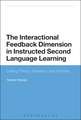
The Interactional Feedback Dimension in Instructed Second Language Learning: Linking Theory, Research, and Practice: Advances in Instructed Second Language Acquisition Research
Autor Hossein Nassajien Limba Engleză Hardback – 12 mar 2015
Preț: 832.92 lei
Preț vechi: 1241.07 lei
-33%
Puncte Express: 1249
Carte tipărită la comandă
Livrare economică 08-22 decembrie
Livrare prin curier în România Termenul estimat este afișat lângă disponibilitate.
Transport gratuit pentru acest produs Plată online sau ramburs, în funcție de opțiunile comenzii.
Retur gratuit în 14 zile Comandă securizată și suport în română.
Specificații
ISBN-13: 9781472510143
ISBN-10: 1472510143
Pagini: 264
Dimensiuni: 156 x 234 x 14 mm
Greutate: 0.37 kg
Editura: Bloomsbury Publishing
Colecția Bloomsbury Academic
Seria Advances in Instructed Second Language Acquisition Research
Locul publicării:London, United Kingdom
ISBN-10: 1472510143
Pagini: 264
Dimensiuni: 156 x 234 x 14 mm
Greutate: 0.37 kg
Editura: Bloomsbury Publishing
Colecția Bloomsbury Academic
Seria Advances in Instructed Second Language Acquisition Research
Locul publicării:London, United Kingdom
V-ar putea interesa
-
 23: The Transition to LanguageAlison Wray-26%Preț: 358.40 lei487.32 lei
 -
 -27%Preț: 359.00 lei491.65 lei
 -
 Foundations of Language: Brain, Meaning, Grammar, EvolutionRay Jackendoff-9%Preț: 386.84 lei425.43 lei
 -
 Child Language: The Parametric ApproachWilliam Snyder-19%Preț: 358.15 lei442.87 lei
 -
 Language Development and Learning to ReadDiane McguinnessPreț: 325.25 lei
 -
 -15%Preț: 506.57 lei595.97 lei
 -
 -15%Preț: 427.07 lei502.44 lei
 -
 How Children Learn LanguageWilliam O'GradyPreț: 287.03 lei
 -
 -23%Preț: 445.39 lei578.42 lei
 -
 -27%Preț: 969.47 lei1328.05 lei
 -
 -23%Preț: 550.45 lei714.86 lei
 -
 Second Language AcquisitionArchibald-23%Preț: 475.06 lei616.96 lei
 -
 Preț: 522.91 lei
 -
 Second Language IdentitiesDavid Block-16%Preț: 180.66 lei215.18 lei
 -
 Teaching and Learning in Multilingual ContextsAgnieszka OtwinowskaPreț: 349.68 lei
 -
 Multilingual Universities in South AfricaLiesel HibbertPreț: 292.13 lei
 -
 The Multilingual Turn in Languages EducationJean ContehPreț: 417.67 lei
 -
 Cognate Vocabulary in Language Acquisition and UseAgnieszka OtwinowskaPreț: 409.09 lei
 -
 Native-Speakerism in JapanStephanie Ann HoughtonPreț: 348.91 lei
Cuprins
Series Editor Foreword
Preface
Introduction
1. Review of key concepts
Part 1. Theoretical underpinnings
2. The role of corrective feedback: Theoretical and pedagogical perspectives
3. Interactional feedback: Types and subtypes
4. How does interactional feedback assist language acquisition?
Part 2. Researching interactional feedback
5. Feedback provision and learner uptake: Descriptive research
6. Feedback effects on learning: Experimental and other pretest-posttest studies
7. Comparative studies of interactional feedback
Part 3. Factors affecting interactional feedback
8. Factors affecting the provision and usefulness of interactional feedback
9. Perception and interpretation of feedback
Part 4. Linking theory, research, and practice
10. Conclusions, implications, and pedagogical recommendations
References
Index
Preface
Introduction
1. Review of key concepts
Part 1. Theoretical underpinnings
2. The role of corrective feedback: Theoretical and pedagogical perspectives
3. Interactional feedback: Types and subtypes
4. How does interactional feedback assist language acquisition?
Part 2. Researching interactional feedback
5. Feedback provision and learner uptake: Descriptive research
6. Feedback effects on learning: Experimental and other pretest-posttest studies
7. Comparative studies of interactional feedback
Part 3. Factors affecting interactional feedback
8. Factors affecting the provision and usefulness of interactional feedback
9. Perception and interpretation of feedback
Part 4. Linking theory, research, and practice
10. Conclusions, implications, and pedagogical recommendations
References
Index
Recenzii
The high quality of the present book resides in several factors that go beyond its mere content ... We here have a publication at hand that shows readers the high complexity of giving feedback in second and foreign language teaching. One of its merits is that it gives readers invaluable advice where this is possible ... An important textbook for (under)graduate courses in SLA and Applied Linguistics.
Interest in interactional feedback and its role in second language (L2) acquisition have a long history, motivated in part by teachers' concerns about whether and how to correct L2 learners and in part by theoretical issues in the field of second language acquisition. Thus a book that brings together the different pedagogical and theoretical perspectives and the research they have given rise to is most welcome. Hossein Nassaji is to be congratulated in producing an informed, comprehensive and very readable account of this body of work. His book is notable for both its breadth of coverage and the clarity with which complex issues relating to interactional feedback are discussed. This is a book that I will be referring to frequently in my own research and in my graduate-level teaching.
Nassaji has reviewed and analyzed hundreds of publications exploring the role of interactional feedback in second language learning. The book covers a range of theoretical perspectives and draws on research with young learners and adults, in classrooms and laboratory settings. Nassaji shows how the research findings can guide teachers in answering important pedagogical questions about how to respond to the errors their students make.
Hossein Nassaji's book provides an excellent and detailed review of interactionist theory and research (descriptive, experimental and comparative) related to the role of feedback in classroom-based language learning. Particularly useful is that Nassaji links theory and empirical findings to pedagogical implications, providing suggestions for enhancing the effectiveness of feedback for second language learning. Each chapter usefully begins with a set of goals for that chapter and ends with a set of discussion questions.
Interest in interactional feedback and its role in second language (L2) acquisition have a long history, motivated in part by teachers' concerns about whether and how to correct L2 learners and in part by theoretical issues in the field of second language acquisition. Thus a book that brings together the different pedagogical and theoretical perspectives and the research they have given rise to is most welcome. Hossein Nassaji is to be congratulated in producing an informed, comprehensive and very readable account of this body of work. His book is notable for both its breadth of coverage and the clarity with which complex issues relating to interactional feedback are discussed. This is a book that I will be referring to frequently in my own research and in my graduate-level teaching.
Nassaji has reviewed and analyzed hundreds of publications exploring the role of interactional feedback in second language learning. The book covers a range of theoretical perspectives and draws on research with young learners and adults, in classrooms and laboratory settings. Nassaji shows how the research findings can guide teachers in answering important pedagogical questions about how to respond to the errors their students make.
Hossein Nassaji's book provides an excellent and detailed review of interactionist theory and research (descriptive, experimental and comparative) related to the role of feedback in classroom-based language learning. Particularly useful is that Nassaji links theory and empirical findings to pedagogical implications, providing suggestions for enhancing the effectiveness of feedback for second language learning. Each chapter usefully begins with a set of goals for that chapter and ends with a set of discussion questions.