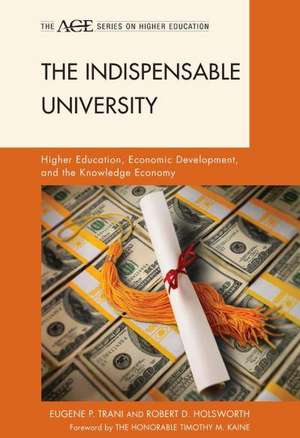
The Indispensable University: Higher Education, Economic Development, and the Knowledge Economy: The ACE Series on Higher Education
Autor Eugene P. Trani, Robert D. Holsworth Cuvânt înainte de Timothy M. Kaineen Limba Engleză Paperback – noi 2013
Case studies are drawn from: urban America; rural America; Europe; the Middle East; and emerging countries. Some of the topics covered include the following: the role of university presidents as change leaders; the relationship between higher education institutions and the political leadership of cities, states, and nations; successful models of partnerships between higher education and the private sector; and future challenges and opportunities facing the modern university.
Din seria The ACE Series on Higher Education
- 21%
 Preț: 257.21 lei
 - 26%
 Preț: 412.88 lei
 - 6%
 Preț: 230.71 lei
 - 17%
 Preț: 381.73 lei
 -
 Preț: 330.16 lei
 - 29%
 Preț: 486.86 lei
 - 26%
 Preț: 340.93 lei
 - 24%
 Preț: 253.75 lei
 - 19%
 Preț: 337.85 lei
 - 15%
 Preț: 513.03 lei
 - 22%
 Preț: 302.19 lei
 - 25%
 Preț: 220.06 lei
 - 24%
 Preț: 268.64 lei
 - 24%
 Preț: 183.24 lei
 - 25%
 Preț: 346.74 lei
 - 32%
 Preț: 343.23 lei
 - 24%
 Preț: 267.67 lei
 - 17%
 Preț: 210.25 lei
 - nou
 Preț: 212.60 lei
 - nou
 Preț: 164.85 lei
Preț: 308.15 lei
Preț vechi: 391.91 lei
-21%
Puncte Express: 462
Carte tipărită la comandă
Livrare economică 23 noiembrie-07 decembrie
Livrare prin curier în România Termenul estimat este afișat lângă disponibilitate.
Transport gratuit de la 400.00 lei Plată online sau ramburs, în funcție de opțiunile comenzii.
Retur gratuit în 14 zile Comandă securizată și suport în română.
Specificații
ISBN-13: 9781475809015
ISBN-10: 1475809018
Pagini: 281
Dimensiuni: 163 x 241 x 21 mm
Greutate: 0.51 kg
Editura: Bloomsbury Publishing
Colecția R&L Education
Seria The ACE Series on Higher Education
Locul publicării:New York, United States
ISBN-10: 1475809018
Pagini: 281
Dimensiuni: 163 x 241 x 21 mm
Greutate: 0.51 kg
Editura: Bloomsbury Publishing
Colecția R&L Education
Seria The ACE Series on Higher Education
Locul publicării:New York, United States
V-ar putea interesa
-
 Tooth and NailJoseph ElliotPreț: 124.14 lei
 -
 Preț: 463.06 lei
 -
 Students: A Gendered HistoryCarol DyhousePreț: 419.98 lei
 -
 Preț: 403.40 lei
 -
 Preț: 360.32 lei
 -
 Hairdressing ScienceF. Openshaw-13%Preț: 536.86 lei617.08 lei
 -
 Landlord and Tenant LawMargaret Wilkie-23%Preț: 287.67 lei372.60 lei
 -
 The Essential Guide to Postgraduate StudyDavid WilkinsonPreț: 375.60 lei
 -
 Doing Postgraduate ResearchStephen PotterPreț: 441.46 lei
 -
 The Postgraduate's CompanionGerard Hall-15%Preț: 568.80 lei669.17 lei
Cuprins
Chapter 1 Foreword
Chapter 2 Basic Premise: Colleges and Universities Indispensable to Economic and Community Development
Chapter 3 The New Role of Higher Education: Economic and Community Development
Chapter 4 U.S Higher Education: The Emergence of Urban Universities
Chapter 5 U.S. Higher Education: The Reinvention of the Land-Grant University
Chapter 6 U.S. Higher Education: Community College, A Uniquely American Institution
Chapter 7 British and Irish Higher Education: Ancient but Thoroughly Modern
Chapter 8 Middle Eastern Higher Education: Two Oases in the Desert
Chapter 9 Higher Education in Developing Countries: The BRIC Nations
Chapter 10 Conclusions: Colleges and Universities Indispensable to Economic and Community Development
Chapter 2 Basic Premise: Colleges and Universities Indispensable to Economic and Community Development
Chapter 3 The New Role of Higher Education: Economic and Community Development
Chapter 4 U.S Higher Education: The Emergence of Urban Universities
Chapter 5 U.S. Higher Education: The Reinvention of the Land-Grant University
Chapter 6 U.S. Higher Education: Community College, A Uniquely American Institution
Chapter 7 British and Irish Higher Education: Ancient but Thoroughly Modern
Chapter 8 Middle Eastern Higher Education: Two Oases in the Desert
Chapter 9 Higher Education in Developing Countries: The BRIC Nations
Chapter 10 Conclusions: Colleges and Universities Indispensable to Economic and Community Development
Recenzii
Indispensable Universities addresses timely and increasingly universal issues in ways that seem to me to be accessible to audiences whose members need the reasoning and information that is provided. It has been a pleasure to read and reread the manuscript. It is imaginative and informed and it has gravity. Its evidentiary basis is solid. It reflects the sound of two wise men talking about matters on which they are utterly qualified to speak. Not many books can claim to do that. I can imagine this book as the kind of standard work that university leaders as well as state and federal policy makers will have to read.
A fine book. Without committed and clearly active presidents/chancellors the important transformative potential of universities in their regional/global contexts cannot be realized. What is especially key here is the ways in which the university is placed in the 'knowledge economy.' Perhaps the best thing about President Trani's book is its full-throttle normative assertion of the 'indispensable' role of the university. It is the argument of passionate higher education advocates. Indispensable Universities is more a policy essay and report from the field of the political economic struggles for the relevance and best practices of twenty-first century higher education.
A terrific read, and I'm sure that it will become a standard work on both sides of the Atlantic. I found it full of insights as well as offering many telling examples. We'll certainly have it on our MBA reading list.
A most exhaustive and informative text, and likely to be very helpful to all presidents interested in promoting economic development and community engagement; Opening chapters are a documented set of arguments; the references are extremely helpful. Best of all are the case studies. The book makes powerful points and then backs them up with well grounded case studies. Precisely the institutions I would have selected as exemplars within their distinctive missions; I loved chapter four on the history of the landgrant mission. Also the references to the full array of postsecondary education, and especially community colleges, was very insightful; The organization of the book is thoughtful as well, and a very easy read.
Eugene P. Trani is convincing in his argument that universities should be economic drivers in their regions....The book weaves together case studies and best practices about higher education from well-known urban and land-grant universities and community colleges.
The book is very interesting and informative. It's a good read! College administrators will learn much from the content of this book. It contains many thoughtful insights and perspectives on the modern university.
Recommended.
An interesting, insightful, and notably wide ranging discussion of what they see as a key aspect of modern higher education-its role in community and economic development.
The core issue in this volume addresses several perspectives on how to reposition higher education institutions to realize the maximum potential by catalyzing economic development for both the institution and the surrounding community and region. The authors presented a clear and easy-to-follow methodology, primarily focusing on public institutions....The authors presented a well-written and clearly organized model on the value of colleges and universities to their communities....The readers most likely to benefit from The Indispensable University are senior level administrators searching for methods to build regional economic strategies and promote distinctiveness for the institutions. In fact, this book should be recommended reading.
A fine book. Without committed and clearly active presidents/chancellors the important transformative potential of universities in their regional/global contexts cannot be realized. What is especially key here is the ways in which the university is placed in the 'knowledge economy.' Perhaps the best thing about President Trani's book is its full-throttle normative assertion of the 'indispensable' role of the university. It is the argument of passionate higher education advocates. Indispensable Universities is more a policy essay and report from the field of the political economic struggles for the relevance and best practices of twenty-first century higher education.
A terrific read, and I'm sure that it will become a standard work on both sides of the Atlantic. I found it full of insights as well as offering many telling examples. We'll certainly have it on our MBA reading list.
A most exhaustive and informative text, and likely to be very helpful to all presidents interested in promoting economic development and community engagement; Opening chapters are a documented set of arguments; the references are extremely helpful. Best of all are the case studies. The book makes powerful points and then backs them up with well grounded case studies. Precisely the institutions I would have selected as exemplars within their distinctive missions; I loved chapter four on the history of the landgrant mission. Also the references to the full array of postsecondary education, and especially community colleges, was very insightful; The organization of the book is thoughtful as well, and a very easy read.
Eugene P. Trani is convincing in his argument that universities should be economic drivers in their regions....The book weaves together case studies and best practices about higher education from well-known urban and land-grant universities and community colleges.
The book is very interesting and informative. It's a good read! College administrators will learn much from the content of this book. It contains many thoughtful insights and perspectives on the modern university.
Recommended.
An interesting, insightful, and notably wide ranging discussion of what they see as a key aspect of modern higher education-its role in community and economic development.
The core issue in this volume addresses several perspectives on how to reposition higher education institutions to realize the maximum potential by catalyzing economic development for both the institution and the surrounding community and region. The authors presented a clear and easy-to-follow methodology, primarily focusing on public institutions....The authors presented a well-written and clearly organized model on the value of colleges and universities to their communities....The readers most likely to benefit from The Indispensable University are senior level administrators searching for methods to build regional economic strategies and promote distinctiveness for the institutions. In fact, this book should be recommended reading.