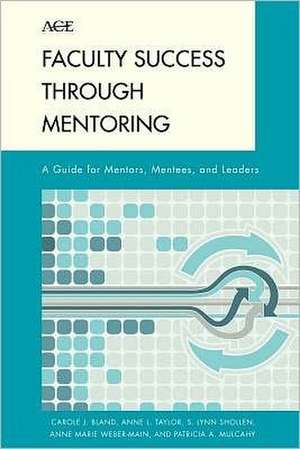
Faculty Success through Mentoring: A Guide for Mentors, Mentees, and Leaders: The ACE Series on Higher Education
Autor Carole J. Bland, Anne L. Taylor, S. Lynn Shollen, Anne Marie Weber-Main, Patricia A. Mulcahyen Limba Engleză Paperback – 26 ian 2012
In Faculty Success through Mentoring, the authors describe the tangible benefits of formal, traditional mentoring programs, in which mentor-mentee interactions are deliberate, structured, and goal-oriented. They outline the characteristics of effective mentors, mentees, and mentoring programs, and cover other models of mentoring programs, such as group and peer mentoring, which are particularly suited for senior and mid-career faculty.
Also included are tools that institutions, mentors, and mentees can use to navigate successfully through the phases of a mentoring relationship. One of the unique features of this book is its explicit attention to the challenges to effective mentoring across genders, ethnicities, and generations. No matter what role one plays in mentoring, this book is an invaluable resource.
Din seria The ACE Series on Higher Education
- 21%
 Preț: 263.38 lei
 - 26%
 Preț: 415.33 lei
 - 6%
 Preț: 230.71 lei
 - 17%
 Preț: 381.73 lei
 -
 Preț: 330.16 lei
 - 29%
 Preț: 486.86 lei
 - 21%
 Preț: 308.15 lei
 - 26%
 Preț: 340.93 lei
 - 19%
 Preț: 337.85 lei
 - 15%
 Preț: 513.03 lei
 - 22%
 Preț: 302.19 lei
 - 25%
 Preț: 220.06 lei
 - 24%
 Preț: 268.64 lei
 - 24%
 Preț: 183.24 lei
 - 25%
 Preț: 346.74 lei
 - 32%
 Preț: 343.23 lei
 - 24%
 Preț: 267.67 lei
 - 17%
 Preț: 210.25 lei
 - nou
 Preț: 212.60 lei
 - nou
 Preț: 164.85 lei
Preț: 262.32 lei
Preț vechi: 340.36 lei
-23%
Puncte Express: 393
Carte tipărită la comandă
Livrare economică 30 noiembrie-14 decembrie
Livrare prin curier în România Termenul estimat este afișat lângă disponibilitate.
Transport gratuit de la 400.00 lei Plată online sau ramburs, în funcție de opțiunile comenzii.
Retur gratuit în 14 zile Comandă securizată și suport în română.
Specificații
ISBN-13: 9780742563209
ISBN-10: 0742563200
Pagini: 232
Dimensiuni: 154 x 233 x 14 mm
Greutate: 0.32 kg
Editura: Bloomsbury Publishing
Colecția Rowman & Littlefield
Seria The ACE Series on Higher Education
Locul publicării:New York, United States
ISBN-10: 0742563200
Pagini: 232
Dimensiuni: 154 x 233 x 14 mm
Greutate: 0.32 kg
Editura: Bloomsbury Publishing
Colecția Rowman & Littlefield
Seria The ACE Series on Higher Education
Locul publicării:New York, United States
Cuprins
Chapter 1: Guide to Using this Book
Chapter 2: Definition and Benefits of Faculty Mentoring
Chapter 3: Mentoring Models and Effective Mentoring Programs
Chapter 4: Mentoring New Faculty Members
Chapter 5: Phases of Effective Mentoring
Chapter 6: Establishing Effective Mentoring Relationships, Especially Across Gender and Ethnicity
Chapter 7: Establishing Effective Mentoring Relationships Across Generations
Chapter 8: Mentoring Mid-Career and Senior Faculty Members
Chapter 9: Mentoring for Faculty Considering Academic Leadership Positions
Appendix A: Checklist for Developing, Implementing, and ASsessing Mentoring Programs
Appendix B: Developing an Academic Career Plan: Self-Assessment Questionnaire: INDIVIDUAL Factors that Promote Faculty Vitality and Career Success
Appendix C: Developing an Academic Career Plan: Self-Assessment Questionnaire: INSTITUTIONAL Factors That Promote Faculty Vitality and Career Success
Appendix D: Bishop Fellowship Program
Chapter 2: Definition and Benefits of Faculty Mentoring
Chapter 3: Mentoring Models and Effective Mentoring Programs
Chapter 4: Mentoring New Faculty Members
Chapter 5: Phases of Effective Mentoring
Chapter 6: Establishing Effective Mentoring Relationships, Especially Across Gender and Ethnicity
Chapter 7: Establishing Effective Mentoring Relationships Across Generations
Chapter 8: Mentoring Mid-Career and Senior Faculty Members
Chapter 9: Mentoring for Faculty Considering Academic Leadership Positions
Appendix A: Checklist for Developing, Implementing, and ASsessing Mentoring Programs
Appendix B: Developing an Academic Career Plan: Self-Assessment Questionnaire: INDIVIDUAL Factors that Promote Faculty Vitality and Career Success
Appendix C: Developing an Academic Career Plan: Self-Assessment Questionnaire: INSTITUTIONAL Factors That Promote Faculty Vitality and Career Success
Appendix D: Bishop Fellowship Program
Recenzii
Carole J. Bland, Anne L. Taylor, S. Lynn Shollen, Anne Marie Weber-Main and Patricia Mulcahy have compiled a superb and much needed book on mentoring in academic institutions. This well- researched and well-written book carefully develops the theme that mentoring facilitates faculty vitality, which is what has kept most of us involved in academia despite uncertainties in funding, and the vagaries of institutions and institutional administrations. The authors have pulled together the approaches and plans of many institutions, which have provided me with new ideas for my own institution. I believe that this book should be required reading for anyone involved in the academy.
This volume provides a ground-breaking guide to universities who want to translate a commitment to faculty development into effective action. A major contribution is its emphasis on how to mentor effectively across the gender, racial and cultural differences that reflect the increasing diverse faculty of today's universities. The thoughtful and eminently practical approach to mentoring outlined in the volume provides a road map to creating and sustaining an engaged faculty that is both excellent and inclusive. This is a "must-read" for everyone involved in faculty development.
This book is indeed a capstone to the life of Carole Bland, who, over the course of her career, defined and advanced the important concepts of Faculty vitality. In this reference, she and her co-editors bring this discussion into coherent discussion for the development of mentoring relationships and institutional mentoring programs . Faculty Success Through Mentoring is both comprehensive and targeted, addresses both process and outcomes, describes personal and organizational strategies, and pays particular attention to the splendid and challenging diversity of faculty in higher education. It will be an essential reference for mentoring program development. For those of us who mentor and are mentored, it will be an essential tool for continuing academic success.
Faculty Success Through Mentoring is a great resource book for faculty interested in research literature and practical information on mentoring, specifically mentoring in academia. This book is an enjoyable read for senior level faculty members and new or junior faculty members, as well as administrators seeking to establish a mentoring program in an academic setting.... Overall, this book provides valuable information for faculty members serving as mentors, mentees, and adminstrators.
This text provides not only a compilation of insightful examples from successful mentors but authoritatively surveys the published literature and research on this critical topic. Thus, it is both comprehensive and extremely well written with a wide range of annotated strategies with illustrations and anecdotes pertinent to those responsible for developing junior faculty, leaders charged with maintaining the enthusiasm of mid-career/established faculty, and those needing to recharge the careers of more senior colleagues (or their own).
This volume provides a ground-breaking guide to universities who want to translate a commitment to faculty development into effective action. A major contribution is its emphasis on how to mentor effectively across the gender, racial and cultural differences that reflect the increasing diverse faculty of today's universities. The thoughtful and eminently practical approach to mentoring outlined in the volume provides a road map to creating and sustaining an engaged faculty that is both excellent and inclusive. This is a "must-read" for everyone involved in faculty development.
This book is indeed a capstone to the life of Carole Bland, who, over the course of her career, defined and advanced the important concepts of Faculty vitality. In this reference, she and her co-editors bring this discussion into coherent discussion for the development of mentoring relationships and institutional mentoring programs . Faculty Success Through Mentoring is both comprehensive and targeted, addresses both process and outcomes, describes personal and organizational strategies, and pays particular attention to the splendid and challenging diversity of faculty in higher education. It will be an essential reference for mentoring program development. For those of us who mentor and are mentored, it will be an essential tool for continuing academic success.
Faculty Success Through Mentoring is a great resource book for faculty interested in research literature and practical information on mentoring, specifically mentoring in academia. This book is an enjoyable read for senior level faculty members and new or junior faculty members, as well as administrators seeking to establish a mentoring program in an academic setting.... Overall, this book provides valuable information for faculty members serving as mentors, mentees, and adminstrators.
This text provides not only a compilation of insightful examples from successful mentors but authoritatively surveys the published literature and research on this critical topic. Thus, it is both comprehensive and extremely well written with a wide range of annotated strategies with illustrations and anecdotes pertinent to those responsible for developing junior faculty, leaders charged with maintaining the enthusiasm of mid-career/established faculty, and those needing to recharge the careers of more senior colleagues (or their own).