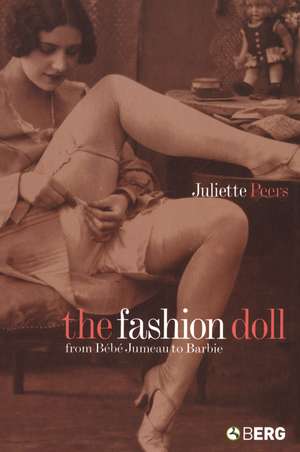
The Fashion Doll: From Bébé Jumeau to Barbie
Autor Juliette Peersen Limba Engleză Paperback – 31 mai 2004
| Toate formatele și edițiile | Preț | Express |
|---|---|---|
| Paperback (1) | 239.18 lei 6-8 săpt. | |
| Bloomsbury Publishing – 31 mai 2004 | 239.18 lei 6-8 săpt. | |
| Hardback (1) | 736.82 lei 6-8 săpt. | |
| Bloomsbury Publishing – 31 mai 2004 | 736.82 lei 6-8 săpt. |
Preț: 239.18 lei
Nou
42.32€ • 49.63$ • 37.17£
Carte tipărită la comandă
Livrare economică 04-18 februarie 26
Specificații
ISBN-10: 1859737439
Pagini: 224
Ilustrații: 20 b&w illustrations, bibliography, index
Dimensiuni: 156 x 234 x 12 mm
Greutate: 0.42 kg
Editura: Bloomsbury Publishing
Colecția Berg Publishers
Locul publicării:London, United Kingdom
V-ar putea interesa
-
 The Secret of the Golden FlowerThomas ClearyPreț: 79.20 lei
 -
 A Harlot's ProgressDavid Dabydeen-57%Preț: 49.63 lei114.89 lei
 -
 Preț: 101.49 lei
 -
 ZeroCharles Seife-21%Preț: 59.00 lei74.79 lei
 -
 If Not, WinterSapphoPreț: 104.82 lei
 -
 Preț: 227.28 lei
 -
 -29%Preț: 87.85 lei124.42 lei
 -
 -34%Preț: 68.01 lei102.75 lei
 -
 Shunga + Bijinga = EroticaBob BentleyPreț: 172.03 lei
 -
 Novels in Three LinesFélix FénéonPreț: 102.21 lei
 -
 InfinitesimalAssoc. Amir Alexander-6%Preț: 84.39 lei89.97 lei
 -
 Geographies of a LoverSarah de de LeeuwPreț: 74.43 lei
 -
 Flametti, or the Dandyism of the PoorHugo BallPreț: 101.24 lei
 -
 -18%Preț: 204.45 lei250.69 lei
 -
 Japanese Erotic FantasiesChris Uhlenbeck-8%Preț: 608.64 lei661.56 lei
Caracteristici
Notă biografică
Juliette Peers is Research Associate and Lecturer of Textile Design, Frances Burke Textile Resource Centre , RMIT University, Victoria.
Recenzii
Descriere
Feminists have argued that the Barbie doll perpetuates unrealistic standards of feminine beauty and undermines the credibility of women - that her long, slender plastic limbs and tiny waist fetishize the female body in unnatural ways and that her mature, overtly fashionable image promotes consumerism and superficiality over and above womens liberty and intellect. Depending on the viewer, Barbie is either a malign symbol of the strategies of the capitalist system or she is a symbol of glamour, high fashion and style, a fascinating indice of cultural change and nostalgic memory. Yet both Barbies fans and detractors assume that she stands alone.In reality she is the most high profile of a series of iconic dolls that over the past century and a half have been intimately connected to notions of fashionability. The prominence of haute couture in popular culture suggests that the link between fashion marketing and dolls should be an obvious one. Yet to date this connection has not been systematically explored. Doll collecting has been viewed as an enthusiasts or curatorial preserve, while the volumes these artefacts speak about culture and identity has not been adequately interrogated. Peers original and shrewd analysis fills a major gap in cultural studies by examining in depth the dolls associations with concepts of femininity and fashionability.