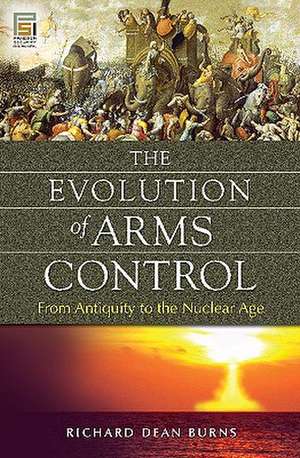
The Evolution of Arms Control: From Antiquity to the Nuclear Age: Praeger Security International
Autor Richard Dean Burnsen Limba Engleză Hardback – 22 iun 2009
Drawing on his knowledge of the comparative history of warfare and arms control across preliterate, ancient, medieval, and modern polities, Richard Dean Burns focuses longitudinally on such perennial arms control issues as negotiation, verification, and compliance. Although he does not, for example, allege that war elephants and nuclear weapons are of equal destructive potential, he does discern instructive similarities between Carthage in 202 BCE and Iraq in 1991 AD.
Arms control and disarmament measures have been pursued and adopted throughout the history and prehistory of human warfare: sometimes as protocols recognizing evolving humanitarian taboos; sometimes as terms imposed by the victors on the vanquished; and sometimes as accords negotiated between rivals fearful of mutual destruction. Arms control measures ramped up in significance and urgency at the dawn of the 20th century by the introduction of rapid-fire weapons, aircraft, chemical agents, and submarines, and again at mid-century with the advent of weapons of mass destruction-nuclear, chemical, and bacteriological-with sophisticated delivery systems. As Burns makes clear, the enormous increase in destructive potential brought about by thermonuclear weaponry essentially changed the nature of war and, therefore, of arms control.
Din seria Praeger Security International
- 30%
 Preț: 407.30 lei
 - 34%
 Preț: 382.83 lei
 - 21%
 Preț: 361.02 lei
 - 22%
 Preț: 345.89 lei
 - 29%
 Preț: 413.54 lei
 - 31%
 Preț: 388.13 lei
 - 28%
 Preț: 432.56 lei
 - 21%
 Preț: 345.39 lei
 - 42%
 Preț: 617.10 lei
 - 30%
 Preț: 348.62 lei
 - 21%
 Preț: 363.36 lei
 - 21%
 Preț: 347.50 lei
 - 21%
 Preț: 347.45 lei
 - 30%
 Preț: 395.83 lei
 - 21%
 Preț: 346.12 lei
 - 21%
 Preț: 346.24 lei
 - 21%
 Preț: 346.86 lei
 - 17%
 Preț: 362.86 lei
 - 22%
 Preț: 366.32 lei
 - 17%
 Preț: 361.94 lei
 - 40%
 Preț: 438.46 lei
 - 20%
 Preț: 348.78 lei
 - 30%
 Preț: 406.62 lei
 - 21%
 Preț: 346.52 lei
 - 20%
 Preț: 365.11 lei
 - 37%
 Preț: 295.16 lei
 - 21%
 Preț: 361.82 lei
 - 22%
 Preț: 332.50 lei
 - 21%
 Preț: 273.62 lei
 - 42%
 Preț: 617.29 lei
 - 19%
 Preț: 343.43 lei
 - 20%
 Preț: 325.83 lei
 - 21%
 Preț: 381.17 lei
 - 29%
 Preț: 418.84 lei
 - 20%
 Preț: 326.96 lei
 - 17%
 Preț: 360.61 lei
 - 20%
 Preț: 351.85 lei
 - 27%
 Preț: 365.68 lei
 - 37%
 Preț: 447.93 lei
 - 21%
 Preț: 382.95 lei
 - 32%
 Preț: 274.69 lei
 - 21%
 Preț: 382.42 lei
 - 21%
 Preț: 361.12 lei
 - 17%
 Preț: 326.87 lei
 - 29%
 Preț: 411.30 lei
 - 22%
 Preț: 331.27 lei
 - 20%
 Preț: 341.76 lei
 - 20%
 Preț: 380.06 lei
 - 21%
 Preț: 346.52 lei
 - 22%
 Preț: 378.09 lei
Preț: 348.26 lei
Preț vechi: 438.12 lei
-21%
Puncte Express: 522
Carte tipărită la comandă
Livrare economică 23 noiembrie-07 decembrie
Livrare prin curier în România Termenul estimat este afișat lângă disponibilitate.
Transport gratuit de la 400.00 lei Plată online sau ramburs, în funcție de opțiunile comenzii.
Retur gratuit în 14 zile Comandă securizată și suport în română.
Specificații
ISBN-13: 9780313375743
ISBN-10: 0313375747
Pagini: 264
Dimensiuni: 156 x 235 x 28 mm
Greutate: 0.54 kg
Editura: Bloomsbury Publishing
Colecția Praeger
Seria Praeger Security International
Locul publicării:New York, United States
ISBN-10: 0313375747
Pagini: 264
Dimensiuni: 156 x 235 x 28 mm
Greutate: 0.54 kg
Editura: Bloomsbury Publishing
Colecția Praeger
Seria Praeger Security International
Locul publicării:New York, United States
V-ar putea interesa
-
 Confidence and Security Building Measures in the New EuropeZdzislaw Lachowski-13%Preț: 331.07 lei380.08 lei
 -
 -16%Preț: 107.53 lei128.60 lei
 -
 Modern War: A Very Short IntroductionRichard English-21%Preț: 55.34 lei69.84 lei
 -
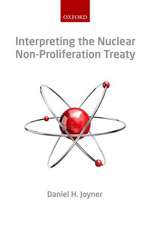 Interpreting the Nuclear Non-Proliferation TreatyDaniel H. Joyner-17%Preț: 372.27 lei447.40 lei
 -
 -22%Preț: 196.60 lei251.70 lei
 -
 -18%Preț: 1252.71 lei1527.70 lei
 -
 European Security and Defence Policy: An Implementation PerspectiveMichael MerlingenPreț: 463.28 lei
 -
 Sanctions, Statecraft, and Nuclear ProliferationEtel SolingenPreț: 288.47 lei
 -
 The International Arms TradeRachel StohlPreț: 223.41 lei
 -
 Non-Proliferation Law as a Special RegimeDaniel H. Joyner-11%Preț: 429.43 lei482.49 lei
 -
 Preț: 179.23 lei
 -
 Path to Zero: Dialogues on Nuclear DangersRichard A. FalkPreț: 399.29 lei
 -
 Proliferation Security MeasuresRodrick D Cooke-27%Preț: 888.82 lei1210.52 lei
 -
 Comprehensive Nuclear-Test-Ban Treaty: Elements, Arguments & AnalysesMarcela N Rodriguez-27%Preț: 1002.64 lei1364.47 lei
Recenzii
Written for anyone interested in arms control and disarmament issues as well as military history, this book reviews the historic means and techniques for arms control such as demilitarization, regulation of arms manufacturing, stabilizing international environments and the outlawing of war. A section also reviews nuclear weaponry before and after the Cold War and the emergence of biological and bacterial delivery systems.
History has shown that war is terrible, but it would be even be more horrifying if nations had not attempted to place
limits on armed conflict. Few readers could have imagined the painstaking negotiations involved in reaching
agreements placing restrictions on weaponry, torture, and other unsavory components of modern war until Burns, a
recognized expert in foreign and national security affairs, published this new book. The author (emer., history,
California State Univ., Los Angeles) highlights the historical antecedents that are at the heart of modern weapons
control accords. But he goes further than that and outlines how victors sought to disarm their former adversaries, as
Rome did with Carthage following the Punic Wars or the Allies did in Germany after WW II. Today, however, the
issues are more complex and require considerable engagement on the world stage. Burns chronicles the progression
of arms negotiations, allowing readers to visualize the intricacy of arms control and grasp the difficulties of finding
common ground in preventing the spread of nuclear weapons. Whether the world's diplomatic efforts will be
successful remains to be seen. Still, a major contribution. Summing Up: Highly recommended. All levels/libraries.
History has shown that war is terrible, but it would be even be more horrifying if nations had not attempted to place
limits on armed conflict. Few readers could have imagined the painstaking negotiations involved in reaching
agreements placing restrictions on weaponry, torture, and other unsavory components of modern war until Burns, a
recognized expert in foreign and national security affairs, published this new book. The author (emer., history,
California State Univ., Los Angeles) highlights the historical antecedents that are at the heart of modern weapons
control accords. But he goes further than that and outlines how victors sought to disarm their former adversaries, as
Rome did with Carthage following the Punic Wars or the Allies did in Germany after WW II. Today, however, the
issues are more complex and require considerable engagement on the world stage. Burns chronicles the progression
of arms negotiations, allowing readers to visualize the intricacy of arms control and grasp the difficulties of finding
common ground in preventing the spread of nuclear weapons. Whether the world's diplomatic efforts will be
successful remains to be seen. Still, a major contribution. Summing Up: Highly recommended. All levels/libraries.
Cuprins
Preface
Introduction
Part I. Means and Techniques: A Historical Typology
1. Arms Limitations and/or Reductions
2. Demilitarization, Denuclearization, and Neutralization
3. Regulating Use/Outlawing Weapons and War
4. Customs and the Law of War
6. Stabilizing the International Environment
Part II. Comments on Arms Control Processes: Negotiations, Verification, and Compliance
7. Arms Control Negotiations
8. The Verification Process
9. Compliance and Noncompliance
10. Reflections -On Nuclear Weaponry: The Cold War and After
Appendix (Chronological listing of treaties and agreements)
Notes
Glossary
Essential Resources
Index
Introduction
Part I. Means and Techniques: A Historical Typology
1. Arms Limitations and/or Reductions
2. Demilitarization, Denuclearization, and Neutralization
3. Regulating Use/Outlawing Weapons and War
4. Customs and the Law of War
6. Stabilizing the International Environment
Part II. Comments on Arms Control Processes: Negotiations, Verification, and Compliance
7. Arms Control Negotiations
8. The Verification Process
9. Compliance and Noncompliance
10. Reflections -On Nuclear Weaponry: The Cold War and After
Appendix (Chronological listing of treaties and agreements)
Notes
Glossary
Essential Resources
Index